Agriculture and climate change
Public consultation is now open on Victoria’s draft Primary Production Adaptation Action Plan 2027–31
 Have your say on the draft Primary Production Adaptation Action Plan 2027–31. Complete a short survey, provide a written submission, or both at Engage Victoria.
Consultation closes on Wednesday 15 July 2026.
Have your say Climate change is a significant challenge facing the agriculture sector. As the climate becomes warmer and drier, it threatens the productivity and sustainability of the sector. Climate change will affect water availability and the state can expect more extreme events such as heatwaves, storms, bushfires, droughts and flood. These changes threaten lives and assets and will increasingly test the resilience of the primary production sector in many ways.
We know that many in the sector are already managing the impacts of these changes.
At the same time, agricultural activities significantly contribute to our State’s overall emissions – the third-largest share of Victoria’s emissions in 2023.
Responding to climate change also presents significant opportunities for Victorian agriculture. Through the Strategy for Agriculture in Victoria, the Victorian Government is committed to protecting and enhancing the future of our sector by ensuring it is well placed to reduce emissions, prepare for climate risk, and take advantage of these opportunities. This includes a commitment from government to position Victorian agriculture as a leader in low emissions agriculture and enable industries to be productive and profitable under a changed climate.
Reducing emissions from the agriculture sector and adapting to climate change is complex. We know that many in the sector are already taking action, while others need more support to get there.
Increasingly, our global export markets are signalling that trading partners will need to demonstrate they are reducing greenhouse gas emissions. For Victoria to remain a leading exporter of food and fibre, industry and government will need to work together to meet these consumer expectations.
 The Victorian Agriculture and Climate Change Statement is a shared vision between the Victorian Government, Victoria’s agriculture sector, including Dairy Australia, Birchip Cropping Group, Woolworths, Meat and Livestock Australia, and the Victorian Farmers Federation, and the Victorian Agriculture and Climate Change Council (VACCC).
Released in 2022, it says:
“ We are committed to a profitable and productive agriculture sector that takes
ambitious action on climate change. We are working together to accelerate
climate change solutions, including taking steps to:
- Understand and reduce our emissions
- Adapt to climate risks, and
- Capture future opportunities”
The Victorian Government is taking strong and lasting action to reduce Victoria’s emissions to net zero by 2045 and build resilient communities that are prepared to deal with the impacts of climate change.
Victorian Government’s second Climate Change Strategy
The Climate Change Strategy 2026–2030 sets out the next phase of the Victorian Government’s response to climate change – which includes cutting green-house gas emissions by 45–50% by 2030, and 75–80% by 2035, compared to 2005 emissions.
The Strategy outlines what the Victorian Government is doing to take climate action that benefits the Victorian economy and community.
The Victorian Government is taking action now with an updated suite of sector pledges right across the economy. The pledges provide a clear way forward for how government will work with each sector to reduce Victoria’s emissions, including those from agricultural activities.
Agriculture Sector Pledge 2026–2030
The Agriculture Sector Emissions Reduction Pledge 2026-2030 establishes the next steps for the Victorian Government to partner with industry towards a profitable and productive agricultural sector that is taking ambitious climate action.
Under the pledge, the Victorian Government will:
- Deliver high priority research with a focus on solutions for livestock methane emissions
- Accelerate commercialisation of innovative low emissions solutions as soon as they are proven safe, effective and are available
- Continue building knowledge and skills across the sector and support uptake of solutions that benefit farm business productivity, reduce emissions and build climate resilience
- Collaborate with industry and other jurisdictions to develop standards and certifications that provide farmers with clarity and reward progress.
The pledge provides further information on these actions. You can also sign up here to stay up to date as this program progresses: Register for updates
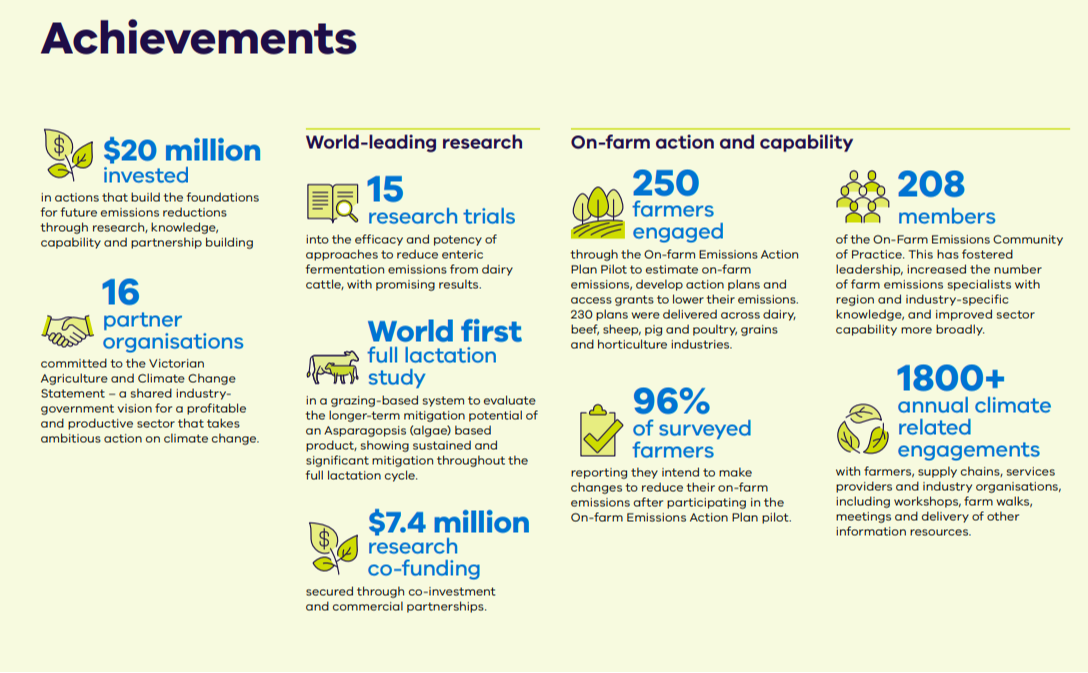
This is the second agriculture sector pledge and builds on progress made by the sector to date and actions delivered under the first Agriculture Sector Pledge (2021-2025). A summary of achievements from the first pledge are shown below.
Related actions for the agriculture sector
Agriculture activities are not the only source or sink of emissions on-farm – there are also opportunities to reduce emissions or sequester carbon through energy, transport, waste and land use, land use change, and forestry (LULUCF). There are opportunities for the agriculture sector across the Climate Change Strategy and other sector pledges.
Victorian farmers may be interested other programs such as the BushBank Program , Trees on Farms Program , and the Victorian Energy Upgrades Program.
The Victorian Carbon Farming Outreach Program provides another avenue for private landholders to reduce emissions and build resilience to a changing climate.
Government is also supporting the agriculture and other primary production sectors to adapt to the impacts of climate change through the Primary Production Adaptation Action Plan.
Primary Production Adaptation Action Plan
The Victorian Government is acting now to support adaptation
In 2022, Victorian Government released the Primary Production Adaptation Action Plan (AAP) as part of releasing plans for seven essential systems that are vulnerable to climate impacts or critical to our climate resilience.
These are Victoria's first set of Adaptation Action Plans — guiding government action and helping institutions, businesses and individuals to respond to our changing climate. The plans will be prepared every five years, to build on the work of the previous plans and reflect the latest climate science.
Each plan sets out:
- the unique challenges and opportunities of climate change for each system;
- the action being taken, and;
- adaptation priorities for the next five years.
The primary production adaptation action plan includes agriculture, plantation forestry, productive fisheries and the infrastructure, workforce and communities supporting these industries.
It covers the full value chain — key inputs, growing and harvesting, production and processing — everything that gets products to market.
Read the Primary Production Climate Change Adaptation Action Plan:
- Primary Production Climate Change Adaptation Action Plan (2022-2026)
 [PDF File - 5.2 MB]
 - Primary Production Climate Change Adaptation Action Plan (2022-2026)
 [MS Word Document - 4.9 MB]
In 2021, a draft Plan was released for public consultation and feedback provided by the community and stakeholders informed the finalisation of the Primary Production AAP.
You can read a summary of the feedback received at Engage Victoria.
Climate change will increase the challenges facing our primary industries
Our state’s primary industries have continued to perform strongly despite many challenges. However, the impacts of climate change, including on agricultural productivity, are already being felt and are projected to increase.
Climate change will challenge the ways that primary industries and governments operate and make decisions — requiring innovative and targeted responses as well as up to date skills, tools, resources and information.
The Primary Production AAP will help guide primary industries in ways to reduce climate change risks, build resilience and harness opportunities — bringing new products to market and generating efficiencies to support business continuity and growth.
Building a solid foundation for climate resilience
Under the Primary Production Adaptation Action Plan 2022–2026, the Victorian Government is focusing on building the climate resilience of value chains, facilitating research and innovation, and supporting primary industries to build further on their climate change adaptation information, skills and capacity.
It includes actions that address:
- Current and future risks and vulnerabilities like more hot days and less rainfall.
- More frequent and severe extreme events like bushfires and flash floods.
- Transformative changes to current ways of doing things for long-term adaptation.
The Plan also helps support more partnership opportunities to stimulate new research and innovation, boost capacity and build capabilities to respond to the impacts of a changing climate.
By building on the work that primary industries are already doing to adapt to climate change, the Plan enables communities, businesses and governments to work together to build a solid foundation for a climate-resilient Victoria for the long term.
To learn more about all of Victoria’s Adaptation Action Plans, visit climatechange.vic.gov.au.