Mountain ash
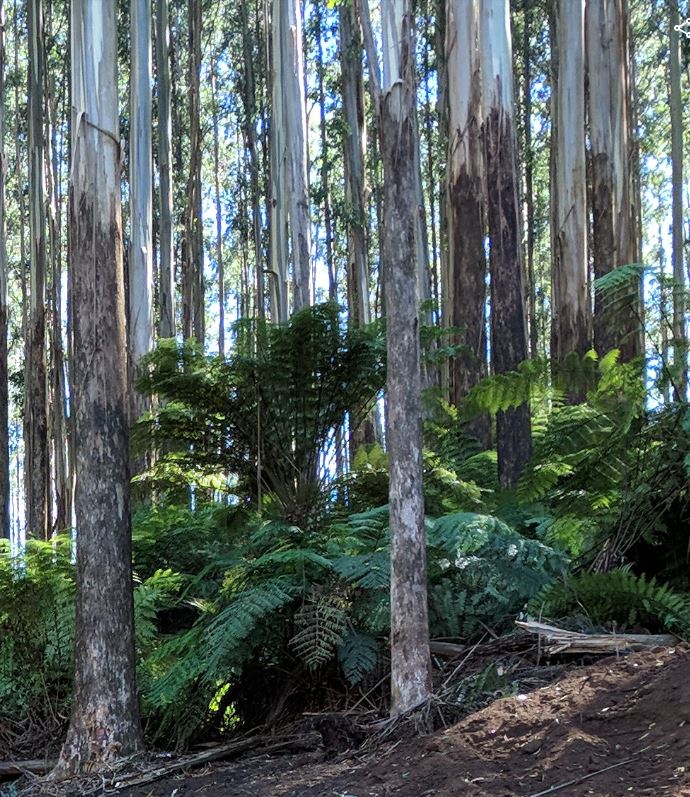
Mountain ash (Eucalyptus regnans) is a very fast-growing Eucalyptus that prefers 1000 mm or more of rainfall annually and deep (>2m) gradational clay loam soils. It was considered a mainstream plantation species until the early 90s but is now rarely planted for plantation forestry. It is fire sensitive and needs to be planted with a high number of stems per hectare (>1500sph).
Table 1: General characteristics for mountain ash
Characteristic | Description |
|---|---|
Botanical name | Eucalyptus regnans |
Growth rate in preferred conditions | Very fast |
Estimated rotation length (yr) in preferred conditions to produce 60cm diameter at breast height | 20–30 |
Preferred annual rainfall (mm/yr) | 1000+ |
Minimum rainfall (mm/yr) | 900 |
Preferred elevation (m) ASL | 100–1000 |
Preferred landscape position | Cool, wet valley |
Preferred soil | Deep (>2m) gradational clay loams |
Prohibitive soil | Poorly drained soils |
Poor drainage tolerance | Low |
Dry site tolerance | Low |
Frost tolerance | High |
Pest and disease problems: trees planted on unsuitable sites are more prone to insect and disease issues | Psyllid, phasmatid and Mycosphaerella leaf spot |
Table 2: Timber characteristics for mountain ash
Characteristic | Description |
|---|---|
Strength: seasoned timber only | SD4: moderate |
Durability: in ground | above ground | 4 | 3 |
Drying: green to 12% moisture content | Considerable collapse occurs during drying, so reconditioning is standard practice. Very high shrinkage – about 6.5% radial and 13% tangential. For best results quarter sawing is required. |
Main commercial products | High-value joinery, plywood, flooring, panelling, general construction, pulpwood. |
Bushfire resistance: measured by bushfire attack level (BAL) | BAL 12.5 and 19 – door and window joinery only |
Least attractive features | Fire sensitive, site specific, not suited to conventional plantation spacings. Needs to be planted densely (>1500sph) for protection. |
Most attractive features | Fast growth, good pulp species, and proven sawlog potential if direct seeded or planted at close spacings. Sapwood resistant to lyctus borer. |
Status as a plantation species | Mainstream prior to early 90s but now rarely planted for plantation forestry. |
Note: Timber characteristics and durability are based on Australian Standard: Timber Natural durability ratings (AS 5604–2005). Refer to the Appendix for an explanatory table. Where (?) applied, rating is based on field experience.
Note: Bushfire resistance measurement is based on naturally bushfire resisting timbers, which are those with inherent bushfire-resisting properties. For more information refer to Australian Standard 3959:2018.
Assumptions and notes
- Sites considered for planting contain at least one metre of soil above an impeding layer (e.g., bedrock or layer impenetrable to roots).
- Please note that most (if not all) eucalypts in Gippsland grow best on sheltered sites.
- Overall slow drying time across air and kiln-dried schedules is recommended to minimise drying degrade. This is the best starting point for inexperienced operators.
References
Beadle CL and Brown AG (eds) 2007. Acacia utilisation and management: adding value. RIRDC Publication No. 07/095, Rural Industries Research and Development Corporation, Canberra.
Boland DJ et. al (1992). Forest trees of Australia. CSIRO Australia.
Bootle KR (1983). Wood in Australia – Types, properties and uses. McGraw Hill, Australia
Carnegie AJ (2002). Field guide to common pests and diseases in eucalypt plantations in NSW. Research and Development Division of State Forests, NSW.
Clarke B, McLeod I and Vercoe T (eds) 2009. Trees for farm forestry: 22 promising species. RIRDC Publication No. 09/015. Rural Industries Research and Development Corporation, Canberra.
Mortimer J (2003). A selection of alternative timbers. Taitua Books, NZ.
National Association of Forest Industries (2004). Timber species and properties, revised edition. Timber Manual Datafile P1
Nicholas ID, Gifford HH and Kimberely MO (1997). Siting black walnut. FRI Bulletin no. 188
Phillips C (1996). Insects, diseases and deficiencies associated with eucalypts in South Australia. Primary Industries SA Forests.
Poole B, Waugh G and Yang JL (2017). Potential for growing and processing durable eucalypts in New Zealand. Publication No. SWP-T036. Solid Wood Innovation. Specialty Wood Products Research Partnership.
Reid R (2017). Heartwood. The art and science of growing trees for conservation and profit. Melbourne Books.
Tepper CJ (2002). Plantation eucalypt species for solid wood products – a profile of Eucalyptus muelleriana. Gottstein Fellowship Report for the Gottstein Memorial Trust
Tepper CJ (2008). Site Matching and Establishing Eucalypt Sawlog Species in Southern Australia. In Beadle CL and Brown AG (eds) 2008. Plantation eucalypts for high value timber. RIRDC Publication No. 08/113, Rural Industries Research and Development Corporation, Canberra.