Manned aerial spraying
This page is about general information for operators and pilots of fixed-wing aircraft and helicopters.
Licensing information about aerial spraying can be found on the aerial spraying page. If you operate a drone, you can find information at drone or remotely piloted aircraft spraying .
Licensing requirements
Aerial spraying of agricultural chemicals in Victoria is regulated by Agriculture Victoria and the Civil Aviation Safety Authority (CASA).
If an aircraft is undertaking aerial spraying of agricultural chemicals in Victoria, the pilot must hold a pilot (chemical rating) licence and the business must hold an agricultural aircraft operator licence, both issued by Agriculture Victoria.
See Licences for aerial spraying of agricultural chemicals for further information.
All aerial vehicles that undertake aerial operations are regulated by CASA and must be licensed by that authority.
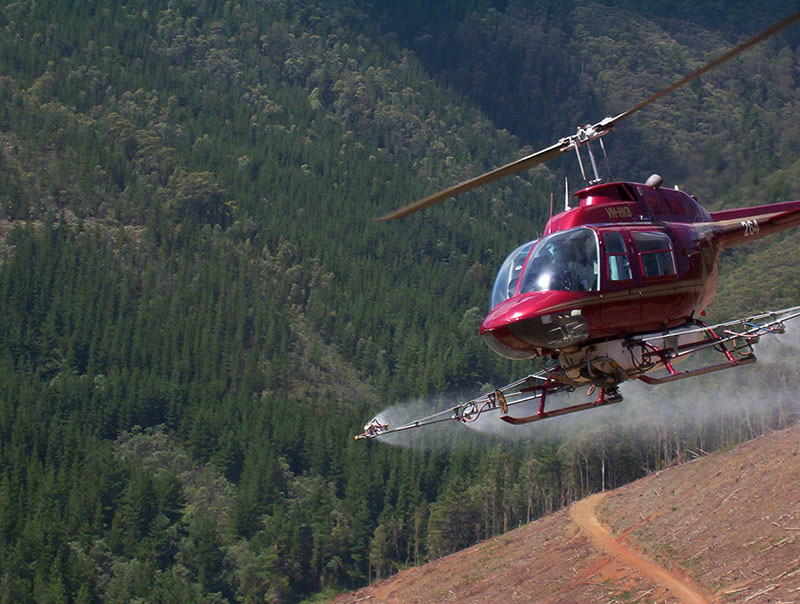
Aerial spraying equipment
One or more of the following methods must be used immediately before and during aerial spraying to provide the pilot weather information at the target area:
- A smoke-generating device used at ground level at or near the point of spraying
- A smoke-generating device that is fitted to the aircraft and operated before and during spraying
- An operating windsock that is clearly visible to the pilot at ground level at or near the point of spraying
- An automatic weather station located at or near the point of spraying, and information about the wind speed and direction continuously available to the pilot
- The pilot being in continuous radio communication with a ground-based person who is located near the point of spraying and uses equipment to measure the wind speed and direction.
Pilot responsibilities
When applying agricultural chemicals by air, a pilot is legally responsible for ensuring that:
- specified chemical use records are made and kept
- spray drift doesn't injuriously affect any plants or stock outside the target area
- spray drift doesn't injuriously affect any land outside the target area so that growing plants or keeping stock on that land can be reasonably expected to result in contaminated plants, stock or agricultural produce derived from that land
- each spray nozzle on the aircraft is fitted with an operating leakproof cut-off valve
- notification requirements are complied with
- if spraying in an agricultural chemical control area, all permit conditions are followed.
Landholders must ensure that any maps provided to aerial operators are accurate and not false or misleading, as this is an offence.
Interstate pilot (chemical rating) licences or equivalents from participating states and territories are valid in Victoria. Interstate pilots must comply with all applicable Victorian laws. For more information visit the automatic mutual recognition and chemical use licensing page.
Interstate aerial spraying operators (the aerial spraying business or aircraft owner, leaseholder or equivalent) must hold an agricultural aircraft operator licence (AAOL) issued by Agriculture Victoria to operate in Victoria. Automatic mutual recognition does not apply to the AAOL, which is a business licence.
Records of use
A person who uses an agricultural chemical must:
- make records of use within 48 hours of using a product
- keep these records for a minimum of 2 years.
Agricultural chemical control areas
There are certain areas across Victoria that are called agricultural chemical control areas (ACCAs) and require a permit to use specific chemicals when aerially spraying. Landholders are responsible to apply for an ACCA permit and the pilot is responsible to follow all the permit conditions.
More information
The following pages outline responsibilities and provides tips for land managers to assist in the safe and appropriate aerial spraying of agricultural chemicals:
- Working with chemicals
- Agricultural chemical control areas
- Notification requirements
- Managing spray drift
- Keeping records of chemical use
If you have questions about the aerial spraying of agricultural chemicals, contact 136 186.
If you have any general questions about aircraft operations, contact CASA on 131 757. For more information, visit CASA.