Dutch elm disease
Dutch elm disease (DED) is a fungal disease caused by the fungal pathogens Ophiostoma ulmi, Ophiostoma novo-ulmi and Ophiostoma himal-ulmi.
DED is considered one of the most devastating tree diseases in the world, targeting elm tree species. It is not known to occur in Australia and is listed as a national priority plant pest for Australia.
When infected by the fungi, elm trees will block their xylem vessels in their sapwood to prevent the fungi spreading further. This also blocks water and nutrient flow in the plant, leading to wilt and, eventually, tree death.
DED can be found in the United States, Europe, New Zealand and parts of Canada, the Middle East and Asia.
Transmission
DED is spread by the importation of infected plants, timber and wood products. Locally, transmission of this disease is by:
- bark beetles, which can carry the fungus
- root grafts between trees, where infected tree roots spread to surrounding healthy tree roots underground
- transport of infected plants or timber
- infected bark mulch.
The European bark beetle (Scolytus multistriatus), which is a vector for the fungus, has been present in Australia since 1974.
Host range
The plant hosts of the DED fungi are Ulmus (e.g. American, English, Chinese or Siberian elm) and Zelkova (e.g. Japanese elm) species of elm trees.
For more extensive host information on DED, please check the Centre for Agriculture and Biosciences International host list sections for Ophiostoma ulmi and Ophiostoma novo-ulmi.
Symptoms
- Leaf discolouration
- Drooping at branch tips
- Curling, browning and premature loss of leaves
- Defoliation (loss of leaves) spreading across the tree
- Development of dark brown streaks under the bark on branches and stems
- Galleries on wood if bark beetles are involved
If a tree is infected with the fungus by a beetle vector:
- wilting, curling and discolouration of leaves appears on one or more branches at the top of the tree
- the disease moves down the tree to the lower branches.
If a tree is infected via root grafts underground:
- the disease develops more rapidly
- wilting, curling and discolouration of leaves start at the lower branches
- the disease moves up the tree to the higher branches.
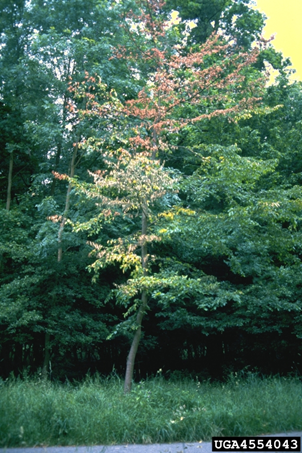
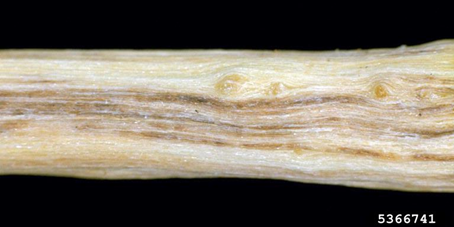
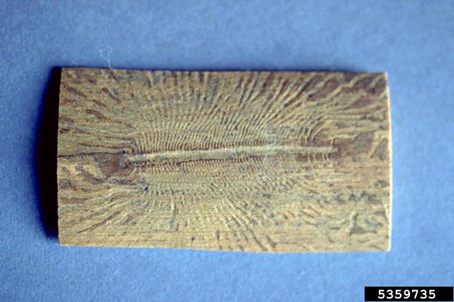
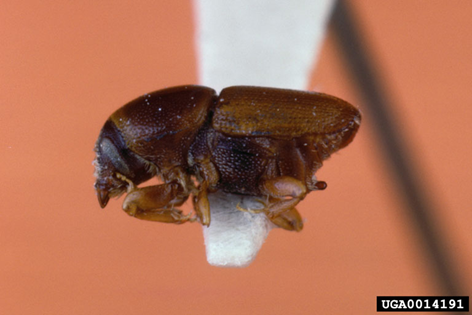
For more photos of DED symptoms, please check the photo sections of the Centre for Agriculture and Biosciences International web pages for Ophiostoma ulmi and Ophiostoma novo-ulmi.
Detection and prevention measures
Agriculture Victoria does active surveillance for DED under the Forest Watch program, regularly responds to reports of suspect plant diseases and conducts exclusion diagnostics on plants with symptoms.
To protect your property, maintain best practice on-farm biosecurity standards. Make sure propagation material is purchased from reputable suppliers and regularly check your plants for symptoms. Report suspect symptoms immediately.
Report any unusual plant pest or disease immediately using our online reporting form or by calling the Exotic Plant Pest Hotline on 1800 084 881. Early reporting increases the chance of effective control and eradication. Please take multiple good quality photos of the pests or damage to include in your report where possible, as this is essential for rapid pest and disease diagnosis and response. Your report will be responded to by an experienced staff member, who may seek more information about the detection and explain next steps.Reporting an unusual plant insect pest or disease
Photo credits
Figure 1: Petr Kapitola, Central Institute for Supervising and Testing in Agriculture, bugwood.org
Figure 2: William Jacobi, Colorado State University, bugwood.org
Figure 3: William M. Brown Jr, bugwood.org
Figure 4: Gerald J Lenhard, Louisiana State University, bugwood.org