Testing crop seed for sowing
Germination testing
Knowing the germination percentage will allow you to accurately calculate the sowing rate. Home germination tests can also help compare the vigour of different seed lots. They indicate the ability of a seed to form a normal seedling in favourable conditions.
The viability of shot grain should always be considered suspect. If seed is suspect because of weather damage or poor storage, it should be germination tested, and the sowing rate adjusted accordingly. Some cereal varieties have a level of seed dormancy and will not germinate until a few weeks after harvest.
Test seed after cleaning for an accurate sample. However, if the seed is likely to have poor germination, test it before cleaning to save the expense of cleaning unsatisfactory seed. This also gives you more time to obtain good quality seed.
Pulse and cereal seed is suitable for sowing if the germination is above 80%. For canola, 85% is considered the minimum.
If cereal germination is less than 70%, it should not be used for sowing. If the result is between 70–80%, do a laboratory test.
If the test is done soon after harvest, it should be repeated closer to sowing time.
Home germination testing methods
- A representative sample is needed. Take random small subsamples and mix. From this, take a seed sample for testing.
- Count 3 separate lots of 100 seeds. Then follow the steps below, depending on the crop type.
- Cereals and pulses
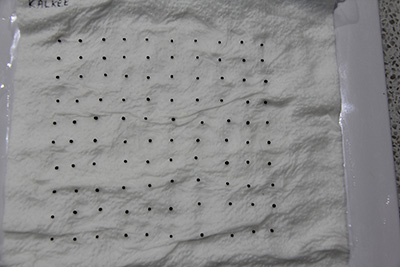
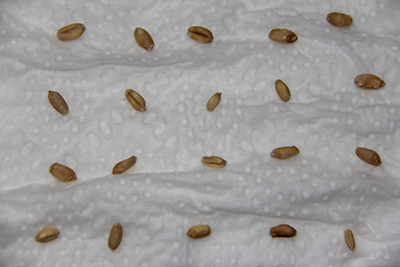
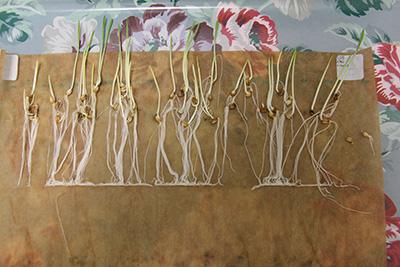
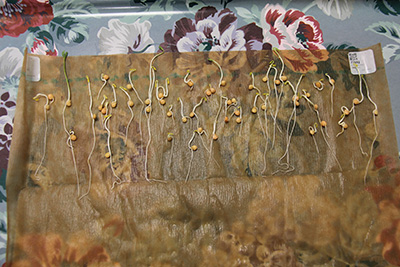
- Place each lot of seeds in a 10x10 grid on 4 sheets of damp (but not drenched) paper towel on a tray or plate.
- Alternatively, sow at 2–3 cm in a seedling tray with seed raising mix or sand.
- For faba bean, use the seedling tray method rather than the paper towel method. Sow as deeply as possible.
- Daytime temperature should be about 20–25 °C and not fluctuate greatly, as can happen on a north-facing windowsill.
- Water gently but do not drench the mix.
- Cover with a plastic container or plastic bag to reduce evaporation.
- Canola
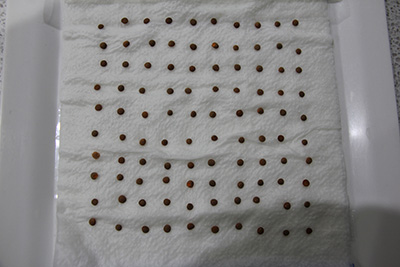
- Place the seeds in a 10x10 grid on 3 sheets of damp paper towel. Gently cover with a sheet of moist paper towel.
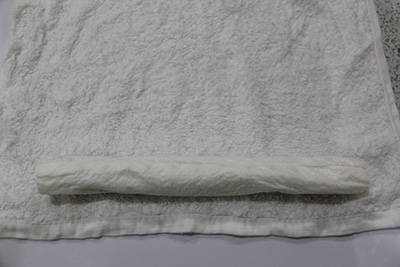
- Roll the moist paper towels containing the seeds.
- Soak a fabric hand towel and wring.
- Roll the hand towel around the rolled paper towel.
- Place in a plastic container or a large ziplock plastic bag to reduce evaporation.
- Label with the seed details and date.
- For seed on paper towel, place in a dark position or cover with a dark cloth.
- Check regularly and lightly moisten the seeds to ensure they do not dry out.
- Undertake counts after the following duration:
- Cereals – 7 to 11 days.
- Canola – 4 to 7 days. Counts at 7 days are the most reliable for canola. Large seed may take slightly longer to germinate than small seed.
- Pulses – 7 to 10 days.
Count only normal, vigorous and healthy seedlings. Do not count diseased, discoloured, twisted or deformed seedlings or those with no roots.
Do not wait for late-emerging seedlings, as these will be damaged or weak.
For every 100 seeds sown, the number germinating is the germination percentage: an average of 87 seeds counted is 87% germination.
Laboratory testing
Weather-damaged seed should ideally be tested in a laboratory for germination. Laboratories can also test for vigour, weed seeds and purity.
A range of accredited laboratories provide germination, vigour and weed seed testing.
For seed-borne disease testing, contact Crop Health Services, Agriculture Victoria on 03 9032 7515 or email CHS.reception@agriculture.vic.gov.au
References
Setter T and Carlton P (2000) ‘Germination and emergence’ In Anderson J and Garlinge W, ‘The Wheat Book: principles and practice’, Agriculture Western Australia, 39–40.
Bedggood W (1997) ‘On-farm seed production’, Agriculture Victoria factsheet, 2 pp.
Canola Council of Canada (undated) ‘Using canola seed and vigour tests’, factsheet, 2 pp.
Department of Primary Industries and Regional Development WA (2015) Can agronomy overcome yield penalty of retained (F2) hybrid TT canola in the low rainfall zone?
Dovuro (1998) Agronomic update: farmer retained canola seed shows decreased yields and lower potential financial return, factsheet, 2 pp.
Dowsley K (1993) ‘Cereal crop management’ In Winter Cereal Sowing Guide: A Guide to Growing Cereal Crops in Victoria, Victorian Department of Agriculture, 96 pp.
Edwards J and Hertel K (2011) ‘Canola Growth and Development’, NSW Department of Primary Industries, 90 pp.
Grains Research and Development Corporation (2021) ‘Retaining seed: saving weather damaged grain for seed’, factsheet, 4 pp.
Grains Research and Development Corporation (undated) Tips for identifying frost risk, web page.
Hannaford Seeds (2019) ‘Retaining seed in a dry and frosty year’, SeedSense, November 2019.
Heinrich A and Liddle W (2024) ‘Agronomic and financial outcomes associated with retaining seed across spring and winter canola hybrids’, GRDC Update Paper.
Jenkins L (2009) ‘Crop establishment’ In Canola Best Practice Management Guide for South-Eastern Australia, Grains Research and Development Corporation.
Marcroft S, Van de Wouw A, Lindbeck K (2024) Retained canola seed – disease implications, GRDC Update paper.
Matthews P and Holding D (2005) ‘Germination testing and seed rate calculation’, NSW Department of Primary Industries, Pulse Point 20 factsheet, 4 pp.
Phillips N (2010) ‘Weather damaged cereal seed’, NSW Department of Primary Industries, Primefact 209 factsheet, 2 pp.
Pritchard F, Marcroft S, Cribb M and Betzner A (eds) (2010) ‘Over the bar with better canola agronomy: demonstration and trial results. Crop establishment case studies.’ Grains Research and Development Corporation and Australian Oilseeds Federation, 36 pp.
Stanley M (1999) ‘Check 1 – pre season check’ In Topcrop Crop Monitoring Guide, Grains Research and Development Corporation, 25–54.
Acknowledgements
Author: Felicity Pritchard. Technical Review: Dale Grey and Luise Fanning. Editor: Jo Cameron.
Retaining crop seed for sowing
The quality of sowing seed is critical to a crop’s success. Good quality seed is harvested from well-nourished plants.
Read more