Retaining crop seed for sowing
The quality of sowing seed is critical to a crop’s success. Good quality seed is harvested from well-nourished plants, which will produce vigorous seedlings.
Freedom from weed seeds, pests, diseases and trueness to type for a particular variety are important quality characters. Retained seed should be checked for germination rate, seed weight and ideally, for seed-borne diseases.
Seed kept for more than 2 seasons will generally have a lower germination percentage than fresh seed, as viability declines with age.
Save seed from pest and disease-free areas
Seed saved from an area with disease may be a source of infection for the next season’s crop.
Seed-borne diseases can attack crops at the vulnerable seedling stage and cause severe plant losses.
Harvest first the area of the paddock that will be saved for seed. This helps prevent contamination with weeds and diseases.
Replace retained seed with certified seed or alternative seed if it becomes diseased, contains off-types or contains weed seeds that cannot be removed by cleaning; certified seed has standards for purity and germination percentage.
For cereals, the main diseases of concern include smuts and bunts. Other diseases can also be carried over, such as Septoria tritici blotch and net form of net blotch.
For canola, disease can carry over in seed where there is a high level of disease-infected pods.
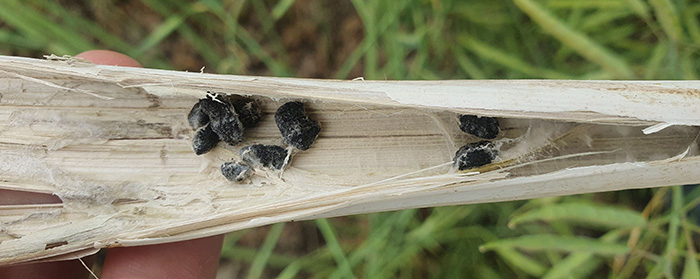
If sclerotinia is an issue in canola and pulses, the disease survival structures – called sclerotes - should be graded out.
Many pulse diseases are carried over in the seed. Testing of pulse seed is needed to determine if seed is infected.
For field pea, avoid saving seed from outer edges of the paddock where pea weevil damage is likely to be greater. Avoid retaining seed from areas infected with bacterial blight.
Save seed from weed-free areas
Ensure that crop seed is the only seed sown. Contaminated (‘dirty’) seed batches can introduce weed seeds into a paddock previously free from that species or introduce new herbicide resistant plants.
If seed is harvested from a paddock with significant weed seed - and cleaning the seed has not removed it – do not re-sow this as it will increase the weed burden in the paddock when sown.
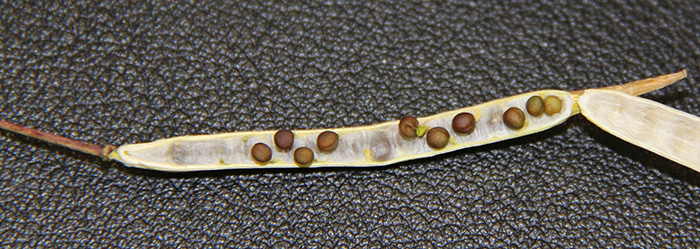
Avoid any areas with wild radish. Green wild radish pods give off substances which inhibit germination of the seed stored with it. They can also survive many years in the soil.
Thoroughly clean harvest equipment before harvesting grain that is to be kept for seed, to avoid contamination from other weeds or crops.
Heavy grading can remove some species of weed seed. However, seed cleaning will not necessarily remove all weed seed.
Use seed from unstressed plants
Plants which have suffered stress such as insufficient moisture, waterlogging, nutrient deficiency or trace element toxicity will produce seed of a poorer quality. These areas of the paddock are also likely to have more weeds.
If frost and/or dry seasonal conditions have affected crops, inspect them before harvest. Keep seed from parts of the paddocks that are least affected by frost and have coped well with dry conditions and produced better quality seed.
Weather-damaged seed
Weather-damaged seed may appear discoloured or with loose or wrinkled seed coats, especially pulses. It can range in appearance from slight staining to ‘sprung and shot’ seed (see breakout box).
Ideally, weather damaged grain should not be used for sowing. If using weather-damaged cereal grain, the suitability of keeping it as seed for sowing depends on the percentage of shot grain and the vigour of the shoots - ignoring sprung grain.
Test weather damaged seed for germination after harvest and again before sowing.
Some general rules of thumb:
- If germination is 10% lower, sowing rates will need to be increased by 10% to attain a similar plant density.
- If only 5% of cereal grain is shot, the seed is likely to be suitable for sowing without a major adjustment to the sowing rate.
- If 10% of cereal grain is shot, the sowing rate should be increased by 10% and so on, up to a maximum of 20% shot grain.
Sprung and shot grain
The germination process begins with slow absorption of water by dry grain. This leads to swelling of the embryo (germ).
If the seed dries out at this stage, the germination process stops, with little to no effect on grain quality or seed vigour.
When the grain water content approaches 30%, the actual germination process starts. The swollen grain splits the covering skin, and the grain is said to be ‘sprung’.
Sprung seed has less stored energy for germination and seedlings can have poor vigour. It is also at higher risk of fungal diseases before and after sowing and physical damage during handling.
If the seed dries out again, no further germination processes take place, and the seed is still satisfactory for sowing.
The final phase is the appearance of roots and shoots, which means the grain has ‘shot’.
Frost and drought-damaged seed
Frost and drought can impact germination and seedling vigour. They often severely reduce germination to 20–40%.
Frost damage to seed will depend on the temperatures, the duration of the frost and the number of frost events during grain filling.
Grain (including pulses) that is frosted during grain fill will be shrivelled and abnormal. Cereal grain frosted slightly later in the dough stage is shrivelled and crimped along the axis.
Crop topping and desiccation of crops
Herbicides used for crop topping or desiccation may potentially impact seed quality. Do not retain seed from crops sprayed (desiccated) with glyphosate pre-harvest.
Grade seed to improve quality
Grade seed heavily to remove smaller seed. Grading will also remove seed that is shrivelled from frost or drought, low seed weight grain, weed seeds, straw, chaff and other impurities, and seed with disease that affects seed size.
Large seeds emerge faster and produce more vigorous plants. These plants will be less susceptible to pests and diseases and more competitive with weeds. They can produce higher grain yields.
Grading is a relatively small cost compared with other crop management inputs but can have a significant positive impact on setting up the season for a higher yielding crop.
Keep cereal seed wider than 2 mm where possible.
Canola considerations
Canola can be difficult to clean weed seeds from.
Unlike cereals, canola can cross-pollinate. Germination and vigour can be reduced in retained seed of open-pollinated (OP) varieties after successive generations. Trials have shown that yields can decline 2–3 years after the initial season.
Avoid retaining OP canola seed from crops which have been stressed during flowering and pod fill, including rain damage.
If retaining canola seed, be extra careful to sow the correct variety due to differences in herbicide tolerance, to avoid any mishaps.
Second generation (F2) hybrid seed should not be retained as – unlike F1 seed – it will be variable in its agronomic traits and disease resistance, which can result in serious yield losses.
Harvest and store seed properly
Pulses are at risk of mechanical damage during harvest and grain handling, so need to be treated gently.
Ensure transport vehicles, augers and storage facilities are thoroughly cleaned before use.
Store seed in a way that does not allow storage pests to breed.
Germination can decline during storage. Keep seed as cool as possible over summer with low humidity; warm and humid conditions in storage can reduce seed viability. Germination is also reduced by fluctuations in temperature and humidity.
Seed with a high moisture content is at greater risk of mould and insects.
Seed treatments
Some seed treatments affect the length of the cereal coleoptile or canola’s hypocotyl, which can affect establishment. The coleoptile is the sheath surrounding the first leaf of a cereal. The hypocotyl is the stem of an emerging canola plant.
If seed has been stressed by frost or a dry season, it is best to choose a treatment that is ‘soft’ on the seed, that is, one that does not negatively affect germination or slow coleoptile or hypocotyl growth.
References
Setter T and Carlton P (2000) ‘Germination and emergence’ In Anderson J and Garlinge W, ‘The Wheat Book: principles and practice’, Agriculture Western Australia, 39–40.
Bedggood W (1997) ‘On-farm seed production’, Agriculture Victoria factsheet, 2 pp.
Canola Council of Canada (undated) ‘Using canola seed and vigour tests’, factsheet, 2 pp.
Department of Primary Industries and Regional Development WA (2015) Can agronomy overcome yield penalty of retained (F2) hybrid TT canola in the low rainfall zone?
Dovuro (1998) Agronomic update: farmer retained canola seed shows decreased yields and lower potential financial return, factsheet, 2 pp.
Dowsley K (1993) ‘Cereal crop management’ In Winter Cereal Sowing Guide: A Guide to Growing Cereal Crops in Victoria, Victorian Department of Agriculture, 96 pp.
Edwards J and Hertel K (2011) ‘Canola Growth and Development’, NSW Department of Primary Industries, 90 pp.
Grains Research and Development Corporation (2021) ‘Retaining seed: saving weather damaged grain for seed’, factsheet, 4 pp.
Grains Research and Development Corporation (undated) Tips for identifying frost risk, web page.
Hannaford Seeds (2019) ‘Retaining seed in a dry and frosty year’, SeedSense, November 2019.
Heinrich A and Liddle W (2024) ‘Agronomic and financial outcomes associated with retaining seed across spring and winter canola hybrids’, GRDC Update Paper.
Jenkins L (2009) ‘Crop establishment’ In Canola Best Practice Management Guide for South-Eastern Australia, Grains Research and Development Corporation.
Marcroft S, Van de Wouw A, Lindbeck K (2024) Retained canola seed – disease implications, GRDC Update paper.
Matthews P and Holding D (2005) ‘Germination testing and seed rate calculation’, NSW Department of Primary Industries, Pulse Point 20 factsheet, 4 pp.
Phillips N (2010) ‘Weather damaged cereal seed’, NSW Department of Primary Industries, Primefact 209 factsheet, 2 pp.
Pritchard F, Marcroft S, Cribb M and Betzner A (eds) (2010) ‘Over the bar with better canola agronomy: demonstration and trial results. Crop establishment case studies.’ Grains Research and Development Corporation and Australian Oilseeds Federation, 36 pp.
Stanley M (1999) ‘Check 1 – pre season check’ In Topcrop Crop Monitoring Guide, Grains Research and Development Corporation, 25–54.
Acknowledgements
Author: Felicity Pritchard. Technical Review: Dale Grey and Luise Fanning. Editor: Jo Cameron.
Testing crop seed for sowing
Knowing the germination percentage will allow you to accurately calculate the sowing rate.
Read more