Determining readily available water
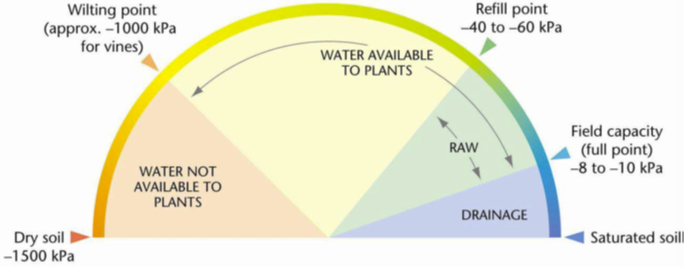
Not all water held in soil is readily available to plants. Some is bound so tightly to soil particles that plants find it difficult to extract for unrestricted crop water use.
Readily available water (RAW) is the amount of water the plant can easily extract from the soil.
RAW is generally the amount of soil moisture held between field capacity and a nominated refill point. Within this soil moisture range, plants are neither waterlogged nor water stressed.
With an understanding of your soil texture (see fact sheet Determining soil texture using ribboning) and the thickness of each soil layer in the root zone, Table 1 can be used to determine readily available water.
The values in Table 1 are presented as mm of moisture available per cm of soil depth. The figures in kPa represent a possible refill point for various horticultural crops. The drier the soil, the greater the soil tension and the more water is needed to bring the soil back to field capacity (−8 kPa to −10 kPa).
Table 1: Readily available water (mm/cm) stored between −8 kPa and −1,500 kPa for a range of soil textures
Soil texture | 8–20 kPa | 8–40 kPa | 8–60 kPa | 8–200 kPa | 8–1500 kPa |
|---|---|---|---|---|---|
Sand (S) | 0.33 | 0.36 | 0.38 | 0.40 | 0.62 |
Loamy sand (LS) | 0.45 | 0.52 | 0.55 | 0.58 | 0.87 |
Clayey sand (CS) | – | 0.55 | 0.60 | 0.64 | 1.00 |
Sandy loam (SL) | 0.46 | 0.59 | 0.65 | 0.70 | 1.15 |
Light sandy clay loam (LSCL) | 0.45 | 0.65 | 0.74 | 1.03 | 1.37 |
Loam (L) | – | 0.69 | 0.84 | 1.00 | 1.43 |
Sandy clay loam (SCL) | 0.39 | 0.61 | 0.71 | 1.01 | 1.43 |
Clay loam (CL) | 0.30 | 0.53 | 0.65 | 0.73 | 1.48 |
Clays (SC, LC, LMC, MC) | 0.37 | 0.46 | 0.57 | 0.66 | 1.49 |
Heavy clay (HC)* | – | 0.25 | 0.41 | 0.49 | 1.20 |
* Interpolated value.
Source: KG Wetherby, soil survey and land-use specialist. This table is the result of detailed field and laboratory studies on 360 samples from the Murray Mallee and Barossa Valley in SA.
RAW methodology
- Determine the root zone depth, either from an excavated soil pit (preferably, Figure 1) or an augur hole. In this situation the roots are located in the top 2 layers
- Determine the thickness of the layers in the root zone.
- Using the ribboning technique, determine the texture of each layer.
- Referring to Table 1, determine the water deficit of each layer. Usually, 40 kPa is the preferred deficit for Victorian Mallee crops.
- Add together the RAW figures from each layer within the root zone to determine a root zone RAW.
Readily available water = deficit (mm/cm) x depth of soil (cm)
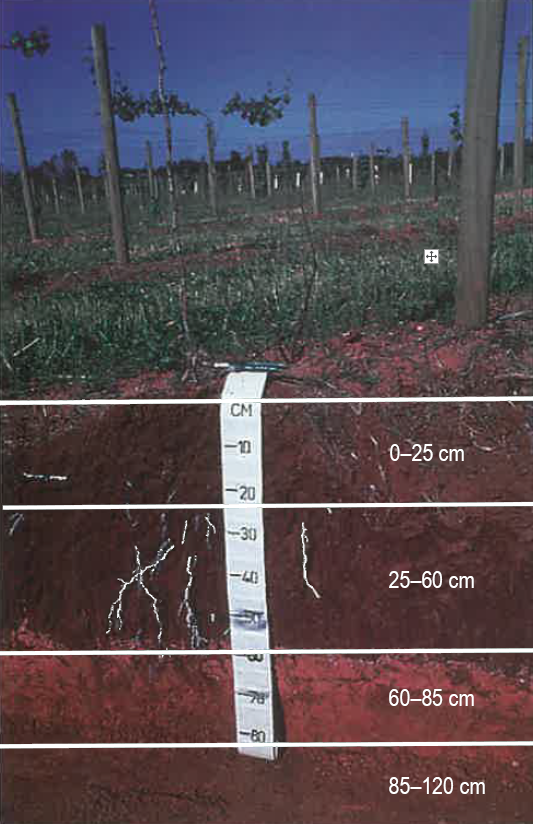
Table 2: Readily available water at descending depths of the root zone in Figure 1
| Readily available water (RAW) (−8 to −40kPa) | ||||
|---|---|---|---|---|---|
Soil texture | Depth (cm) | Thickness | mm/cm | Calculation | RAW |
Sandy loam | 0–25 | 25 | 0.59 | 25 × 0.59 | 14.8 |
Sandy clay loam | 25–60 | 35 | 0.61 | 35 × 0.61 | 21.4 |
Light clay | 60–85 | 25 | 0.46 | Root zone RAW = 36.2 | |
Medium clay | 85–120 | 35 | 0.46 | ||
Calculating RAW
For example:
A sandy loam (SL) has been determined to be the texture of the first layer, which is 25 cm thick. In order to bring a sandy loam from refill point (40 kPa) to field capacity (8 kPa):
0.59 mm depth of water (Table 1) is needed for every cm depth of that soil type (mm/cm).
As the sandy loam layer is 25 cm thick (Figure 2), (25 cm x 0.59 mm/cm) = 14.8 mm of water is needed to bring that particular soil layer back to field capacity.
A sandy clay loam (SCL) texture was determined in the second layer. In order to bring this SCL layer from refill point (40 kPa) back to field capacity (8 kPa) 0.61 mm depth of water is needed for every cm depth of that soil type (mm/cm).
As the sandy clay loam layer is 35 cm thick (Figure 2), (35 cm x 0.61 mm/cm) = 21.4 mm of water is needed to bring that particular soil layer back to field capacity.
As the root zone is located within these 2 layers only, in this situation the root zone RAW would be:
14.8 + 21.4 = 36.2 mm