Using readily available water to help schedule irrigation
Readily available water (RAW) is the amount of water a plant can easily extract from the soil. It is determined through soil inspection and calculations (see Determining readily available water).
An understanding of your RAW, combined with known crop water use requirements (mm/d) and irrigation system application rates (mm/h), can be used to assist with irrigation scheduling.
The following 3 irrigation scenarios are provided as examples, assuming:
- RAW = 36 mm
- Crop water requirement = 5.5 mm per day (mm/d)
Specific data from your own property should be used when developing irrigation schedules.
Full-cover sprinkler irrigation
A RAW figure for a full-cover irrigation system (such as overhead or low-level sprinklers) can be used directly to help schedule irrigation.
If the RAW value is 36 mm and the crop is using 5.5 mm per day then:
36 mm ÷ 5.5 mm/d = 6.5 day irrigation interval before the RAW of the root zone is exhausted.
When determining how long to run a well maintained and performing full-cover irrigation system with an application rate of 4.5 mm/h:
36 mm RAW ÷ 4.5 mm/h = 8 hours of irrigation to take the soil in the root zone from refill point to field capacity with minimal through drainage.
Part-cover or micro sprinkler irrigation
In their primary form, RAW figures relate to full-cover irrigation systems (scenario above). RAW figures must be adjusted to account for the reduced wetted area if a part-cover irrigation system is being used.
To determine the wetted area, run the irrigation system for a short time until the water pattern becomes visible. Measure the width of this wetted strip. At the same time, measure the distance between the irrigation laterals (likely to be the same as the crop row spacing).
If the lateral rows are 7 m apart and the wetted strip is 3 m, then three-sevenths (or 43%) of the area is being wetted up. Micro irrigation systems will typically wet 30% to 50% of an orchard.
If the full cover RAW is 36 mm, then the part cover RAW becomes 36 x 3/7 = 15 mm.
If the crop is using 5.5 mm/d, then 15 mm RAW ÷ 5.5 mm/d= 2.8 (say 3) day irrigation interval.
If the application rate of the sprinklers is 3 mm/h, then 15mm RAW ÷ 3 mm/h= 5 hours of irrigation to take the soil in the root zone from refill point to field capacity with minimal through drainage.
Drip irrigation
To determine the wetted area for drip irrigation systems, run the system for a normal shift. Using a shovel, determine the width of the wetted strip. This width will usually be found within 30 cm to 50 cm of the surface. For most soil types, water will move approximately 50 cm either side of the dripline, resulting in a 1m wetted strip. The width of the wetted strip will generally be influenced by soil texture, with a narrower wetted area for sandy soils and wider for heavier soils.
Measure the width of this wetted strip, as well as the row spacing.
If the rows are 3 m apart and the wetted strip is 1 m then one-third (or 30%) of the area is being wetted up.
If the full cover RAW is 36 mm, then the wetted area is 36 x 1/3 = 12 mm.
If the crop is using 5.5 mm/d, then 12 mm RAW ÷ 5.5 mm/d = 2.2 (say 2) day irrigation interval.
If the application rate of the drip system is 1.2 mm/h, then 12 mm RAW ÷ 1.2 mm/h = 10 hours of irrigation to take the soil in the root zone from refill point to field capacity with minimal through drainage.
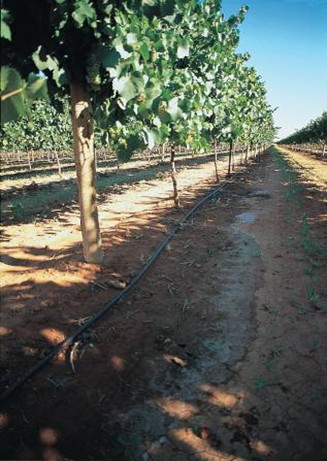
An understanding of your soil RAW, combined with your crop’s water use and irrigation system application rate, provides the information necessary to form the basis of an irrigation schedule. Ongoing monitoring by measuring soil moisture, plant response or climate-based measures, are recommended to refine this irrigation schedule.