Copper deficiency in sheep
Ben Ashton and John WebbWare (Mackinnon Project, University of Melbourne)
Copper is an essential trace element that is required for both livestock and plants. Copper is necessary for a number of enzymes that complete numerous tasks, such as body, bone and wool growth, and is required for collagen and red blood cell formation, as well as nerve and immune functions. Sheep are more at risk of copper deficiency than other livestock species, likely due to their larger demands for copper compared to cattle. British breeds require roughly 5 mg/kg of dry matter while merinos have demands of around 7 mg/kg of dry matter.
Developing copper deficiency in livestock is a complex process, as it can develop from a primary deficiency, where sheep do not ingest enough copper from pasture, or a secondary deficiency where the copper is bound in complexes with molybdenum or sulfur that limit copper absorption.
Copper deficiency is often seen on coastal and other sandy soils or sandy loam derived from granites and sedimentary soils. In addition, copper deficiency occurs on peaty swamps where molybdenum levels are high. Secondary deficiencies can be induced through lime application, which reduces copper availability and increases molybdenum availability, as well as in very wet seasons where pastures are excessively waterlogged and clover production is limited.
Copper availability tends to be lowest from midwinter to spring, due to low pasture availability. Green feed also has less copper availability than standing dry feed.
Regardless of the original copper status of soils, a previous topdressing of copper will affect current copper availability. Some research shows previous copper application to soils can correct deficiencies for more than 13 years, although this is highly variable.
The complex interaction between molybdenum, iron and sulfur can exacerbate copper deficiency, depending on seasonal conditions, so it is imperative to know if you are in an at-risk area.
Signs of deficiency
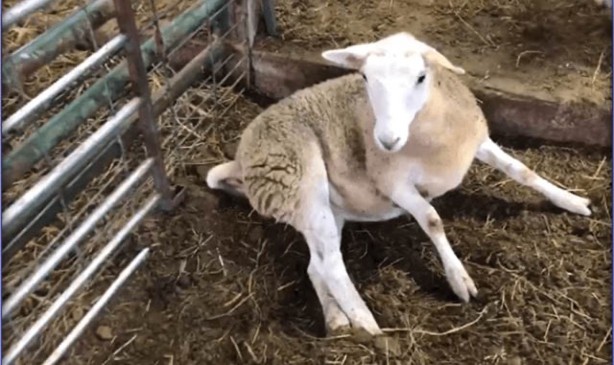
The 2 most common signs of copper deficiency in sheep are ‘swayback’ (enzootic ataxia) and fragile bones or fractures. Swayback is often seen at lamb marking, with lambs displaying the characteristic wide hindlimb stance as well as the weaving walk and falling over when mustered. Fractures are often noted in lambs that are mustered despite very little force being used.
Copper deficiency also affects wool early on with loss of crimp ‘steely wool’ and loss of wool pigment in black sheep. Bodyweight growth responses are not common with sheep unless deficiency is significant.
How to diagnose copper deficiency
Copper levels in livestock tend to decrease in winter and spring, so this is the best time to identify deficiencies, especially if the level of deficiency is minor. Ideally, copper status is tested for by liver biopsy or postmortem collection from stock. Blood samples are easier to collect but not as sensitive unless liver stores are depleted.
Collection of pasture for leaf tissue tests is useful if copper, molybdenum and sulphur is analysed to understand if primary or secondary copper deficiency is occurring. This can be done by calculating the ratio of copper, molybdenum and sulphur. Soil testing is not useful for determining copper deficiency.
How to correct copper deficiency
Given that copper deficiency is complicated and overdosing can cause toxicity, you should always monitor sheep to confirm deficiency in sheep and after treatment to ensure prevention strategies are effective.
There are numerous supplementation options available. When a producer has issues with swayback in lambs, copper injection (a variety of products registered for use usually providing 3 months protection) or oral drench (usually 1 to 2 months protection and not as effective if excess molybdenum is the problem) can be given to the ewes. Ideally this should be at least 6 weeks before lambing, to ensure adequate copper for neural and bone development in foetal lambs.
Treating lambs at lamb marking to minimise the impact of fractures is generally too late. It can still be considered, but professional advice and careful dosing are essential to avoid toxicity and ensure appropriate critical care.
Copper boluses (offering 9 to 12 months protection) are also worth considering for significant deficiencies, due to their longer duration.
Apart from treating deficient sheep, topdressing pasture with copper can provide long-term protection against copper deficiency. Over-supplementation can lead to toxicity if not monitored and tested regularly.
The risk of toxicity is amplified in sheep that have liver damage such as those that have previously grazed heliotrope or Patterson’s curse. Chronic toxicity may occur at 3.5 mg of copper per kg of bodyweight over a long period (weeks to months) which may occur if feeding supplements high in copper.
Reference
- Borobia M, Villanueva-Saz S, Ruiz de Arcaute M, Fernández A, Verde MT, González JM, Navarro T, Benito AA, Arnal JL, De Las Heras M, Ortín A. Copper Poisoning, a Deadly Hazard for Sheep. Animals (Basel). 2022 Sep 13;12(18):2388.
This article is produced as part of the MLA-funded Trace Element project being run by Meridian Agriculture, with the Mackinnon Project and Agriculture Victoria. To learn more about the project and see workshop presentations on both animal and pasture trace elements go to meridian-ag.com.au/trace-element