Supplementary feeding during lambing
Steve Cotton (Dynamic Ag) and Jane Court (Agriculture Victoria)
Feeding during lambing has been more common during the recent poor seasons with low feed availability.
Farmers have used a range of strategies including trail feeding; self or lick feeders and/or broadcasting of beans or maize to cover the most intensive lambing period. Anecdotally, all methods have been successful for some.
For example, in previous editions of SheepNotes we reported on 2 case studies that used different feeding methods during lambing, with excellent results. In 2025, the Jenkins fed a 12 to 14 day ration of maize (using a fertiliser spreader) to lambing ewes and after this period trail fed every 2 to 3 days. There was some green paddock feed, and some very wet weather early on. They didn’t provide hay. In 2024, the Maconachies trail fed ewes over lambing when there was some dry pasture feed.
The ewes were trail fed beans at 150 g/head/day, 3 times/week (plus ad lib hay) and usually later in the day. They had no problems with mismothering and ewes and lambs did well. They found the ewes were not hungry so any that were lambing stayed with their lambs rather than rush to the grain. They also feel the ewes do better with trail feeding than self-feeders when there is some dry pasture.
Some of the potential pros and cons associated with each method are outlined in Table 1.
Table 1: Potential advantages and disadvantages of different feeding methods over lambing
Trail feeding | Feeders | Broadcast |
|---|---|---|
Simple infrastructure | Fill feeders less frequently – less labour | No or very little paddock entry over critical lambing period |
Can chose where to feed each time | Less wastage | Low labour |
Time consuming | Ewes can feed when they want to so less likely to leave lambs unless there are too few feeders, particularly with larger mob sizes | Little infrastructure required if using fertiliser spreader/spreading contractor. If not, you need to purchase a linkage spreader which is a considerable investment |
May be high wastage (especially in wet weather) or in high stocking situations or where ground cover is limiting | Can have some control over intake by winding up or down, but some ewes may still hang around and guts while others don’t frequent. Adequate number of feeders are likely to be important. | Can be used to encourage ewes to spread out over the paddock |
Ewes may rush to the ute and leave lambs, but there are examples of this not happening when ewes are well fed. Feeding times and number per week may also impact. | Higher cost to purchase but can also be used in lamb feedlot scenarios to dilute initial purchase/depreciation costs | Ewes need to be well trained to full grain ration before spreading these large amounts |
Danger of running over stock | Feeders can block up so may need frequent cleaning. This can occur with pellets and when using a cereal grain mixed with beans and the feeders are wound down to limit intake. When feeders are opened to allow adequate flow of beans, acidosis risk increases | Wet weather during the feed period may lead to sprouting or high wastage, particularly with beans, but less so with maize due to waxy outer coating |
Stock can bog up the area around feeders (so some form of matting is recommended). Best placement of feeders in the paddock relative to water and shelter is still unknown | Birds may become a problem | |
Have been reports of lambs getting stuck under feeders |
A simple decision matrix can be used to determine the most appropriate feeding method for your farm, infrastructure and labour constraints. The best feeding method may depend on:
- Joining length. For example, a shorter 17 to 21 day joining will increase the number of lambs born every day, so disturbance by trail feeding may increase the likelihood of mismothering
- Time of lambing. Lambing later in the season reduces the risk of having no pasture available for lambing even with a June break. With low pasture availability early in the lambing period, feeding ewes during the first cycle may help increase pasture quantity to support second cycle lambers without the need for supplementation
- Condition of ewes pre-lambing. Have you hit your lambing condition score targets? If the ewes are in sub optimal condition, any method of feeding will be better than not, even if some mismothering occurs
- Scale of your business. Can you afford to purchase enough self-feeders to cover all lambing ewes? If not, can you afford to cover the twin bearing ewes only? If you already have self-feeders on hand, consider using these with the twin bearing ewes and trail feed the single bearing ewes. Additionally, in large scale businesses it can be time consuming trail feeding all mobs, particularly if you have smaller twin and triplet mobs. Do you have enough labour and time to trail feed?
- Type of feed. Large grains like beans and maize can be spread easily with minimal wastage while cereal grains and pellets can be either trail fed or used in self-feeders to minimise wastage. Pellets are better in feeders if the ground is wet
- Paddock access. Water availability for many farmers was limited in 2025, meaning that not all paddocks could be used for lambing. Other paddocks, such as those in the Skipton area are covered with volcanic rocks making vehicle access impossible. These farmers employed the broadcasting method of feeding in 2025 which was very successful.
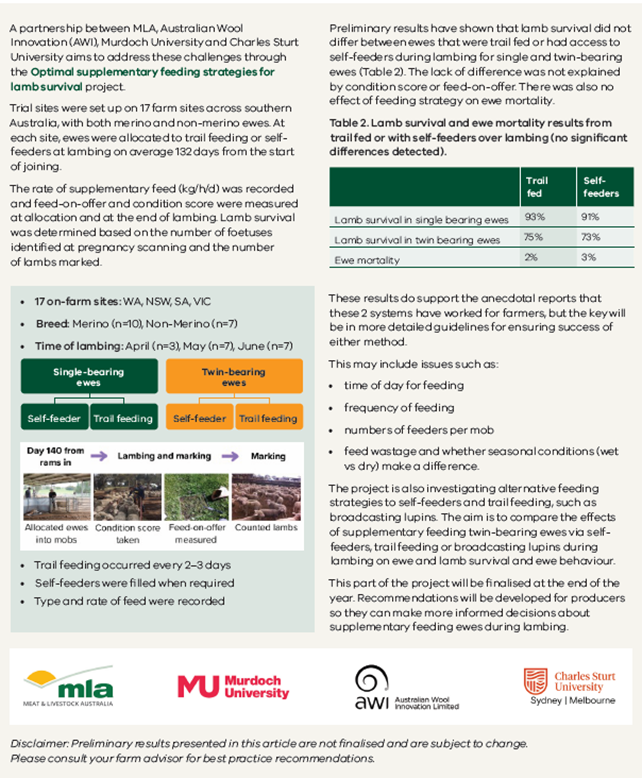
There are however currently no evidence-based guidelines available for supplementary feeding ewes during lambing, with only anecdotal evidence suggesting self-feeders or trail feeding are better for lamb survival.