Triplet management
Compiled by Alison Desmond, Agriculture Victoria
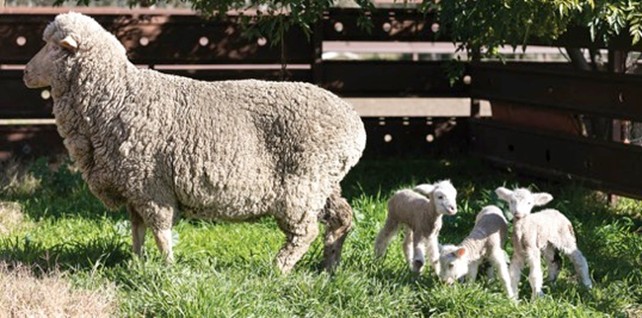
Triplets are becoming more common in Australian sheep flocks as improvements in genetics and nutrition lift reproductive performance and scanning results. However, higher scanning rates only translate into profit if they can be converted into live lambs. Managing triplets in the same way as twins is one of the fastest ways to lose both ewes and lambs. Flocks achieving consistent results focus on 3 fundamentals: pregnancy scanning for multiples, managing condition score, and allocating feed according to reproductive status.
Scanning for singles, twins and triplets is the starting point. From there, knowing which ewes are carrying triplets creates clear management opportunities. These ewes can be managed separately to single and twin-bearing ewes to improve lamb and ewe survival rates, which is particularly valuable when rebuilding numbers. Alternatively, if concerned about feed availability or the season ahead, triplet bearing ewes may be sold to producers with the capacity to manage them effectively. There is little benefit in chasing high numbers if you can’t convert them into lamb survival.
Results from the MLA national triplets project show that lamb survival achieved in commercial flocks directly affects reproductive rate (RR%). As an example, for an autumn-lambing Merino flock in the WA grain–sheep zone, the difference between the top and bottom 20% of producers was around ±7% lamb survival for both twins and triplets relative to the average. That difference alone has a major impact on whole-flock performance.
Triplets need to be managed differently
Scanning provides 2 key opportunities to capture value. The first is nutritional management from scanning to lambing, where feed can be allocated to lift condition score in twin and triplet-bearing ewes, driving birthweight and colostrum production. The second is paddock allocation for lambing and early lactation, matching feed-on-offer, shelter and privacy to ewe demand. This reduces mismothering, exposure losses and ewe deaths, particularly in high-litter-size mobs.
Condition score underpins triplet lamb and ewe survival
Condition score influences ewe survival, lamb birthweight, colostrum production and ultimately lamb survival. It should be treated as a fuel gauge – once it drops too low, recovery is slow, difficult and expensive. Higher condition score at lambing, and gaining condition after scanning, reduce ewe mortality (particularly pregnancy toxaemia) and increase lamb survival through improved birthweights.
If triplet ewes are left in a general multiple mob with twins from scanning through to lambing, they typically lose around 0.2 condition score relative to twins. To perform well, Merino triplets need to be around +0.2 condition score higher than twins by lambing, not behind them.
For Merino ewes, aim to gain about +0.2 condition score between scanning and lambing. Maternal ewes should at least hold condition, with gains possible under good management. The higher Merino target builds in a safety margin because Merino lambs are generally lighter at birth therefore more affected by poor nutrition. Merinos are also less resilient than maternal ewes when feed is tight.
Meeting the nutritional demands of triplet ewes during late pregnancy is difficult, as intake capacity is restricted. For this reason, feeding triplet ewes well earlier in pregnancy is critical. There is only a short window to build fat reserves before the gap between energy demand and intake becomes too large.
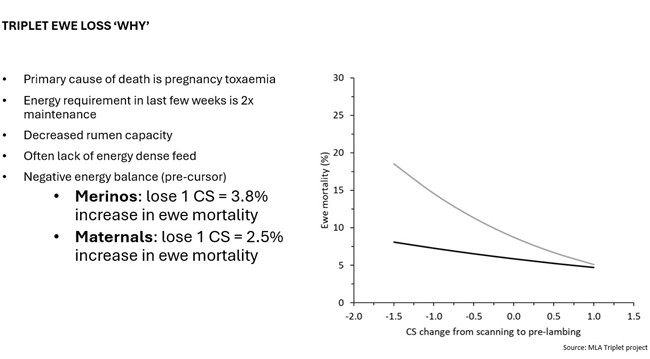
Figure 5 shows that the main cause of death in triplet bearing ewes is pregnancy toxaemia, caused by inadequate energy intake. The top light shaded line shows that Merino triplet ewes very sensitive to condition score loss from scanning to lambing. The dark bold line indicates that maternal triplet ewes are less sensitive to condition score loss, although they are not bullet proof.
Source: AWI Repro Masterclass.
Paddock allocation
When allocating paddocks to triplet bearing ewes, the aim is to provide good-quality feed, minimal disturbance, privacy for lambing and shelter. High quality green feed at or above 1500 kg DM/ha allows ewes to achieve optimal intake of energy and protein dense feed, ensuring each mouthful contributes to meeting nutritional requirements. Specialist fodder crops may be an option where sufficient numbers of triplet ewes justify their use.
The optimum mob size depends on many variables such as paddock size and layout but as a guide triplet optimum mob size is typically 30% of that of twins. In practice, paddock allocation and mob size are often a compromise, depending on available paddocks and the number of ewes in each pregnancy category.
Animal health
Standard animal health practices, including worm control and vaccination programs, continue to apply. However, multiplebearing ewes have higher nutritional demands and should not be held in yards or sheds close to lambing for routine treatments. Plan treatments early, minimise stress events from midpregnancy, and avoid yarding ewes during the final 4 weeks of pregnancy.
Calcium demands are also higher in multiplebearing ewes, and supplementation may be required before and during lambing to reduce the risk of hypocalcaemia. Stress can trigger redistribution of calcium and magnesium within the body and may induce hypocalcaemia even where overall calcium status is adequate. Older ewes (>3 years) carrying more than one foetus represent the highest risk group and require closer monitoring.
Higher survival is achievable
With adoption of best practice and very targeted management, particularly in maternal systems, targets of greater than 90% survival for singles, around 160% marking for twins and up to 180% for triplets are realistic. At around 80% triplet survival, these targets are also highly relevant for modern Merino systems.
Differential management does come with additional costs, including more time at scanning, additional labour and targeted feeding. Scanning for litter size may cost around 40 cents per head more than basic multiple scanning. However, benefits are realised through higher lamb marking percentages and improved ewe survival. Around 30% of the total benefit of differential management is directly linked to meeting condition score targets, with the remainder coming from improved lambing conditions and survival.
While triplets often make up a relatively small proportion of the flock, their influence on overall reproductive rate can be significant. As scanning rates increase, the link between ewe survival and lamb survival becomes even stronger.
References and resources:
- 2023 BestWool/BestLamb Conference presentation recording: Managing triplets – lifting ewe and lamb survival
agriculture.vic.gov.au/support-and-resources/networks/bestwoolbestlamb/
bestwoolbestlamb-conference-videos/2023-conference-presentations - MLA Triplet best practice management guide:
- AWI and MLA pregnancy scanning resource: wool.com/pregscanning
- AWI Repro Masterclass: wool.com/training-extension/repromasterclass/