Driving Victoria’s economic growth
Victoria’s $22.2 billion agriculture sector underpins our way of life. It feeds us, clothes us, creates essential jobs in our regions and supports the productive management of our landscapes.
Agribusiness is identified as a priority sector in the Victorian Government’s Economic Growth Statement, recognised as an engine of the state’s economic growth. From premium beef and dairy to delicious vegetables, fruit and award-winning wines, Victoria’s farmers and agribusinesses punch above their weight in producing high-quality food, fibre and beverages for Victorians and the world. Victoria’s agribusinesses are ideally positioned to deliver safe, sustainable and high-quality food into the future.
In 2023–24, agriculture made a record contribution to the state’s economy, with gross value of $22.2 billion.* The map below detailing the value of agricultural products demonstrates the diversity of production and interdependence across the state. You can find out more on our agriculture and food industries webpage.
Victoria also exported a total of $22.1 billion worth of food and fibre products in 2024–25, retaining its position as Australia’s number one food and fibre exporter. Victoria achieved its 2030 export target 6 years ahead of schedule.
* Based on ABS data (Value of Agricultural Commodities Produced), supplemented by analysis by Agriculture Victoria.
Gross value of agricultural production by region
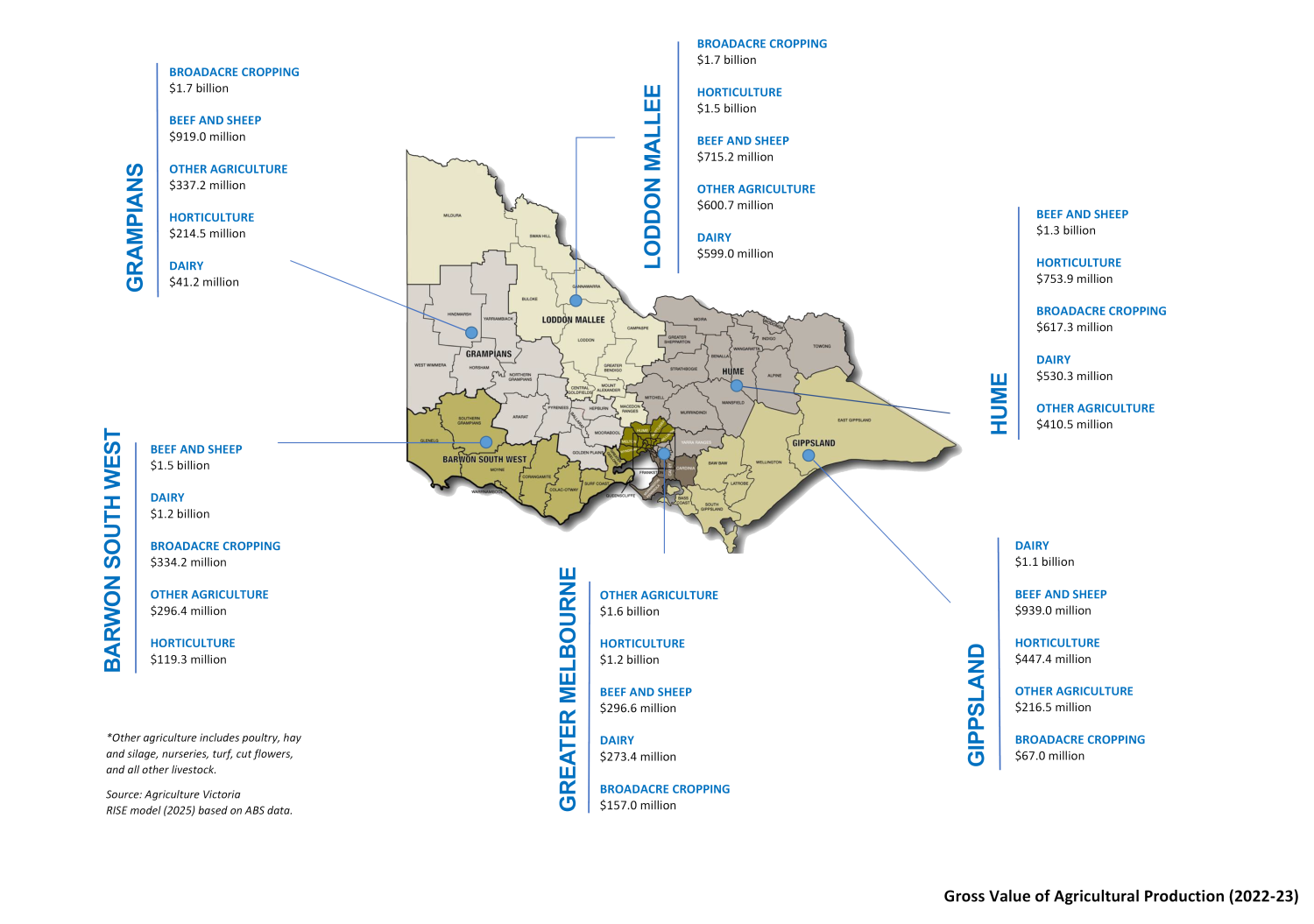
Loddon Mallee: Broadacre cropping ($1.7 billion) and horticulture ($1.5 billion) are the largest industries, followed by beef and sheep ($715.2 million), other agriculture ($600.7 million) and dairy ($599 million).
Grampians: Broadacre cropping ($1.7 billion) leads production, followed by beef and sheep ($919 million), other agriculture ($337.2 million), horticulture ($214.5 million) and dairy ($41.2 million).
Barwon South West: Beef and sheep ($1.5 billion) and dairy ($1.2 billion) are the top industries, with smaller contributions from broadacre cropping ($334.2 million), other agriculture ($296.4 million) and horticulture ($119.3 million).
Hume: Beef and sheep ($1.3 billion) are key industries, followed by horticulture ($753.9 million), broadacre cropping ($617.3 million), dairy ($530.3 million) and other agriculture ($410.5 million).
Gippsland: Dairy ($1.1 billion) is the largest industry, followed by beef and sheep ($939 million), horticulture ($447.4 million), other agriculture ($216.5 million) and broadacre cropping ($67 million).
Greater Melbourne: The largest sector is other agriculture ($1.6 billion), which includes poultry, nurseries, turf and flowers, followed by horticulture ($1.2 billion), beef and sheep ($296.6 million), dairy ($273.4 million) and broadacre cropping ($157 million).
Agriculture is the backbone to the state’s strong trade performance and a critical driver of economic development, jobs growth and productivity, particularly in regional Victoria. Agriculture and food manufacturing support the employment of over 150,000 people and are relied upon by many other industries across the state, including logistics, tourism and hospitality. Importantly, it provides food security for our state and the nation.