Farming Forecaster
Soil moisture and temperature
Knowing how much moisture is in the soil, and what that might mean for pasture growth over the coming months, can help farmers make more informed decisions about preparing for and managing the season ahead. While cropping businesses have used soil moisture data for yield forecasting for many years, sheep and beef producers are increasingly using it to guide management decisions and prepare for changing seasonal conditions.
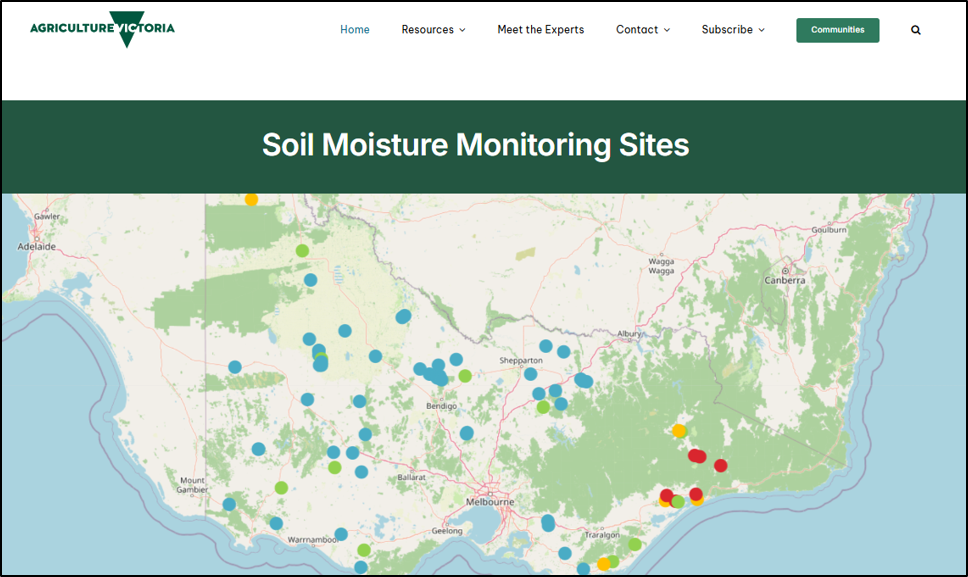
Agriculture Victoria’s soil moisture monitoring network provides access to real time soil temperature and moisture data across a range of Victorian pasture and cropping environments (Figure 1).
Farming Forecaster
The Farming Forecaster decision support tool was developed by NSW Land Services, CSIRO and farmer groups to provide a simple dashboard to farmers. It provides soil moisture data and pasture forecasting, allowing farmers to compare a range of seasonal scenarios using different percentile forecasts and better understand what the coming season may look like.
For most sites the dashboard shows real time soil moisture probe data and modelled pasture forecasting as the key functions. There are extensive sites across NSW and Tasmania. Farmers can choose the closest soil moisture probe and get immediate data on predicted pasture growth and forecast for the next 4 months.
Figure 2 shows what the top of the dashboard looks like – with the actual soil moisture from a close by probe (on the left) and modelled current and predicted pasture growth (on the right). The different colour bands in the right-hand side graph indicate the range in the amount of herbage available based on historical climate percentiles. The solid black line shows where green feed availability is tracking currently – and the coloured lines provide a forecast for the next 4 months based on historic climate data for the local climate at this site. Clicking on the different percentiles in the graph key on the right, will provide a forecast for green feed availability for the next 4 months for the 10th, 25th; 50th; 75th and 90 percentile. Given the dry seasonal outlook for spring, it may be most useful to look at the 10th; 25th and 50th to take this into account.
Agriculture Victoria together with Farming Forecaster have recently launched 4 sites in Victoria: south west (Joel South); central (Baynton); north east (Warrenbayne) and east Gippsland (Bairnsdale). All sites have improved pastures with good fertility. Pasture forecasts are made using GrassGro – a biophysical CSIRO model that is set up to represent the farming system, including type of enterprise and considers aspects such as stocking rate and time of lambing or calving. More information is provided on all these aspects on the web site.
At the time of compiling the newsletter, seasonal forecasts for some of the Victorian sites are quite different.
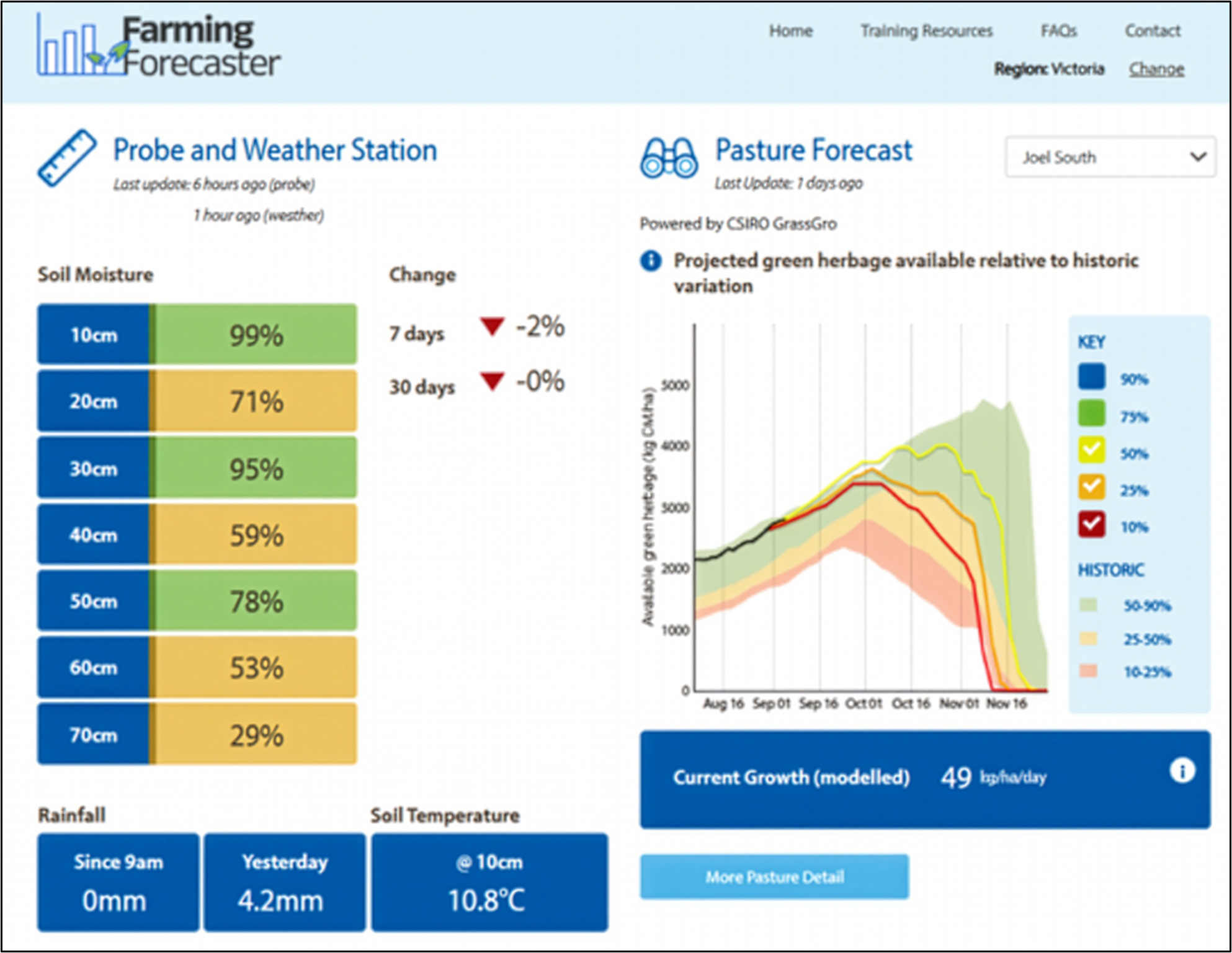
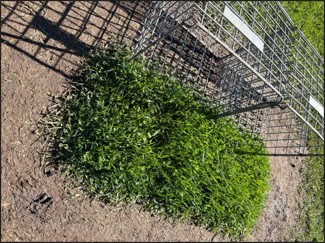
Figure 3 shows the Joel South site on 6 September. At this time, it was not fully wet to depth but had good soil moisture in the top 50 cm and soil temperature just above 10 degrees Celsius supporting good pasture growth for this time of year (black line near the 90th percentile).
Given these conditions, the pasture forecast graph on the right – shows that average spring conditions (as shown by the yellow line) would lead to an above average spring (sitting above the yellow shading). Even a drier season, as represented by the red and orange lines (as 10 and 25 percentiles) indicate a good season but an earlier peak and a shorter spring. Note that the lines represent green feed availability and not total feed.
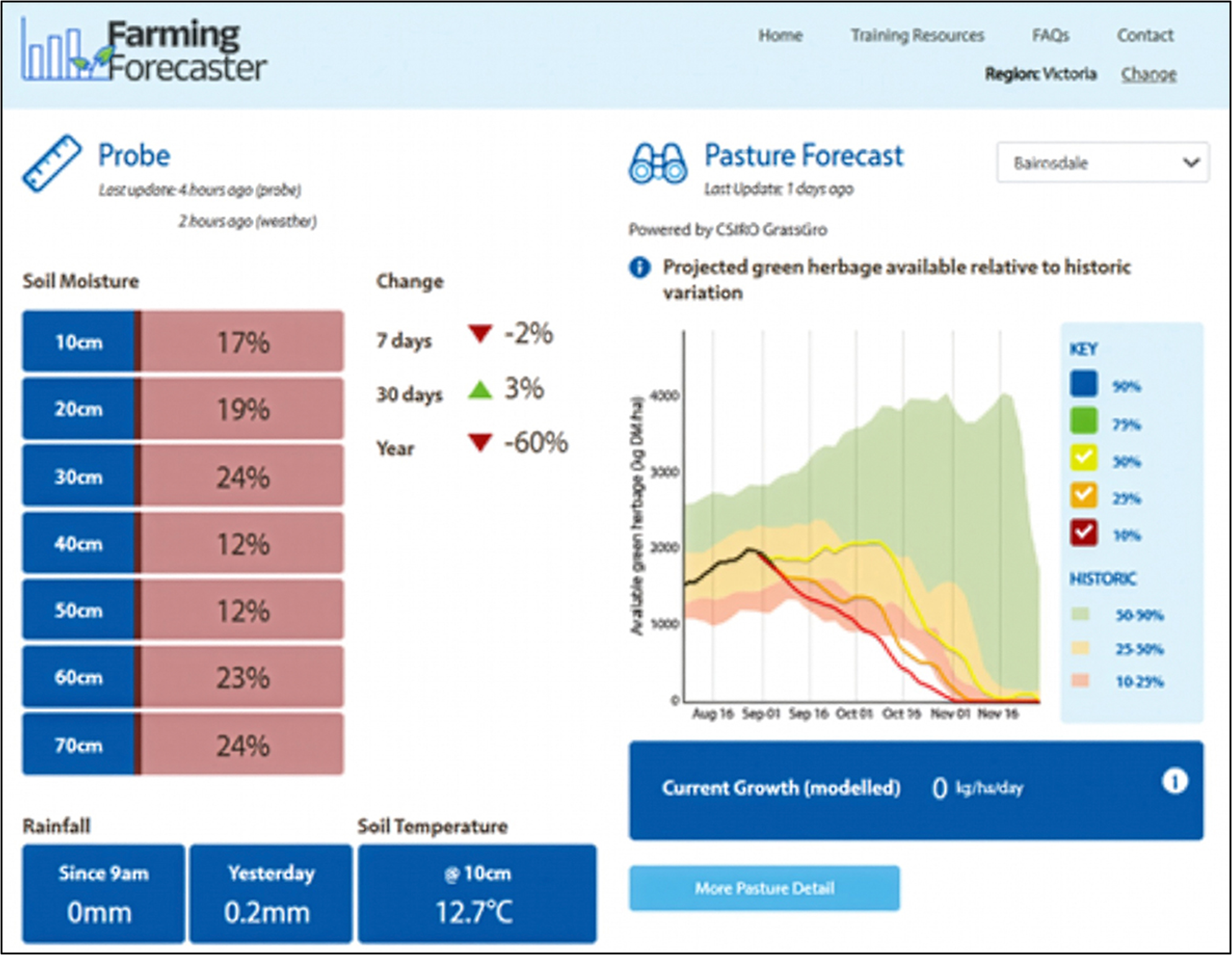
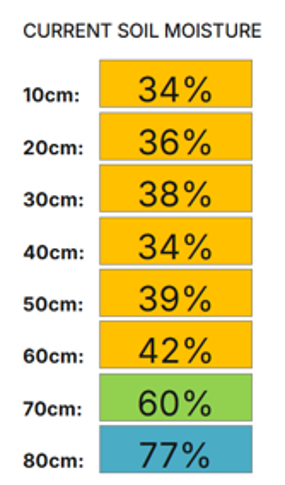
The east Gippsland site at Bairnsdale has been much drier as indicated by the probe data in Figure 4. Of interest, there is a probe in the adjacent paddock to this one which is unimproved and lower fertility. The soil moisture under this paddock is much higher (Figure 5) – illustrating the higher utilisation of soil moisture by the improved pasture shown here. The forecast graph is indicating that it would take rainfall/seasonal conditions at least in the 50th percentile to get an average spring, albeit a shorter one.
Timing of rainfall, rather than just the amount, is critical for optimising pasture growth.
The forecasts suggest strong early spring growth at many sites, but also reinforce the need to plan for an earlier finish if follow-up rainfall is limited. Monitoring local soil moisture and pasture forecasts can help producers make more informed decisions about stocking rates, supplementary feeding and fodder conservation.
A collaborative project with NRM South in Tasmania will see 13 more sites rolled out over Victoria in the next 12 months.
Farming Forecaster webinar
A webinar was held on 18 August to walk through the Farming Forecaster dashboard. Matthew Lieschke from Local Land Services in NSW showed what the forecast for spring pasture is looking like at 2 of the Victorian sites. The forecast uses historic climate data for each site to estimate what the season could look like depending on good, average or low spring rainfall. Matt explained how this helped farmers in a similar position in 2023 to make more informed decisions about planning for the spring ahead.