Paddock preparation reduces worm risk in lambing paddocks
Ben Blomfield, Veterinary Consultant, and Keren Walker, Agriculture Victoria
The Enhancing Sheep Worm Control Project is now in its second year, providing insights into practical strategies that can help producers improve worm management in sheep flocks. The Producer Demonstration Site (PDS) is co-funded by Meat & Livestock Australia and Agriculture Victoria.
A demonstration at Gelantipy is investigating whether using cattle grazing or a crop break before lambing can reduce infective worm larvae (L3) contamination in lambing paddocks and lower worm challenge for ewes and lambs.
Reducing pasture larval levels before ewes and lambs enter paddocks may decrease worm challenge during a critical production period.
Demonstration design
Following bulk worm egg count (WEC) monitoring, pregnant ewes received a pre-lamb drench on 17 August 2025 and were allocated to 1 of 3 treatment groups:
Cattle cross-over (CX)
Lambing paddocks were grazed exclusively by cattle from December through to mid-August, providing approximately 8 months without sheep grazing. The objective was to reduce sheep worm contamination by replacing sheep with a non-host species for most sheep worm parasites.
Crop break treatment (Spell ARG)
The crop break paddock was:
- Spelled from 20 April
- Sown to annual ryegrass on 3 May
- Not grazed until pre-lambing in mid-August
This provided approximately 4 months without additional sheep worm contamination. The objective was to allow infective larvae already present on pasture to die off before lambing.
Control treatment (Sheep ARG)
The control paddock was:
- Sown to annual ryegrass on 10 March
- Grazed by sheep from 19 May to 21 June
- Then spelled until pre-lambing in August
This treatment reflected a more typical sheep grazing system and provided a benchmark against which the alternative strategies could be compared.
Ewes lambed in September. Ewe WEC was monitored in October (at lamb marking) and November. Lambs were drenched and weaned at the end of November and removed from the paddocks. The main worm species were black scour worms (Trichostrongylus), small brown stomach worms (Teladorsagia) and Barber’s Pole (Haemonchus).
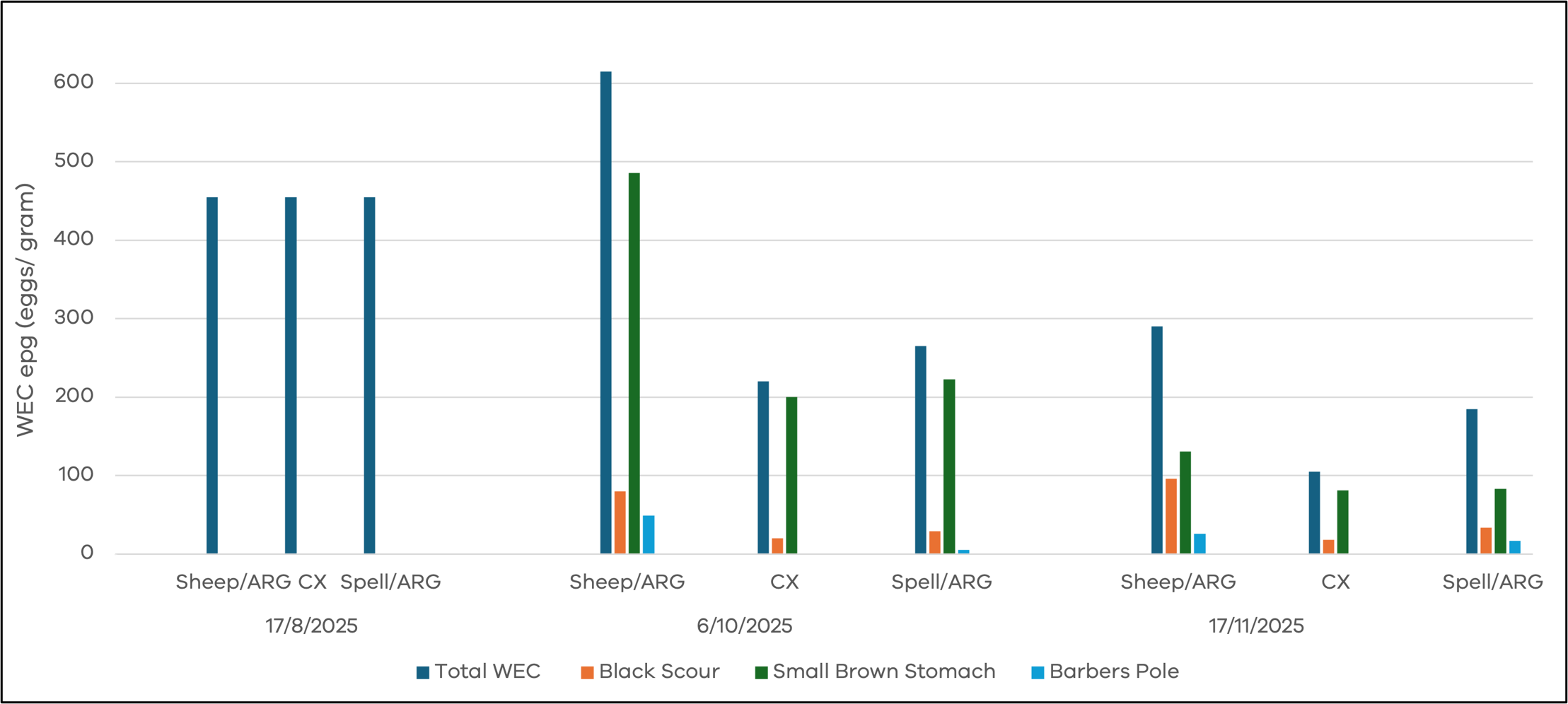
Graph of worm egg counts (eggs per gram, epg) for each treatment.
On 17 August all treatments were at about 400 epg.
On 6 October the control (Sheep/ARG) was over 600 epg, about 490 of which was small brown stomach worm; CX was just over 200 epg, mostly small brown stomach worm; and Spell/ARG was about 260 epg, also mostly small brown stomach worm.
On 17 November Sheep/ARG was nearly 300 epg, about half brown stomach worm and half black scour worm; CX was 100 epg; and Spell/ARG was about 190 epg.
Results 2025
Worm egg count monitoring showed that both alternative treatments reduced worm larval uptake compared with the control paddock (Figure 1). Average WEC increased in the control mob (Sheep/ARG) to greater than 600 eggs per gram (epg) after lambing in early October and to just under 300 epg in November. The main species responsible was the small stomach worm. Both the cattle cross-over and crop break treatment mobs were significantly lower for WEC compared to control. These treatments were less than 300 epg in October and less than 200 epg in November.
Strategic paddock preparation can play an important role in integrated worm management and reduce reliance on drenches alone.
Key findings
- Cattle cross-over produced the greatest reduction in worm challenge at both monitoring times.
- The crop break treatment also reduced larval pick-up compared with the control.
- Both strategies demonstrated the value of reducing sheep worm contamination before lambing.
- Cattle cross-over and crop breaks are valuable tools when used alongside monitoring and effective drench programs.
- Integrated parasite management helps protect drench effectiveness and improve long-term worm control outcomes.
These findings highlight the opportunity for producers to use grazing and pasture management to lower worm pressure before ewes and lambs enter lambing paddocks.
Important consideration
While cattle can be an effective tool for reducing sheep worm contamination, younger cattle can carry Barber’s Pole worm.
When using cattle to prepare lambing or weaning paddocks, cattle should be older than 12 months of age to minimise the risk of introducing Barber’s Pole Worm.
Next steps
The Gelantipy demonstration will continue through 2026, providing a second year of data to further evaluate the long-term benefits of cattle cross-over and crop break strategies for reducing worm burdens in lambing paddocks.