Broadcasting grain supplements to lambing ewes
Matthew Lieschke and Brett Littler, Local Land Services NSW with additions from Steve Cotton, Dynamic Ag and Jane Court, Agriculture Victoria
Key points
- Broadcasting large grains (e.g. maize, faba beans, lupins) has gained interest from producers as a way of supplementing lambing ewes in tough seasons.
- Preparation is key – what mobs/paddocks will be targeted and how much supplement will be required.
- Allow 2 to 3 weeks to transition ewes onto a full ration before lambing.
- Producers are commonly spreading 7 to 14 days’ worth of supplement before the peak lambing period. Some have opted to feed enough to cover the first cycle (17 to 21 days), as 70 to 80% of lambs are born in this period, particularly for short joinings.
- Carefully monitor lambing paddocks to ensure ewes don’t run out of feed.
- Lambing ewes require continuous access to roughage – either as dry standing feed or hay.
- Where possible, reduce mob size. This helps with lamb survival.
Background
Optimising ewe nutrition during pregnancy and lactation is key for increasing lamb survival. In Southern Australia, supplementary feeding during lambing is often required, especially in flocks lambing in autumn and early winter.
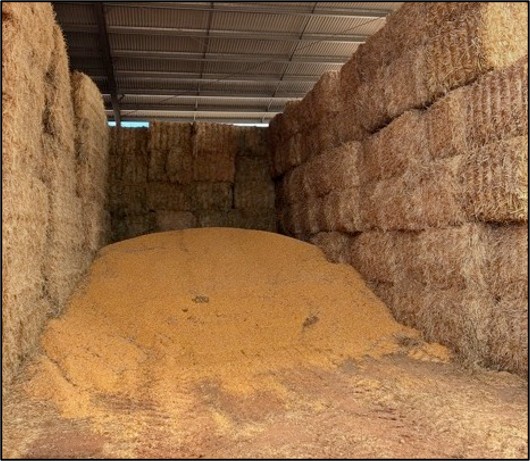
2024 and 2025 were extremely tough in some parts of southern Australia, with some producers feeding continuously for up to 18 months. Therefore, many producers needed to feed full or nearly full rations, before and during lambing. What to feed and how, was a challenge to meeting nutritional requirements while minimising the risk of mismothering.
Producers reported varying levels of success with trail feeding and self-feeders (see article in the autumn 2026 edition of SheepNotes). This prompted interest in broadcasting large grains such as lupins, faba beans and maize to provide requirements of energy and protein to lambing ewes, whilst minimising disturbance to ewes. Broadcasting can also reduce labour cost due to a much longer interval between feeds, with feed generally being spread every 7 to 14 days or up to 21 days depending on mob size and weather conditions
Three point linkage spreaders and fertiliser spreaders have typically been used to broadcast grain.
What does the science say?
There is limited scientific literature around broadcasting grain for sheep feed. A research trial in WA investigated the impact of feeding interval on ewe and lamb performance where lupins were broadcast to autumn lambing ewes grazing a wheat stubble. However, this study didn’t look at lamb survival. At this stage, it’s uncertain whether broadcasting increases lamb survival compared with trail feeding or using self-feeders, although evidence suggests there’s no significant difference in lamb survival between trail feeding and the use of self-feeders (see autumn 2026 edition of SheepNotes).
Developing a strategy
Like any feeding program, it is important to allow some time to develop a plan and get organised. Things to consider include:
- What mobs will you will you be targeting and on which paddocks?
- What grain will you use and how much supplement will be required – refer to Table 1 for an overview of commonly used grains and consider undertaking a feed test of your available grain.
- Budget for enough of the grain to get through lactation to avoid switching between different feed types and methods.
- Do you have the equipment to spread grain yourself, or will a contractor be required?
- Getting ewes on to grain – allow 2 to 3 weeks to bring ewes up to a full ration and get used to a new feed. Some producers have had acidosis issues when transitioning across to maize and not allowing enough time. Typically, in seasons with limited pasture feed, sheep are already used to eating grain, so the main consideration is transitioning to larger grains (e.g. maize or beans).
- What will be the source of roughage, how much is available and how will it be fed if it is also to be supplemented in the paddock.
Table 1: Grains that are commonly used when broadcasting to lambing ewes, feed values1 and comments on value
| Grain | Typical feed analysis Average and range in brackets | Advantages | Disadvantages |
|---|---|---|---|
| Maize |
DM: 88 %
ME: 14.8 MJ/kgDM (14.3 to 15.4 MJ/kgDM) CP: 9% (7 to 11%) |
Very good at boosting colostrum production due to high starch content2 Minimal wastage due to large grain size Highly visible – a large, bright yellow grain that is more visual than beans and lupins. Easier to assess what’s left in the paddock Better able to withstand wet conditions (needs higher soil temperatures to germinate). | Higher acidosis risk than lupins or faba beans but less than for barley and wheat (high starch but lower rumen degradability compared to wheat and barley) Low protein May take some time for sheep to adapt to maize if they have not been previously exposed to it. |
| Faba beans |
DM: 91%
ME: 13.4 MJ/kgDM (12.6 to 15.9 MJ/kgDM) CP: 27% (21 to 30%) |
Good source of energy and protein. Higher source of rumen degraded and undegraded protein, calcium and fibre compared to cereal grains |
Higher level of starch than lupins = moderate acidosis risk.
Harder to visually see/monitor in the paddock (compared to maize) More prone to wastage than maize if rain occurs (germination) |
| Lupins |
DM: 93%
ME: 14.2 MJ/kgDM (10 to 16 MJ/kgDM) CP: 30% (11 to 40%) |
Good source of energy and protein. Low starch and high fibre so lower acidosis risk than maize and faba beans. Highest source of rumen undegraded protein of any pulse used for livestock feed. On average 150 g/kgDM compared to beans at 65 g/kgDM and peas at 45 g/kgDM. |
Cost – lupins tend to be more expensive than faba beans and maize on an energy basis. Harder to visually see/monitor in the paddock (compared to maize) More prone to wastage than maize if rain occurs (germination) Easier to auger and mixes more evenly through self feeders if mixed with cereal grains (compared to beans) |
The training of ewes prior to broadcasting is critical – especially if using a feed that the sheep have never seen before. There have been cases where broadcasting hasn’t been successful because the ewes were not properly trained to an unfamiliar feed. Whilst lupins and beans are relatively safe grains, maize is a cereal grain which is high in starch and requires more care with introduction. Maize is safer than wheat and barley due to lower rumen degradability (more bypass starch) which reduces the risk of acidosis but does not eliminate it altogether.
Assess the amount of pasture in lambing paddocks (green and dead). How much feed is currently present in lambing paddocks, and what is likely to be present during lambing? This is a key consideration for developing the ration.
One producer spread maize in paddocks containing very little green pasture (around 300 kg DM/ha green), but the green feed had good leaf height (around 4 cm). In this case, the ewes weren’t interested in picking up the maize – they were more focused on grazing the green pasture. The producer reverted to trail feeding, as the ewes were willing to pick up the maize from a trail. In another case, a producer who regularly feeds maize to lambing ewes, reported that in 2025 ewes started to slip. It was still dry at this time with no green pick and so the assumption was that protein may have been limiting for high producing ewes.
This highlights that spreading isn’t a “bullet-proof” strategy. It is important to observe stock, remain flexible and be willing to revert to trail feeding or change the ration if ewes aren’t picking up the broadcast supplement. In scenarios where there is little to no green pick available during lactation, beans should be considered over maize, but the addition of protein rich hay such as vetch or lucerne hay has been used successfully with maize to lift the protein content of the ration.
Table 1 summarises the advantages and disadvantages of the 3 large grains with typical feedtest values. DM – Dry Matter (%); ME – Metabolisable Energy (MJ/kgDM); CP – Crude Protein (%).
Targeting the high-risk period
For naturally mated flocks that are joined for 5–6 weeks, around 75% of lambs are born in the first 3 weeks. Most of these lambs are born between day 7 and day 20 so this is the high risk period for mismothering. Table 2 contains an example strategy that aims to achieve a balance between feeding frequency, risk of acidosis (maize) and wastage due to wet weather (e.g. trampling of grain into wet soil, germination etc).
Table 2: An example program that combines trail feeding and broadcasting grain during the lambing period.
| Day of the lambing period | Description |
|---|---|
| Day 1 | Spread 1 weeks’ worth (or trail feed ewes for the first week) |
| Day 7 | Spread 2 weeks’ worth |
| Day 21 | Spread 10 days’ worth |
| Day 30 | Trail feed3 |
How much should I spread?
The amount of grain spread (kg/ewe) will depend on a range of factors including:
- mature size of the ewe
- number of lambs at foot (singles vs twins)
- the quantity and quality of pasture
In Table 3, Grazfeed (a CSIRO feed software) has been used to predict the amount of maize (at 15 ME, 10% CP) and hay required for lambing ewes grazing paddocks containing no feed (Scenario 1) compared to a very short, green ‘pick (Scenario 2). While the amounts shown in the Table are based on maize, they can also be used as a guide for lupins and faba beans.
In practice, a common spreading rate is 1 to 1.5 kg/ewe/day, with producers often spreading 10–15 days’ worth of maize (e.g. 15 kg of grain/ewe). The 1 kg/ewe/day amount aligns quite well with the predicted rates in Table 2 where there is some green feed available. However, in situations where the paddock contains no green feed, it is likely that ewes will consume more than 1 kg/day of grain. In some cases, stock have consumed the grain quicker than expected. As such, it is important to closely monitor lambing paddocks to ensure ewes don’t run out. Taking photos is a good way of monitoring the amount of residual grain.
Table 4: Estimated daily amounts of maize and hay (kg/hd/day, as fed) for lambing ewes with and without green pasture. Ewes 55 kg mature weight merinos4
Scenario 1: No paddock feed available
| Feed type | Singles | Twins |
|---|---|---|
| Maize (kg/hd/day) | 1.3 to 1.5 | 1.6 to 2.0 |
| Hay (kg/hd/day) | 0.4 to 0.5 | 0.4 to 0.5 |
Scenario 2: ewes grazing 500 kg green pasture (0.7 – 1.0 cm in height)
| Feed type | Singles | Twins |
|---|---|---|
| Maize (kg/hd/day) | 0.6 to 0.8 | 0.8 to 1.1 |
| Hay (kg/hd/day) | 0.1 | 0.2 |
* In situations where maize has been used and there is no green pasture available towards the end of lambing, gradually switching over to a cereal grain (with 10% lupins) is recommended to achieve a better energy: protein ratio. Young lambs have a high protein requirement and will start eating some of the grain. Alternatively, if you have access to high-quality hay such as vetch or lucerne, this can be used in conjunction with maize as the transition period back to a cereal grain can be challenging, particularly if paddocks are too wet to trail feed in or you don’t have access to feeders.
Where should I spread?
The proportion of the paddock covered by spreading will depend largely on paddock size, stocking rate, spreading rate and terrain. For very large paddocks with lower stocking rates, the aim might be to cover around 30% of the paddock. In this scenario, you could target areas in the paddock that have trees/wind breaks to encourage ewes to graze in areas that offer better protection. When paddocks are relatively small, spreading is often done across the entire paddock. In all cases, the general aim should be to broadcast grain across a large area to encourage ewes to spread out and ‘work’ different areas of the paddock.
Roughage and minerals
Roughage needs to be available at all times. It can be in the form of dead paddock feed, hay, straw or silage. Having at least 20% fibre in the diet is important for lactating ewes to support rumen function and improve milk quality and production. Fibre also helps mobilise calcium and improves calcium and magnesium absorption in the rumen which is critical to reducing the incidence of metabolic disease in the lead up to and during lambing. Avoid feeding roughage around sheep camps.
In situations where maize is being used and green paddock feed is minimal, feeding a good quality hay or silage containing at least 9.5 ME and 15% protein is recommended to help balance the low protein content of maize.
Cereal grains and pulses tend to be low in calcium and salt. These minerals can be provided by adding finely ground agricultural limestone (1.5%) and salt (0.5%) by weight to the grain, e.g. 15 kg lime/tonne and 5 kg/tonne salt or use a commercial lick or loose lick (with a waterproofing agent). Alternatively, you can make your own loose lick.
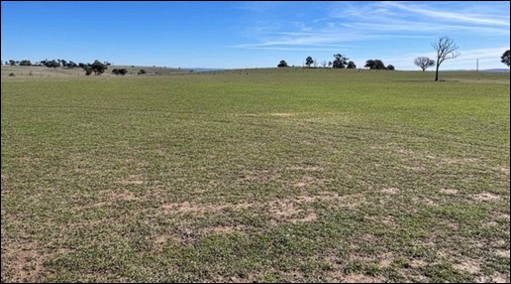
This 20-ha paddock was running 200 ewes (10/ha). The ewes were being fed 10 kg of maize per ewe, which lasted around 10 days.
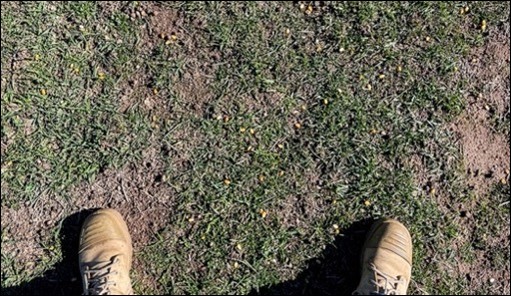
Close up photo of maize in the paddock at end of May 2025, around 1 week after the autumn ‘break’. Maize is clearly visible among the short, green pasture.
Other articles
- A case study: Feeding lambing ewes in 2025 (Sheep Notes, Summer 2025)
- Lamb producers spread grain to maximise lamb and ewe survival (Sheep Central)
2 Banchero et al 2015. Colostrum production in ewes: a review of regulation mechanisms and of energy supply. Animal 9, 831–837.
4 Calculated using Grazfeed based on the following: Maize containing 15 MJ/kgDM ME, 9% crude protein and hay at 9.5 MJ/kgDM ME. Predicted feeding rates do not account for cold weather or wastage.