Are you using pain relief at marking?
Alexandra Sadler, Agriculture Victoria
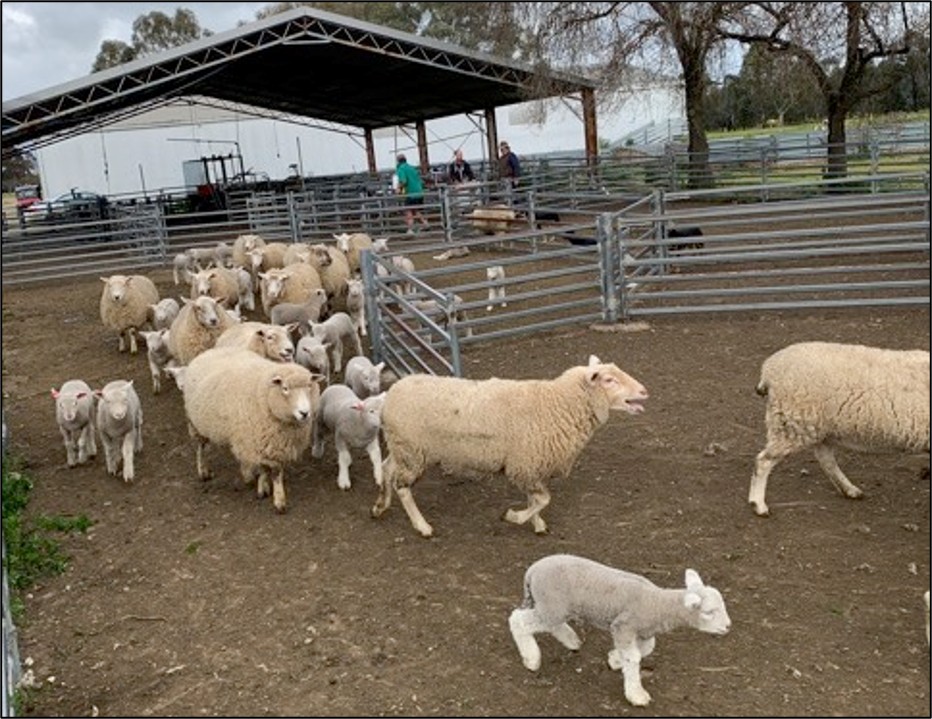
While Merino breeders who mules have used pain relief for years due to the mandatory requirement, the use of pain relief for all lambs at marking by producers is becoming more widespread as they see the benefits. Access to the pain relief products becomes easier through vets and rural suppliers.
Using pain relief at marking helps to alleviate stress and the initial pain for the lambs and promote healing. Some observations from a lamb producer who used pain relief at marking for the first time last year included:
‘Normally we see ram lambs rolling around against the side of the pen they have been released into, that was almost non existent when we used pain relief. Lambs were quick to mother up, and walked out of the yards back to the paddock much better.’
‘Whilst it’s another two needles to fit in with the space of our rotary lamb marking cradle, the benefits far outweigh the cost – we will definitely use it again.’
The Australian Animal Welfare Standards and Guidelines recommend that pain relief should be used where practical for all animals undergoing tail docking and castration. Pain relief must be administered when mulesing sheep in Victoria under the Prevention of Cruelty to Animals Regulations. There is extensive evidence for the efficacy of pain relief used at marking to reduce immediate and short-term pain at docking and castration sites. Any reduction in stress and pain in lambs is a welfare improvement and may assist the lambs in mothering up and returning to normal feed intake levels more quickly.
There are two main types of pain relief that can be used at marking: local anaesthetic, and non-steroidal anti-inflammatory drugs (NSAID). These drugs can be delivered in a variety of ways and are suitable to use when using elastrator rings or surgical methods for castration; or rings, sharp knife and hot knife methods to dock tails.
The local anaesthetic used for lamb marking is lignocaine and is sold under a variety of brand names, which generally takes effect within minutes and lasts 45 minutes to 1 hour once injected. This drug is administered subcutaneously at the operation sites i.e. the scrotum and tail. For docking, it’s a single injection at the site where the ring or docking will be applied. For castration, a dose is administered either side at the base of the scrotum just under the skin, not into the muscle or testicle. To give it time to numb the relevant area, it is recommended that the lignocaine be injected as soon as possible after the lamb is put into the marking cradle, ahead of either docking and/or castrating. It is important to use the correct dose rates when administering lignocaine as there is a risk of overdose and toxicity if not used correctly.
The NSAID used for lamb marking is meloxicam which can be administered as an oral gel applied inside the mouth between the molar teeth and cheek, or by subcutaneous injection delivered high on the neck behind the ear. In either method of administration, it generally takes 15–30 minutes to take effect, lasts up to 3 days, and provides anti-inflammatory effects as well as pain relief.
Given the fast-acting nature of lignocaine and the longer term coverage provided by the NSAID the two products work well together. Indicative prices are provided in Table 1, but for lignocaine the costs are roughly 25 cents for a ewe lamb and twice that for a ram lamb. Meloxicam is slightly more expensive and comes out at approximately 70–90 cents per lamb (ewes and ram lambs both get only one injection of NSAID).
Another pain relief option is Tri-Solfen, a topical anaesthetic spray which combines lignocaine, adrenaline, antiseptic and Bupivicaine, a longer-acting local anaesthetic, and is applied to open wounds, such as mulesing or surgical docking sites. The effect of this treatment is around 24 hours, and unlike the other pain relief options, it is generally available at agriculture retailers and does not need to be purchased from a veterinarian.
Table 1: Pain relief options, administration, length of action and indicative costs.
| Drug | Type | Administration | Time of effects | Cost |
|---|---|---|---|---|
| LIGNOCAINE | Local anaesthetic | Subcutaneous injection at operation site | 1 to 3 minutes up to 1 hr | $33.88/100ml (NumOcaine brand) |
| MELOXICAM | NSAID | Subcutaneous injection behind ear or oral gel | 15 to 30 mins up to 3 days | $90–130/100ml liquid injectable (Metacam20), $325/450ml oral gel (Buccalgesic) |
| TRI-SOLFEN | Local anaesthetic combination | Topical spray on wound | Up to 24 hours | $275/1L |
The combination of a local anaesthetic and an NSAID to give the longest possible pain relief is best practice. However, use of either type of pain relief provides a welfare improvement. Each of these options carries additional costs and requires extra steps in the marking process. The administration of pain relief at marking has not been shown to improve production outcomes in the long term. Pain relief has been shown to reduce the behaviours associated with pain and can help with lambs being more willing to mother up quickly and follow mum out to graze. The benefits of these treatments are primarily for animal welfare, peace of mind, and to meet consumer expectations and maintain social license.
All anaesthetics should be used with the advice of your veterinarian.