Lamb finishing
Nick Linden, Agriculture Victoria
If you are planning on finishing lambs on grain this spring/summer, there are a couple of big ticket items to consider:
- Get lambs growing as quickly as possible.
- Make sure the growth is cost-effective which will depend on growth rates and input costs.
Early growth is good growth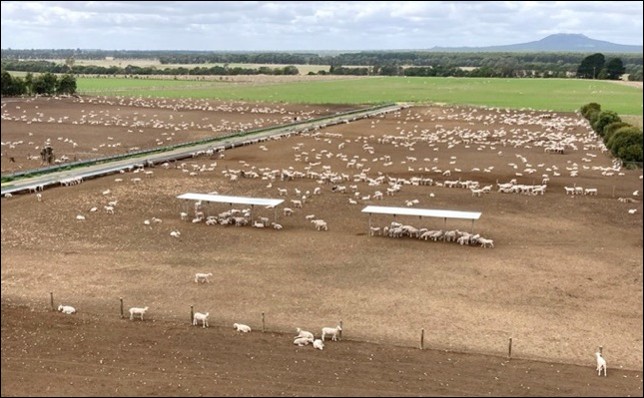
This includes pre-weaning, but from a lamb finishing perspective the first few days on feed are important to overall success when lambs are in the finishing system.
How your lambs start when they first go on feed and into the finishing system is a key part of setting them up for success and getting them to target weights as soon as possible. Generally speaking, the shorter the feeding period, the better.
In the context of a planned 7-week finishing period, lambs cannot afford a slow week. One bad week in a 7-week finishing period is equivalent to 15% of their time on feed. One bad week would be like having to run 115 meters in a 100-metre race – impossible to win under those constraints. We rarely see lambs put on 15 kg of gain for the finishing period if they haven’t gained 2.5kg in the first 3 weeks (including induction to grain). They need the early gain to achieve the overall longer-term target.
Key things to get right to optimise this early growth
The adaptation phase for getting lambs on a high grain ration needs to be meticulous.
The feedlot infrastructure (and ration) needs to give every lamb the best chance of success.
Lambs should be monitored and weighed regularly to identify and address issues early, monitor performance and provide better information for budgeting.
A smooth adaptation to the finishing diet starts with some learned behaviour. ‘Imprint’ feeding or giving lambs access to grain pre-weaning is a critical success point to later grain feeding. Having the lambs exposed to grain while their dam can teach them what it is and to actively seek it out makes getting weaned lambs started on grain much easier. While for many people the season has been kind through to weaning, don’t just view grain feeding ewes and lambs pre-weaning as a supplementary feed, it’s an education that will stick with the lambs for later in life. As few as 3 pre-weaning feeds of grain has been shown to increase the speed with which lambs will take to a grain-based ration in later life. The quicker we can get lambs eating their grain-based diet, the better. The last thing we need when starting lambs on grain is to have half the mob hanging back and not eating from day one. Lambs that hang back in the introductory phase are often the ones that will come in and gorge themselves later in the feeding period and suffer from acidosis. Every lamb eating from the start of the feeding period is the goal; exposure to grain feeding pre-weaning will help achieve it.
Don’t rush the introduction of a high percentage grain ration to lambs. It takes time for the rumen bacteria that are the specialists in grain digestion to dominate the bacterial population. If too much grain is being consumed before the lambs have a healthy population of specialist bacteria to break down the grain, the grain will ferment, the pH will drop and the lambs can end up with clinical or subclinical acidosis. It’s worth noting that acidosis might be compromising animal performance well before we see symptoms such as scouring and lameness in lambs. Introducing the high grain diet carefully, with small daily increases, while ensuring every lamb is eating their daily allowance is critical to accelerating performance once lambs get to ad lib feeding levels, which will be roughly 1 kg/hd/day. A bad experience can set them back through a rumen imbalance, or they may develop an aversion to the diet which limits later intake.
Be aware of the obvious – during the induction phase, lambs will not be getting the energy they need from grain alone to fulfil their growth potential. We need to minimise this energy deficit. If feeding roughage during the induction phase as opposed to grazing on pasture, use the best quality hay that you have and save the lower quality roughage for when the lambs are on ad lib grain and getting all the energy they need from concentrates. If introducing the grain induction while lambs are still on pasture, make sure that all lambs are coming to the feed trail – even if that means feeding lambs in corner of the paddock and holding them on the trail until all lambs are picking at the grain.
Adaptation to the feedlot environment
If you are finishing lambs on self-feeders, it would be preferable that lambs have some access to similar feeders before getting to the feedlot. This could happen during the imprint feeding or adaptation phase, with a common strategy of running the feed trail up to the feeder and scattering some grain in the feeder trough. Similarly with water, if lambs have only had access to dams but will have troughed water during finishing, ensure they are drinking from troughs before induction to the feedlot.
The ‘standard’ recommendation for pen space is 1 lamb/5m2. Whilst some shed facilities will push well beyond this (with extra emphasis placed on trough space for water and feed), for an outdoor facility it makes sense to stick with the standard values. When we have looked at lamb performance at higher densities such as 3m2 per lamb we see similar average growth rates, However, variation in lamb performance increases where high performing lambs continue to grow well, but lambs with lower growth rates have poorer performance and the number of shy feeders goes up.
Do your sums
Costing out your finishing enterprise is essential. Margins are often slim and doing your sums and refining the figures as each group of lambs goes through your system is important. Every group of lambs you finish maximises the chance that your next group of lambs will give you a profitable outcome. Capturing data from each group of lambs: what were the growth rates in first, middle or last 2 weeks on feed, how much did they eat, length of time on feed to target weights, etc., will let you refine your budgets and make you much better at estimating future returns.
Many people finishing lambs will be familiar with the lamb feedlot calculator, a great tool available through NSW Agriculture. For those that haven’t used it, and for those that might just want a refresher, Geoff Duddy has a comprehensive webinar, Does it make cents to finish lambs?, on the Feeding Livestock website. (Or just go to the Agriculture Victoria feeding livestock website and put ‘lambs’ in the search and it will come up).
No serious finishing business does their feed costing on a $/tonne basis alone. Most lamb finishers will be costing out ingredients and rations on a cents/megajoule (MJ) and/or a cents/unit of protein basis. This is a far better figure to help build the most cost-effective rations that achieve the performance you need.
However, cents/MJ doesn’t tell the whole story.
We could have:
- a home mixed ration1 that is 11.7 MJ ME/kg DM and costs $350/t (using 60% barley at $340/t, 17% lupins at $410/t, 21% cereal hay at $200/t, 1% salt and 1% limestone), or
- we could have a commercially available finisher pellet that is 11.5 MJ ME/kg DM and costs $550/tonne.
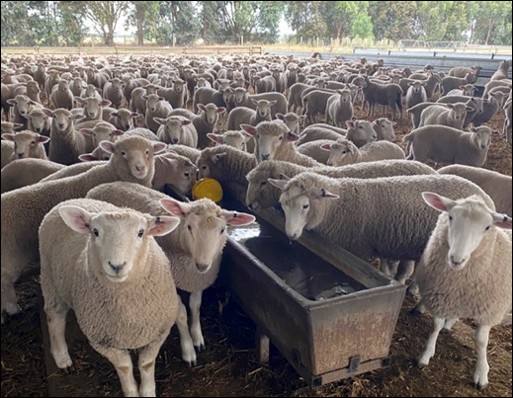 If we assume that both rations have a similar/adequate crude protein, and are 90% dry matter (DM), the pellet ration comes out at 5 cents/MJ and the home mixed ration at 3 cents/MJ.
That’s interesting but to fully assess the two ration options, it’s worth going a step further and costing rations on a cost per unit of gain basis. This is harder, as you will need to have a feel for what growth rates you could expect from your lambs on the different rations. The need for realistic values is a great case for why it’s important to monitor and weigh your lambs.
The overall cost of feed per unit of liveweight gain will be impacted by the amount of feed the lambs eat (feed conversion), growth rates and the cost of the ration. Higher growth rates with the same ration cost would reduce the cost of production as would a lower ration cost with the same growth rates.
Feed conversion is generally an unknown, unless you have been specifically trying to monitor it. It is common to use a conversion ratio for lambs of 6:1 (i.e. 6 kg feed to produce 1 kg of liveweight). But this can vary widely due to the background and genetics of the lambs as well as the ration. The feed conversion for the pelleted ration may be better than from the home mixed grain ration which, if so, will likely be due to the inclusion of an ionophore to control coccidiosis, which has the added advantage of improving feed efficiency. Whilst this is a large topic on its own, literature would suggest that ionophores have the potential to improve efficiency by 5 to 10% for ruminants on a high grain diet. The most common ionophore used in lamb pellets is Bovatec™, but not all pellets will contain it.
If we assumed a feed conversion ratio of 6.5:1 for the home mixed ration and a growth rate of 300 g/hd/day, the feed cost per kg of live weight gain comes out at $1.37.
If the pelleted ration had a conversion ratio of 5.5:1 and a growth rate of 400 g/hd/day – the feed cost comes out at $1.36 per kg liveweight. So for this scenario, a growth rate greater than 400 g/hd/day would tip the balance in favour of pellets while a growth rate greater than 300 g/hd/day would favour the home mixed ration.
This isn’t a competition between pellets versus home mixed rations as both can lead to good results, but the example illustrates the importance of understanding your costs (of which rations are a significant portion) and understanding what growth rates your lambs need to achieve to deliver the most profitable outcomes.
Setting your lambs up for success through meticulous adaptation to the finishing diet, meeting all of their requirements for space and social interactions while in the feedlot and then monitoring financial and lamb performance are key steps to successful longer term lamb finishing.
1 If you are using a home mixed ration, the ‘Ration builder’ spreadsheet on the sheep ‘tools’ tab of the Feeding Livestock website is a good resource to check the cost and expected energy and protein levels of your rations.