Joining ewe lambs – an opportunity?
Alison Desmond, Agriculture Victoria
As some producers turn their thoughts to rebuilding their flocks, the question is: what are the options for my system and how do I do it?
One of those options may be joining ewe lambs, which can increase profitability and lifetime reproductive performance. Having a younger flock structure can also set you up for a quicker and stronger recovery once conditions improve.
However, before you go down this path, ensure you have the required discipline, attention to detail and commitment to nutrition and management. For some enterprises, joining ewe lambs may not be the best fit, especially if there’s still room to improve the performance of older or maiden ewes.
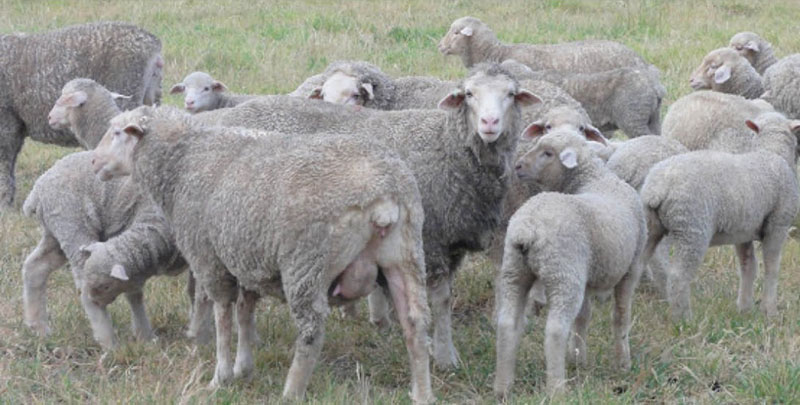
Why consider joining ewe lambs?
- Faster flock recovery: Younger ewes can help rebuild numbers more quickly.
- Improved lifetime productivity: Early joining can lead to more lambs over a ewe’s lifetime.
- Genetic gains: Selecting the right rams can accelerate progress in key traits.
However, reproductive performance in ewe lambs is typically lower and more variable than in mature ewes. Success depends on getting the genetics, nutrition and management right.
Genetics matter
The genetic background of the ewe lambs will contribute to success, as it will interact with the nutrition provided – that is, the right mix of traits can improve the response to nutrition.
Selecting rams with high post-weaning weight (PWT) ASBV can improve early growth, helping their daughters reach joining weight sooner. Additionally, rams with higher post-weaning fat (PFat) produce daughters that show enhanced responses to both nutrition and growth. While weaning rate (WR) and yearling weaning rate (YWR) are genetic traits worth selecting for to improve the reproductive rates of ewe lambs, they are less heritable than traits like growth, fat and muscle. Fertility traits are very lowly heritable and hence nutrition is still king.
Timing and targets
It is important to note that ewe lambs are joined between 7 and 9 months of age, and if joining at 7 months of age, it is easy to match the timing of the mature ewes' joining cycle. But if you join at 9 months of age, you will need to ensure tighter joining and weaning to ensure you can align joining the following year to the main flock. However, to do this, you need to ensure the critical mating weight of 45 kg can be reached at joining for maternal genotypes and modern Merinos.
Nutrition is king
From weaning to joining, weight gain is crucial. Depending on weaning weight, ewe lambs need to gain 150–200 g/day to hit joining targets.
Ewe lamb weight at joining drives ovulation and conception rates. Research has shown that heavier ewe lambs will be more fertile and rear more lambs at their first joining.
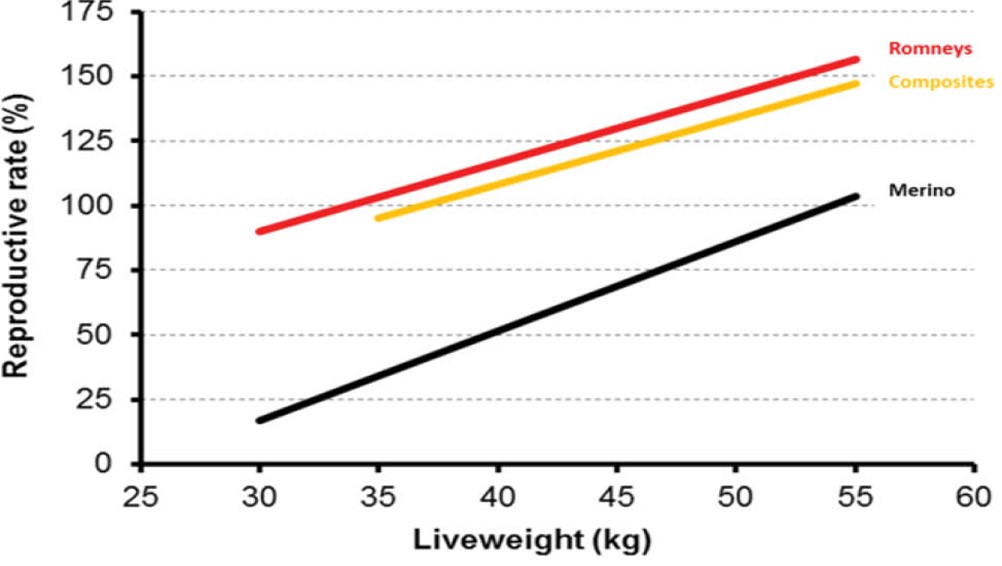
Liveweight at joining is the most important factor in achieving reproductive success in ewe lambs, however; nutrition during joining plays a part in reproductive success.
Weight change during joining
Ewe lambs have a shorter, less precocious and more fickle oestrus cycle and must be kept growing during joining.
Research undertaken by Dr Andrew Thompson and his team at Murdoch University found that improving the nutrition of Merino ewe lambs during joining significantly increases their reproductive rate, and the effects of liveweight at joining and growth rate during joining are additive. For every 100g/day increase in growth rate during joining, the reproductive rate in Merino ewe lambs increased by 20%, and most of the effect of growing faster during joining on reproductive rate was in addition to the fact that faster growing lambs are obviously heavier at the time of conception.
Growing an extra 100g/day during joining had a similar impact on reproductive rate as an extra 5kg of liveweight at the start of joining.
Figure 10 shows the impact of joining weight and weight gain during joining on subsequent scanning and reproductive rate.
Starting liveweight (kg) | Growth rate during joining | Scanning result | Reproductive rate | |||
|---|---|---|---|---|---|---|
Dry | Single | Twin | Triplet | |||
30 | 50 | 58 | 33 | 8 | 0 | 50 |
35 | 50 | 43 | 42 | 15 | 0 | 72 |
40 | 50 | 30 | 47 | 23 | 0 | 93 |
45 | 50 | 21 | 46 | 32 | 1 | 112 |
50 | 50 | 15 | 43 | 41 | 1 | 128 |
55 | 50 | 11 | 39 | 49 | 1 | 141 |
60 | 50 | 9 | 34 | 56 | 1 | 150 |
30 | 150 | 53 | 37 | 10 | 0 | 57 |
35 | 150 | 38 | 45 | 17 | 0 | 80 |
40 | 150 | 26 | 47 | 26 | 1 | 101 |
45 | 150 | 18 | 45 | 36 | 1 | 120 |
50 | 150 | 13 | 40 | 46 | 1 | 135 |
55 | 150 | 9 | 35 | 55 | 1 | 148 |
60 | 150 | 7 | 30 | 62 | 2 | 157 |
30 | 250 | 48 | 40 | 12 | 0 | 64 |
35 | 250 | 34 | 46 | 20 | 0 | 87 |
40 | 250 | 23 | 47 | 30 | 0 | 109 |
45 | 250 | 15 | 43 | 41 | 1 | 127 |
50 | 250 | 11 | 37 | 51 | 1 | 143 |
55 | 250 | 8 | 32 | 59 | 2 | 155 |
60 | 250 | 6 | 27 | 65 | 2 | 163 |
More recent research has investigated the effects of growth rate during joining on the reproductive rate for maternal ewe lambs. The table shows the impact of growth rate in maternal ewe lambs during joining and the importance of keeping your ewe lambs growing to improve reproductive rate.
For maternal ewe lambs, an extra 100g of growth/day delivers about 8% extra foetuses scanned. While the results for maternal ewe lambs are not as significant as the Merino ewe lambs, it does still highlight the importance of ewe lambs growing during the joining period. For instance, as you move down the table from a 45kg ewe lamb growing at 50g/day during joining (highlighted red) to growing at 150 g/day (highlighted amber) to growing at 250 g/day (highlighted green), the percentage of dry ewe lambs declines and the percentage that conceive twins increases.
Joining management
Management (beyond nutrition) will contribute to a good result. It is recommended to join 1 ram per 50 ewes. These rams should be experienced rams. You can get a response to more rams per ewe, but realistically you might not have enough rams to do this.
It is recommended to use teasers (vasectomised rams or treated wethers) 15 days before putting the rams in. This is because many young ewes will have their first ovulation as a silent ovulation (when they will not mate), so the opportunity to mate is limited, given they will also have a shorter oestrus (joining) than older ewes.
Common pitfalls
Those that have had poor results with joining ewe lambs have encountered problems such as:
- low conception rates
- low litter size (few twins)
- poor or small weaners
- poor recovery of ewe lambs and low conception the following year.
Final thoughts
Joining ewe lambs can be a powerful tool—but only if done right. Focus on:
- hitting target weights
- maintaining growth during joining
- selecting the right genetics
- managing rams and teaser use effectively.
Getting it right in their first breeding season sets these young ewes up for a productive and profitable lifetime.