Post-weaning management – self-replacing flocks
Rob Inglis, livestock production coordinator, Elders
While weaner management is just one component of the overall sheep husbandry and management package, we believe it is an undervalued one.
Weaner management begins at conception
The body condition score of the ewe at joining and during the first trimester of pregnancy has a profound effect on lamb birthweight and ewe milk production during lactation. Therefore it sets the foundation for weaning weight. This becomes a self-perpetuating cycle. Heavier lambs at 6 weeks enable earlier weaning, which enables more ewe recovery time, meaning better-conditioned ewes (condition score > 3.5) at subsequent joining – usually with a lower feed requirement to achieve said goal.
Weaning
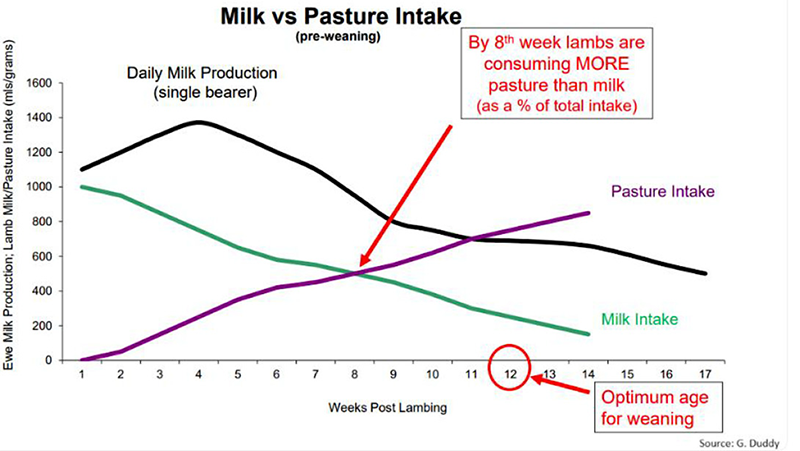
Weaning is ideally at around 12 weeks but can be earlier if pasture feed is limiting so the weaners can be managed preferentially. Figure 1 shows that by 8 weeks, lambs are eating more pasture than milk, so there is no advantage keeping them with the ewe beyond 12 weeks as they are just competing for nutrition.
Variation in weaner weight
A single lamb born of a mature ewe could be as much as 20kg heavier than a late twin born out of a maiden ewe, in a 5-week joining.
Single early born: Birth weight 5.5 kg + (300 g/day growth x 84 days) = 30 kg
Late twin born: Birth weight 3.8 kg + (150 g/day growth x 45 days*) = 11 kg
Should all these lambs be weaned concurrently?
The answer is yes, but they have very different nutritional requirements and so for best result, should be drafted into at least 2 mobs according to weight. The breakup of mobs could include:
- Heavy mob – weighing more than 22kg
- Light mob – less than 22kg
Each of these mobs will have different protein and energy requirements – the lighter the lamb the more concentrated the ration must be – and a supplementary ration tailored to suit the weight and required growth rates of each group will be necessary.
Wether lambs that are being retained have the lowest priority for much growth, once they have reached the benchmark 40% of their mature weight (or standard reference weight (SRW)). The standard reference weight is the weight of a fully grown, dry sheep in condition score 3. They can catch up later when feed is in good supply as compensatory growth can cover early growth inertia later on. For ewe and ram lambs however, an even growth trajectory during puberty is critical.
Animal health is critical for ensuring weaners get the most from the nutrition you give them. Regularly monitor worm burdens with an effective drench. To protect lambs from clostridial diseases (such as pulp kidney), 2 vaccinations need to be given by weaning and a booster follow up at 12 months of age.
Table 1: Energy (MJME) and protein requirements (crude protein) of weaners at various weights and growth requirements (Source: FeedingLivestock)
Weight and daily growth rate | Energy requirement | Approximate protein requirement CP % |
|---|---|---|
15 kg growing at 100 g/day | 6.5 | 16 |
15 kg growing at 200 g/day | 10 | 18–20 |
25 kg growing at 0 g/day | 6 | 9–12 |
25 kg growing at 100 g/day | 8 | 12–14 |
35 kg growing at 0 g/day | 6.5 | 9–11 |
35 kg growing at more than 200 g/day | 21 | 15–18 |
- Weaners should be managed and fed in mobs determined by weight.
- Energy and protein requirements vary according to liveweight.
- Weaners should receive the requisite vaccination and parasite control management.
Post-weaning management
Puberty and skeletal development
Under optimum nutritional conditions, bone growth almost doubles during puberty. Any nutritional stress during puberty will obviously stifle it. While the roles of calcium, vitamin D and phosphorous and a number of micro minerals in skeletal development are well known, perhaps what is less appreciated is the role of collagen in bone structure.
Nutritional stress during puberty compromises collagen development – the foundation upon which the inorganic bone is constructed – which limits the amount of hydroxyapatite (ostensibly calcium and phosphorous) which can be amassed. Bone is the body’s repository for calcium, the mineral of greatest importance in reproductive performance.
A diet which is balanced for both energy and protein and contains the requisite minerals and vitamins is imperative for weaner growth and development, particularly during puberty.
Lifetime reproduction
Numerous livestock research groups have produced compelling data which shows a clear correlation between weight at puberty and reproductive efficiency, yet the message doesn’t seem to be filtering down to producers. A number of Australia’s leading sheep veterinarians and consultants have compiled a program – Weaners For Profit (RIST) – to address this.
Figure 7 illustrates the desired (blue) and actual (orange) weight for age curve for ewe lambs/weaners with a 60kg standard adult reference weight.
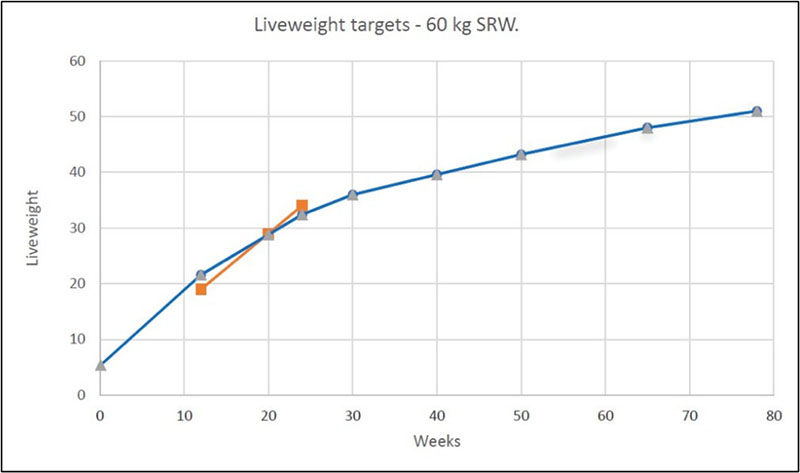
The desired growth rate from weaning (week 12) to the end of puberty (12 months) is around 0.5kg per week or circa 75g/day. This growth rate of 75g/day has also been shown to favour high survival rates post weaning.
- Aim for post-weaning growth rates of at least 75 g/day.
- Maintain an even growth trajectory and don’t rely on compensatory growth rates to catch up.
Heavier lambs at puberty raise more lambs
The table shows results from Lee et al 2009 (from AWI Winning with weaners).
The 2 flocks – C-flock and D-flock – are different Merino bloodlines, with different SRW. NRR is the net reproductive rate (the number of lambs weaned over 5 years). The weight (LWt) is the liveweight of the ewe weaners at 9 months of age or at the beginning of puberty. Merino ewes reach sexual maturity at about 9 months.
The trend is the same for both bloodlines, irrespective of SRW, that weight at puberty has a significant impact on the net reproductive rate of ewes over their reproductive life.
Table 2: Net reproductive rate for 2 Merino bloodlines at different weights at 9 months of age (Source: Lee et al 2009; from AWI Winning with weaners)
Flock | Ewes ranked on lifetime NRR (lambs weaned/ewe joined) | |||||
|---|---|---|---|---|---|---|
| Bottom 25% | Average | Top 25% | |||
| Lwt (kg) | NRR | Lwt (kg) | NRR | Lwt (kg) | NRR |
C-flock | 28.4 | 1.6 | 28.8 | 3.0 | 30.1 | 5.6 |
D-flock | 26.9 | 1.0 | 27.4 | 3.8 | 28.4 | 4.8 |
Heavier lambs at the beginning of puberty (9 months) raise more lambs in their lifetime.