Significant sheep diseases
Berwyn Squire, goat health veterinary officer, Agriculture Victoria
Victoria is fortunate to be free of most of the serious diseases that affect sheep in other parts of the world. The Victorian Significant Disease Investigation (SDI) Program aims to boost Victoria’s capacity for the early detection of such diseases in livestock and wildlife by increasing the participation of vets and subsidising the cost of SDIs.
Subsidies are available from Agriculture Victoria for the initial field investigation, including clinical and post-mortem evaluation, laboratory testing and a follow-up investigation of significant disease events.
To be considered ‘significant’, one or more of the following criteria must be met for the disease event:
- An unusual or atypical manifestation of disease, including high morbidity, mortality and/or rate of spread
- An initial investigation fails to establish a diagnosis, including when veterinary treatment does not produce the expected response
- There are findings suggesting a possible effect on trade, public health, biodiversity or the viability of a farm, industry or region, excluding events where there is a genuine suspicion of an emergency animal disease (EAD)
Where there is a genuine suspicion of an exotic or emergency animal disease, Agriculture Victoria will lead the disease investigation and cover the cost of the investigation.
In Victoria, over 37,000 property identification codes (PICs) indicate they have sheep and 193 properties have more than 10,000 head, of which 37 have more than 20,000 sheep. The larger sheep flocks are predominantly located in south-west Victoria. Laboratory results that are entered on Agriculture Victoria’s disease management systems include SDIs, disease investigations that are conducted by our animal health and welfare staff, and positive notifiable disease* results.
In the past 5 years, (1 July 2020 to 30 June 2025), there have been 2,140 sheep disease investigations on 1,497 properties. Half of these were funded as SDIs. Twenty-six properties had more than 5 disease investigations, with 10 of these having more than 5 SDIs.
Figure 1: Clinical sheep investigations (July 2020 to June 2025)
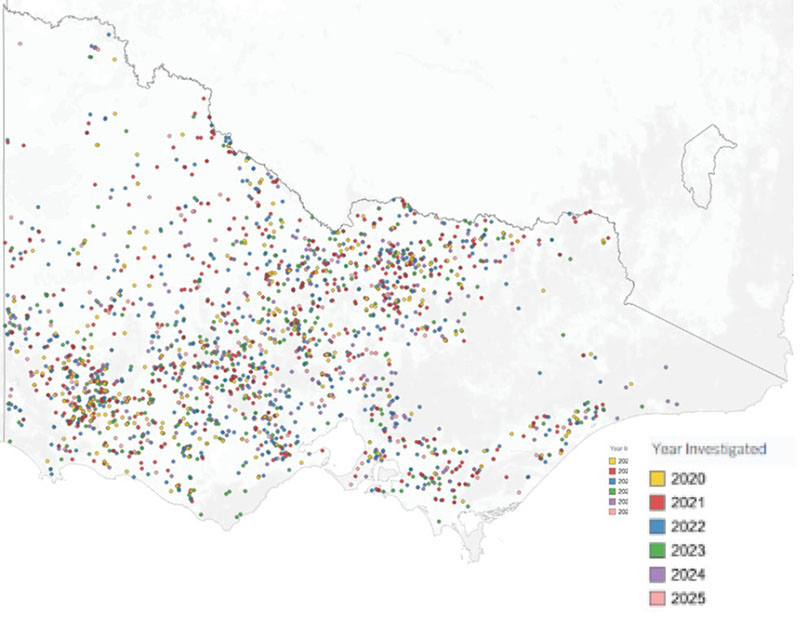
The top 10 clinical signs included abortion, ataxia/incoordination, blindness, death, diarrhoea, emaciation/cachexia (weight loss), lameness, listlessness/lethargy, pyrexia (fever) and recumbency. Diarrhoea was seen in 21% of cases, weight loss in 17% and listlessness/lethargy in 16%.
If a necropsy (postmortem) was undertaken, the predominant signs were of abomasitis (inflammation of the abomasum), abscess, anaemia, emaciation, enlarged lymph nodes, gastroenteritis, hepatic lipidosis, jaundice, oedema, pneumonia and serous atrophy (fat degeneration).
The top 10 diseases tested for included anthrax, campylobacter infection, footrot, hypocalcaemia, internal parasites, listeriosis, paratuberculosis, salmonellosis, transmissible spongiform encephalopathies (TSEs) and yersiniosis.
The top 10 diseases diagnosed included campylobacter infection, footrot, hypocalcaemia, internal parasites, listeriosis, mycoplasma, paratuberculosis, polioencephalomalacia, salmonellosis and yersiniosis.
For cases with more than 200 deaths the main causes were campylobacter infection, chlamydial infection, internal parasites, iodine deficiency, lactic acidosis (grain overload), Mannheimia haemolytica, mismothering and yersiniosis.
In 27% of cases internal parasites were a contributing, if not the main cause, of the disease presentation.
Over the past 5 years there has been an increased understanding of biosecurity measures, but there is still room for improvement in knowledge and action in preventing disease.
Notifiable diseases, EADs and diseases of note in sheep over this period:
- Akabane was excluded as the cause of abortions, dystocia and congenital malformations on 3 properties
- Anthrax was detected in sheep on one property and excluded as the cause of sudden death on another 104 properties
- Bluetongue was excluded on 4 properties
- Border disease was detected on 4 sheep properties
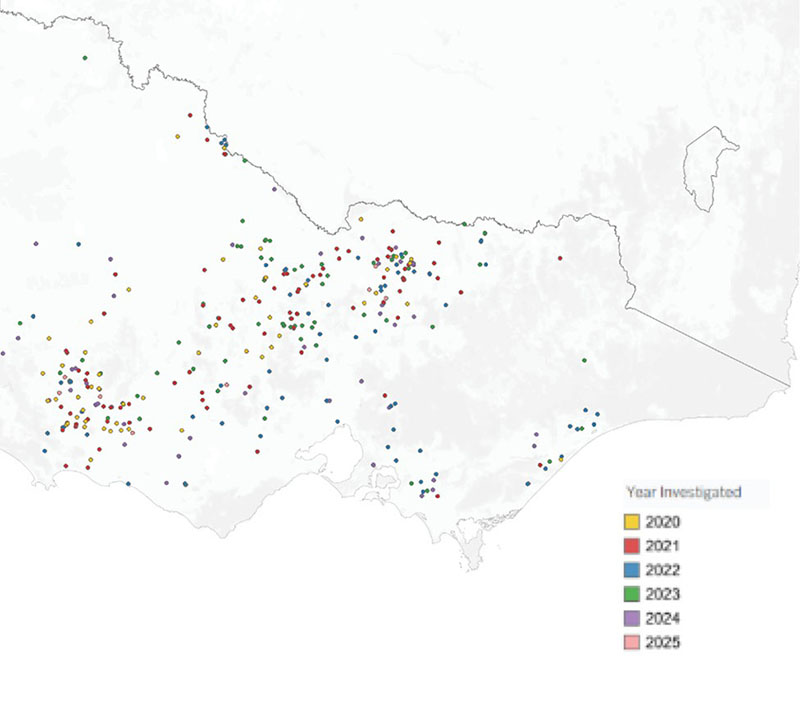
- Foot and mouth disease (FMD) was excluded on 16 sheep properties
- Footrot was detected on 96 sheep properties
- Leptospirosis was excluded on 8 properties
- Listeriosis was diagnosed on 81 properties and excluded in a further 172 sheep cases
- Ovine brucellosis was detected in 27 sheep flocks
- Paratuberculosis was detected on 104 sheep properties
- Polioencephalomalacia was detected as the cause of neurological issues on 46 sheep properties
- Q fever was excluded as the cause of abortions in sheep on 6 properties
- Rotavirus caused gastrointestinal issues in young ram lambs on a sheep property that had been burnt out the previous summer
- Salmonellosis was diagnosed as the cause of diarrhoea in 47 sheep flocks
- Toxoplasmosis was diagnosed as the cause of abortions in 4 sheep flocks
- TSEs were excluded on 260 sheep properties
- Vesicular stomatitis was excluded in 15 sheep flocks
Figure 2: EAD exclusions in sheep
Suspect a significant disease?
If you suspect a significant disease that needs investigation, contact your vet. If you suspect an exotic disease or EAD, immediately contact your local Agriculture Victoria animal health and welfare officer on 136 186 or the all-hours Emergency Animal Disease Hotline on 1800 675 888.
* Notifiable diseases are animal diseases, defined under the Livestock Disease Control Act 1994, that when suspected by owners, vets or laboratories must be reported within a defined time frame (either immediately, within 12 hours or within 7 days, depending on the disease). Read more information on these diseases.