Optimising drought recovery and performance of your perennial pastures
Lisa Warn, Lisa Warn Ag Consulting Pty Lt
 This article has been reproduced and updated from a previous article published in 2018 by the same author.
Drought conditions across Victoria have placed significant pressure on our perennial pasture systems. Producers have done an incredible job managing stock nutrition and using stock containment or sacrifice paddocks to protect pastures and soils.
Many producers continued to feed stock in containment areas well after the very late ‘break’ to help pastures recover and build a feed wedge. Other tactics like gibberellic acid or nitrogen application in winter were also used to boost pasture growth and perennial grass recovery.
However, some producers are now concerned about the amount of annual species (capeweed, erodium, silver grass (Vulpia spp.) or barley grass) in their perennial pastures. A frequently asked question is can the pasture be salvaged or does it need to be re-sown?
Manipulate or renovate?
The high capital cost of resowing pastures means that it is not a decision to rush into. Before totally writing off a degraded perennial pasture, it is important to explore low-cost opportunities to lift the performance of the pasture.
The first step is to collect some objective information about the number of perennial grasses per square metre surviving in the pasture. This will allow you to decide whether there is any point trying to manipulate the current pasture or whether it is a re-sow job.
The method I use is to walk a transect across the paddock (like you do when soil sampling) and throw out a quadrat (a metal or plastic square) every 20 to 30 paces. Count the number of perennial grasses in the quadrat and multiply by a factor to convert plants per quadrat to plants per square metre. Take at least 20 assessments for the paddock. (MLA has recently produced a Pasture Paramedic kit that includes a 30 cm x 30 cm plastic square – so if using that square, multiply number of plants in the square by 10 to convert to plants/m2. If using a 25 cm x 25 cm square, multiply by 16 to get plants/m2.)
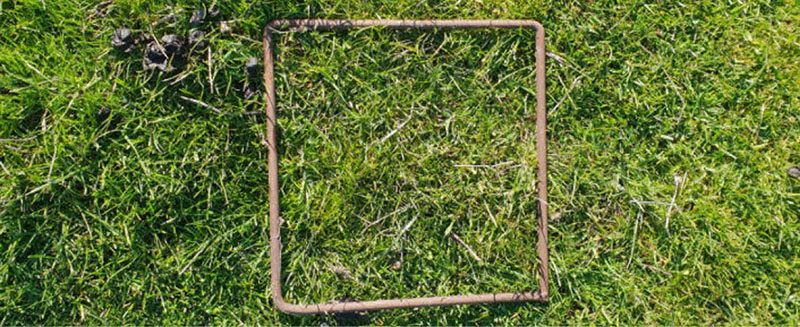
Often you will be surprised at how many desirable perennial grasses are present once you get down on your hands and knees to look closely. This is particularly true for phalaris and winter-active type fescues, which can survive hard grazing and drought better than perennial ryegrass and cocksfoot. For perennial ryegrass, even with best practice management, dry years and soil pests (cockchafers etc) will reduce plant density. Many perennial ryegrass pastures have not survived this drought.
For phalaris, fescue or cocksfoot pastures, if at least 10 plants are present per square metre, don’t write the pasture off. There is an adequate base to work with. For ryegrass pastures, due to the smaller potential plant size, you would need at least 20 plants/m2.
Grazing tactics to improve the perenniality of the pasture
There are 2 main ways you can use grazing tactics to increase dry matter production from the perennial grasses in a pasture.
First, you can try to increase size and vigour of the surviving perennial grasses. Rotational grazing (focusing on achieving appropriate length of rest during autumn and winter) will allow the plants to increase their basal/crown area, dry matter production and root growth. Phalaris tends to increase tiller size in response to rotational grazing, whereas perennial ryegrass and cocksfoot will increase the number of tillers per plant.
While phalaris is more drought tolerant than other perennial grasses, there are differences in how well cultivars cope with overgrazing and how quickly you can recover their basal cover after drought. Individual plants of the semi-winter dormant Australian and the winter-active Holdfast GT cultivar, can develop flatter, broader crowns than the more upright growing winter-active cultivars like Sirosa or Holdfast. This allows them to spread more and withstand heavy grazing better. All phalaris cultivars have their tiller buds below the soil surface which means when the plant is dormant in summer, these buds are protected from grazing. I have seen many examples where phalaris paddocks have been used as drought sacrifice paddocks and the phalaris has survived and not needed re-sowing.
Phalaris and fescue can also spread into gaps by rhizomes. Rhizomes are short stems that grow horizontally beneath the soil surface and produce new daughter plants. Rotational grazing and good soil fertility will assist this.
Getting the rest period right for the perennial grass species you are encouraging is the most important part of managing the rotation. Research shows that using ‘leaf stage’ as an indicator of when the grass is ready to graze in autumn to early spring will optimise the grass growth rates. Different species have a different maximum number of leaves per tiller that they can maintain before the oldest leaf starts to die off. Allowing a grass to regrow its maximum number of leaves per tiller after grazing will optimise photosynthesis, storage of carbohydrates, root growth and dry matter production.
For perennial ryegrass and fescue, the target is to graze at the 3-leaf stage; for phalaris and cocksfoot, the target is to graze at the 4-leaf stage. If soil moisture is not limiting, the time it takes for grasses to regrow to their target leaf stage will be driven by the temperature at the growing point. So, the rest period may need to be 30 to 40 days in autumn, 40 to 60 days in winter and 15 to 25 days in spring. For best results, the rest period should be varied during autumn-early spring in response to rate of leaf emergence and not based on fixed time intervals.
The Broadford Grazing Experiment (1994–2003) demonstrated how a rundown Sirosa phalaris pasture (which was sown in 1988) could be transformed with rotational grazing and adequate fertiliser. The pasture had only 7 plants per square metre at the start of the experiment and phalaris made up less than 10% of the pasture composition. This increased to 60% to 70% after 3 years.
The second way to increase dry matter production from perennial grasses is to increase the numbers of perennial grasses by encouraging seedling recruitment. This is a realistic option for cocksfoot or perennial ryegrass pastures, which ‘recruit’ seedlings more readily than phalaris and fescue.
This tactic involves removing stock over late spring–summer to let surviving plants run to head and drop seed, and then resting the paddock after the autumn break to allow the seedlings to establish. This is the mechanism by which old Victorian type perennial ryegrass pastures can recover from drought events. Early flowering cultivars (such as Victorian) have a chance to drop some seed if the season cuts out early, so even if the plant dies, new seedlings can establish the following year.
The net result of having either larger or more numerous perennial plants per square metre is to occupy more space in the pasture, which will reduce the proportion of the pasture that is annual species and reduce bare ground over summer. Obviously, you want to keep adequate sub-clover in the pasture; aim for a spring pasture composition of 40% clover and 60% grass.
Check for nutrient constraints
Don’t overlook soil fertility as a potential factor limiting the productivity of the perennial grasses. If high-fertility loving species such as capeweed dominate the pasture, the grazing method is more likely to be holding back the perennials. If onion grass or sorrel are dominant, this can indicate phosphorus deficiency. A soil test will pinpoint any macro nutrient deficiencies or pH/aluminium issues. Dominance of silver grass can be linked to nitrogen deficiency, so make sure the clover growth and nitrogen fixation is not being limited by a trace element deficiency like molybdenum. A clover leaf analysis can indicate if trace elements are deficient.
Herbicide manipulation
Selective herbicides can be a quick, short-term option to reduce broadleaf or annual grass weed content in a pasture but unless the conditions that favour the weeds are changed they will eventually come back. Broadleaf weeds, like capeweed, have a bank of hard seed that can remain viable for up to 7 years, so capeweed will come back each autumn if there is bare ground and inadequate competition. Spray-topping (with a low rate of glyphosate or gramoxone), to reduce seed-set of barley grass, is an option after seed head emergence but before it dries off (milky dough stage for glyphosate or dough stage for paraquat).
Value of new cultivars
Even if there are enough perennials surviving in the paddock to have a go with pasture manipulation, newer perennial grass or clover cultivars may offer some advantages over the old cultivars you have in your paddocks.
For example, the winter-active cultivars of phalaris produce around 50% to 100% more winter feed than Australian and Uneta phalaris. Once again, because of the capital costs of establishing pastures, you must be confident you are going to achieve a significant lift in stocking rate to make the exercise profitable.
If there are still opportunities to improve the performance of your current pasture, exhaust these options first. The winter growth of old Australian phalaris pastures can be lifted by using gibberellic acid in winter. If old cultivars have not performed well or survived on your farm, don’t expect new cultivars to do any better if there is an underlying issue with soil fertility or grazing management. Review which perennial grass species are best suited to your soil types and climate.
Spring pasture assessments
As well as being the time for soil and leaf testing, spring is also a good time for auditing pasture species composition and perennial grass density (plants/m2) in paddocks.
A comparison of the pasture data with stocking rate records for the paddocks will allow you to identify paddocks that are letting you down, and to prioritise action and expenditure. Analysis of these objective data from the paddocks will help you to make decisions about where to get the best return per dollar invested.
At a glance
- Resowing pastures has a high capital cost – there may be opportunities to improve degraded perennial pastures at a lower cost
- If you find 10 perennial plants per m2 - manipulate, don’t renovate.
- The latest cultivars may be more productive but have you optimised the productivity of the cultivars you have?
- The Pasture Trial Network is developed and hosted by Meat & Livestock Australia. It compiles the data from independent trial sites of a range of pasture varieties and can be used to compare the performance (seasonal and total dry matter production) of tested varieties of legumes and grasses.
So, if you intend to sow new pastures, have a look at the performance at localities relevant to your environment.