Pastures are growing but is your water storage full?
Kerri Goschnick, Agriculture Victoria, Alexandra
Pasture growth rates have been strong in many areas, but soil profiles are drying quickly and in some areas water storages are not full.
So unless you have a reliable water supply, now is a good time to assess your water requirements and put plans in place to ensure you don’t run out unexpectedly.
How much water do I currently have available to continue my business?
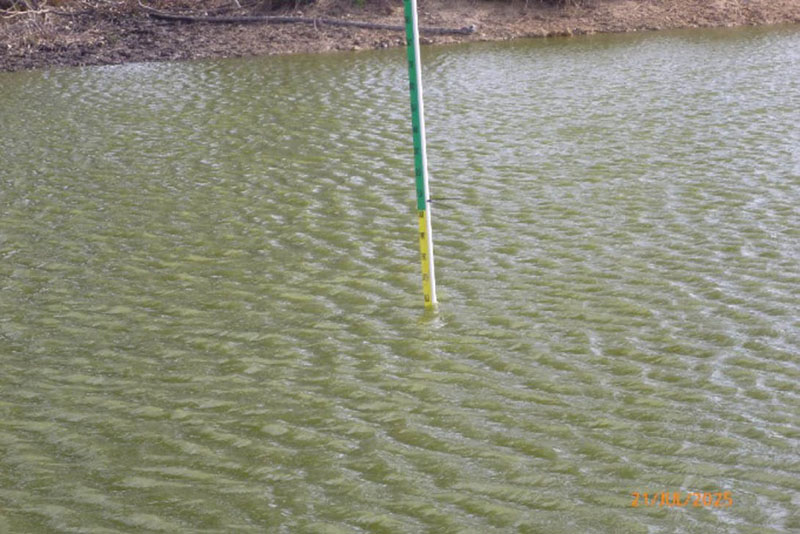
Do a stocktake of what you have. This will give you a ‘right now’ picture of your situation and allow you to plan for the near future. There is a farm water calculator on the Agriculture Victoria website to help work out your storage capacity and water use. Using a painted pole (red, yellow, green) in your dam provides a quick visual guide to check water depth and calculate volumes easily.
Consider whether your dams are suitable for the current stock type and class. Are wild animals (such as deer and kangaroos) having much impact on available water? Could you combine smaller volumes into the largest dam to help minimise evaporation and maintain water quality? This can be achieved at a relatively low cost using poly pipe and a fire pump, especially if you’ve got a trough and pipeline system.
Regularly measuring your dam will give you an idea of usage – how much stock are drinking and what you may be losing through evaporation and/or leakage. Identify which is having the greatest impact or if it is simply because there has been insufficient rainfall to produce the required run-off. Generally, rainfall needs to be greater than 20 mm per event to produce run-off and more like 60 mm when grass or crop height is greater than 50 mm. Most areas have not had these types of rain events for some time.
Leakage from dams would be evident as wet spots or green grass in a small area during the drier part of the year and can be an issue if dry dams fill quickly, with dam walls slow to re-saturate. Products are available to fix leaks, but this can be costly ($1,000 to $10,000 or more), so ensure you are aware of your soil type and the nature of the leak, and follow product instructions carefully.
Once treated, the dam would need to be fenced to exclude all stock. Some form of steps or other structure would need to be added to the inside batters so animals or people who do access the storage can get out of the water safely and not damage the treated batter or liner.
Evaporation
Wind has the biggest effect on evaporation: even in good seasons you can lose up to 0.75 m of water from open storages, which can equate to half the storage volume in most cases. When the surface area is greater, water depth is shallow (less than 1 m) and temperatures are higher over summer, water loss will be higher. Dams deeper than 3 m will have cooler water and evaporation will be reduced.
There are a variety of materials that can be used to cover the dam surface area to minimise evaporation further. Powders, oils and polymers are all affected by wind blowing the product to one side and will need to be monitored or reapplied. Floating plastic sheets, discs and balls have been used but are expensive and can trap small animals. Storage enlargement is not always an option due to soil types, contractor availability, planning requirements, time of year for earthworks and cost – which can be $10,000 or more.
Key messages
- Calculate what you have now – and plan from there.
- Don’t get complacent if your dams are full now. Continue to monitor levels throughout warmer months.
- To access the farm water calculator and other water resources, go to Farm water solutions