Wind erosion control: During the growing season
Key points
- Ground cover is the primary way to control erosion.
- Acting early with the aim of maintaining cover is the best option.
- A recent decision-support framework for farmers calculates the minimum ground cover level required at the end of the growing season, the ‘trigger cover’ to get through the next summer erosion period.
- The framework offers a 4 to 6-month lead-time of predicted ground cover during a future drought. This allows farmers time to adjust farm management to maintain cover going into summer.
Four decision trigger points to manage and control erosion
This series of decision trigger points can help land managers prepare for and mitigate wind erosion. This page discusses the first of 4 decision trigger points:
- Trigger 1: During growing season, June to September
- Trigger 2: Any time cover is less than 60%
- Trigger 3: Any time there are signs of erosion:
- Trigger 4: At sowing, to avoid sandblasting
Using the decision-making framework
Review the 4 trigger points to know if a decision needs to be made and what action to take.
Trigger 1 - During growing season (June to September)
If ground cover is:
- above the trigger level of 70%, then no additional action is required.
- below 70%, then change management to maintain cover.
Trigger 2 - Any time ground cover is less than 60%
If this is the case, destock and do not cultivate.
Trigger 3 - Any times there are signs of erosion
If you notice any visible signs of erosion, refer to Decision support for when there are signs of erosion.
Trigger 4 - During sowing time
To avoid sandblasting, if ground cover is:
- above the trigger level of 50%, then no additional action is required.
- below 50%, then sow in a north-south direction and keep standing stubble. If feasible, sow a cereal every second year
On this page we discuss the first of these trigger points - During growing season, June to September.
Trigger 1: Wind erosion prevention, June to September
Soils need sufficient ground cover to avoid wind erosion and land degradation. It needs to persist throughout the dry parts of the year and until after sowing. This applies to both grain growing and winter pasture areas.
Ground cover is highly seasonal in crops and pastures in Victoria. It peaks during the growing season, in winter or spring. It then declines through the dry season before increasing again (see Vegetation cover triggers: Victorian Wimmera, 2001 to 2025).
With good management, wind erosion does not occur every year but is more likely during droughts. Early warning of the onset of drought can help land managers take action to prevent wind erosion before ground cover is reduced to levels that increase the risk of wind erosion. These actions include reducing livestock numbers in paddocks and minimising cultivation.
Decision-support framework using June to September trigger
Australian wind erosion experts have recently developed a decision-support framework for land managers. The framework calculates the minimum cover level, the ‘trigger cover’ that is required at the end of the growing season. It also calculates the ground cover measured during previous droughts (’drought cover’, ‘DC’) which is defined as the lowest-ranked 20% (20th percentile) of monthly cover since 2001.
If the cover is above the trigger cover level, then there is sufficient ground cover to control wind erosion in the following dry season.
This framework offers a 4 to 6-month lead-time for predicting vegetation cover during a future drought, that is, the drought cover level. This allows time to adjust farm management to maintain ground cover going into the next summer.
In most years, ground cover levels are above the trigger. In the lead-up to drought, or when drought is already present, it is likely that the paddock ground cover will be below the trigger cover level, and a change in management is required.
The framework uses the concept of an ‘improvement target’. This means aiming to improve drought cover levels relative to those of the past 2 decades.
After using the framework to make early decisions about changing management, ground cover levels should be higher during future droughts compared with previous droughts.
An improvement target is used, rather than a fixed 50% target, as the drought cover is not always below 50%. In the example shown below for Yarriambiack Local Government Area (Shire), the drought cover is 55%. Also, in some situations achieving 50% is not always feasible.
Vegetation cover triggers: Victorian Wimmera, 2001 to 2025
The graph below is an example from Yarriambiack Shire where drought cover is 55% (black line). This is used to calculate the trigger cover level of 76% (red line), which provides a 4 to 6-month warning of impending drought cover levels.
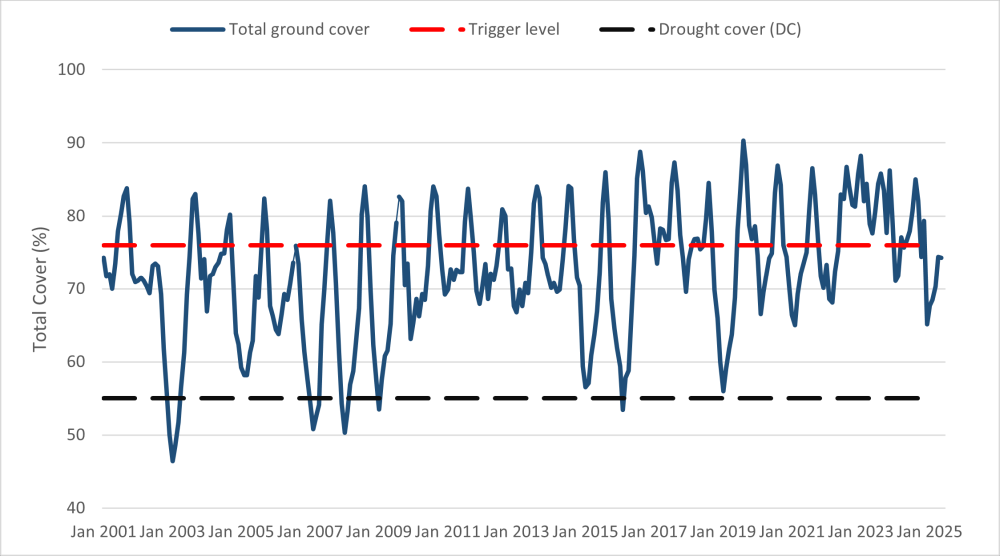
Trigger level: 76
Drought cover: 55
Total ground cover:
| Year | JAN | FEB | MAR | APR | MAY | JUN | JUL | AUG | SEP | OCT | NOV | DEC |
|---|---|---|---|---|---|---|---|---|---|---|---|---|
| 2001 | 74.3 | 71.7 | 72.0 | 70.0 | 73.5 | 77.9 | 80.3 | 82.7 | 83.8 | 79.2 | 72.1 | 70.9 |
| 2002 | 71.1 | 71.5 | 71.1 | 70.3 | 69.4 | 73.2 | 73.5 | 73.1 | 69.3 | 61.8 | 55.5 | 50.0 |
| 2003 | 46.4 | 48.6 | 51.7 | 56.6 | 61.3 | 69.2 | 74.4 | 82.3 | 83.0 | 77.6 | 71.4 | 74.1 |
| 2004 | 66.9 | 71.8 | 72.0 | 73.0 | 73.6 | 74.8 | 74.9 | 78.1 | 80.2 | 72.7 | 63.9 | 62.4 |
| 2005 | 59.2 | 58.2 | 58.2 | 61.3 | 62.9 | 71.8 | 68.8 | 76.1 | 82.4 | 78.2 | 67.6 | 66.3 |
| 2006 | 64.4 | 63.8 | 66.5 | 69.3 | 68.5 | 70.6 | 73.6 | 75.9 | 73.4 | 65.8 | 61.4 | 57.6 |
| 2007 | 54.6 | 50.8 | 52.4 | 54.1 | 65.1 | 70.0 | 76.9 | 82.1 | 77.7 | 70.7 | 61.2 | 54.3 |
| 2008 | 50.3 | 53.2 | 56.9 | 58.7 | 62.6 | 67.3 | 80.2 | 84.0 | 80.0 | 69.7 | 62.3 | 57.3 |
| 2009 | 53.5 | 57.5 | 60.8 | 61.5 | 65.2 | 74.6 | 79.1 | 82.6 | 82.0 | 70.5 | 73.5 | 63.1 |
| 2010 | 65.4 | 68.6 | 66.2 | 69.3 | 68.5 | 73.2 | 80.7 | 84.0 | 82.7 | 77.5 | 72.6 | 69.2 |
| 2011 | 69.9 | 72.7 | 71.2 | 72.6 | 72.3 | 72.3 | 79.2 | 83.7 | 79.9 | 75.0 | 69.7 | 67.9 |
| 2012 | 70.2 | 73.4 | 68.6 | 72.1 | 71.2 | 73.2 | 76.7 | 80.9 | 80.0 | 72.7 | 72.8 | 67.6 |
| 2013 | 66.8 | 69.9 | 67.6 | 70.8 | 69.4 | 75.0 | 81.7 | 84.0 | 82.5 | 74.3 | 73.4 | 71.8 |
| 2014 | 70.1 | 70.8 | 69.6 | 69.9 | 74.1 | 78.3 | 84.1 | 83.8 | 76.9 | 71.5 | 70.4 | 59.4 |
| 2015 | 56.5 | 57.1 | 60.9 | 63.7 | 66.9 | 72.2 | 81.8 | 86.0 | 79.6 | 68.6 | 64.6 | 61.9 |
| 2016 | 59.4 | 53.4 | 57.8 | 58.8 | 65.9 | 74.5 | 85.1 | 88.8 | 86.1 | 80.4 | 81.3 | 79.8 |
| 2017 | 76.5 | 73.5 | 78.3 | 78.1 | 76.7 | 76.8 | 84.6 | 87.3 | 83.5 | 77.4 | 74.3 | 69.6 |
| 2018 | 74.0 | 75.9 | 76.8 | 76.9 | 75.4 | 75.9 | 79.6 | 84.5 | 77.8 | 69.8 | 66.0 | 60.0 |
| 2019 | 56.0 | 59.0 | 61.8 | 63.7 | 68.8 | 78.1 | 83.4 | 90.3 | 87.0 | 78.7 | 76.8 | 78.6 |
| 2020 | 74.6 | 66.5 | 69.5 | 71.7 | 74.2 | 74.9 | 83.2 | 86.9 | 84.2 | 76.0 | 74.4 | 70.3 |
| 2021 | 66.4 | 65.0 | 69.3 | 72.1 | 73.4 | 75.0 | 80.8 | 86.5 | 82.9 | 76.5 | 71.7 | 70.1 |
| 2022 | 73.3 | 68.6 | 68.1 | 72.4 | 75.2 | 82.9 | 82.3 | 86.7 | 84.0 | 81.5 | 81.3 | 85.7 |
| 2023 | 88.2 | 82.0 | 84.4 | 78.9 | 77.6 | 80.4 | 84.4 | 85.8 | 83.5 | 77.7 | 86.2 | 79.6 |
| 2024 | 71.1 | 71.8 | 77.1 | 75.7 | 76.6 | 77.9 | 80.6 | 85.0 | 82.1 | 74.4 | 79.3 | 65.1 |
| 2025 | 67.7 | 68.5 | 70.3 | 74.4 | 74.3 | 80.3 | 81.9 | 81.9 | 85.5 | 79.0 | 72.0 |
Further reading
Leys, JF, McDonald, SE, Murphy, SR, Turnbull, GL, and Harden, S (2026) Land degradation decision trigger points to minimise soil erosion in rangelands. The Rangeland Journal. (Submitted).
Leys, JF, McDonald, SE, and Turnbull, GL (2025) Predicting drought using remotely sensed vegetation cover. In 'XII International Rangeland Congress.' (Eds. SE McDonald, R Hacker, T Pressland, J Silcock, J Reseigh and T Beutel) pp. 428-432. (XII International Rangeland Congress: Adelaide).
McDonough C and Leys J (2022) Practical tactics to improve ground cover and ensure soil preservation following successive low rainfall seasons, Ground Cover, December 2022.
McIntosh G, Leys J and Biesaga K (2006) ‘Estimating ground cover and soil aggregation for wind erosion control on cropping land’, Mallee Sustainable Farmers Inc.
Tozer P and Leys J (2013) Dust storms – what do they really cost? The Rangeland Journal 35: 131-142.
Acknowledgement
Author: Dr John Leys, DustWatch Australia Pty Ltd
Editors: Melissa Cann, Jo Cameron, Felicity Pritchard and Adam Buzza
The FBR Program is jointly funded through the Australian Government’s Future Drought Fund and the Victorian Government’s Sustainability Fund.