Wind erosion control: Practical tactics for when and how to use emergency tillage
Key points
- If erosion starts, it is essential to stop erosion and prevent the eroded area from growing rapidly.
- Emergency tillage may be warranted if cover falls below 50%, which may occur after a fire or in a drought.
- Emergency tillage aims to create soil roughness with either soil clods or ridges.
- If putting in ridges or rip lines, ensure they are close together – 50 to 100 cm apart.
- Aim to till across (not with) the direction of eroding winds.
Four decision trigger points to manage and control erosion
This series of decision trigger points can help land managers prepare for and mitigate wind erosion. This page discusses the practical tactics for when and how to use emergency tillage for the third of 4 decision trigger points:
- Trigger 1: During growing season, June to September
- Trigger 2: Any time cover is less than 60%
- Trigger 3: Any time there are signs of erosion:
- Decision support for when there are visible signs of erosion
- Practical tactics for when and how to use emergency tillage
- Trigger 4: At sowing, to avoid sandblasting
Option 1 - When there are signs of erosion: do nothing
Doing nothing is the appropriate action when it is not possible to roughen the soil surface. This is primarily the most appropriate action for sandy soils when wind erosion is occurring because:
- the lighter clay particles and organic material have already blown out of the soil as dust
- the heavier, low-nutrient sand is left behind on the surface. This is ‘lag sand’ and it is protecting the fresh soil underneath, reducing further nutrient loss.
- disturbing the lag layer with cultivation brings soil (without organic matter and potentially less clay content) to the surface. This can result in further soil and nutrient loss without controlling the erosion.
Note that dust-suppressing chemicals that bind to the surface may be used in certain situations in high-value areas.
Option 2 - When there are signs of erosion: tillage, ridging or ripping
Depending on the soil type and available tillage equipment, there are 3 tillage options: full tillage, ridging and strip ripping. The aim for all options is to:
- roughen the soil surface to trap any loose soil that may be moving
- cover the surface with soil clods too large to be lifted by the wind
- protect the loose sand-sized particles between the clods.
Regardless of the method used, the area to be treated should include the entire eroding area, plus additional buffer areas. It is important to:
- work across the direction of (i.e. perpendicular to) the eroding winds
- start roughening on the upwind edge and work downwind if the landscape is flat
- roughen on the contour on sloping land, where water erosion is a risk.
Tillage considerations
Before undertaking emergency tillage for erosion control, be aware of the following:
- Tillage or ripping is not recommended on grazing land due to increased risk of erosion and weed invasion.
- On sloping land, tillage should be done on contour. The spacing depends on slope.
- Before sowing, the ridges will need to be flattened.
- The tillage should be done perpendicular to (across the direction of) eroding winds. For westerly winds this is north-south.
- For sodic soils, tillage at depth is not recommended.
Full tillage for erosion control
Full tillage should only be used when good soil clods can be produced. The aim of full tillage is to cover the surface thoroughly with large soil clods.
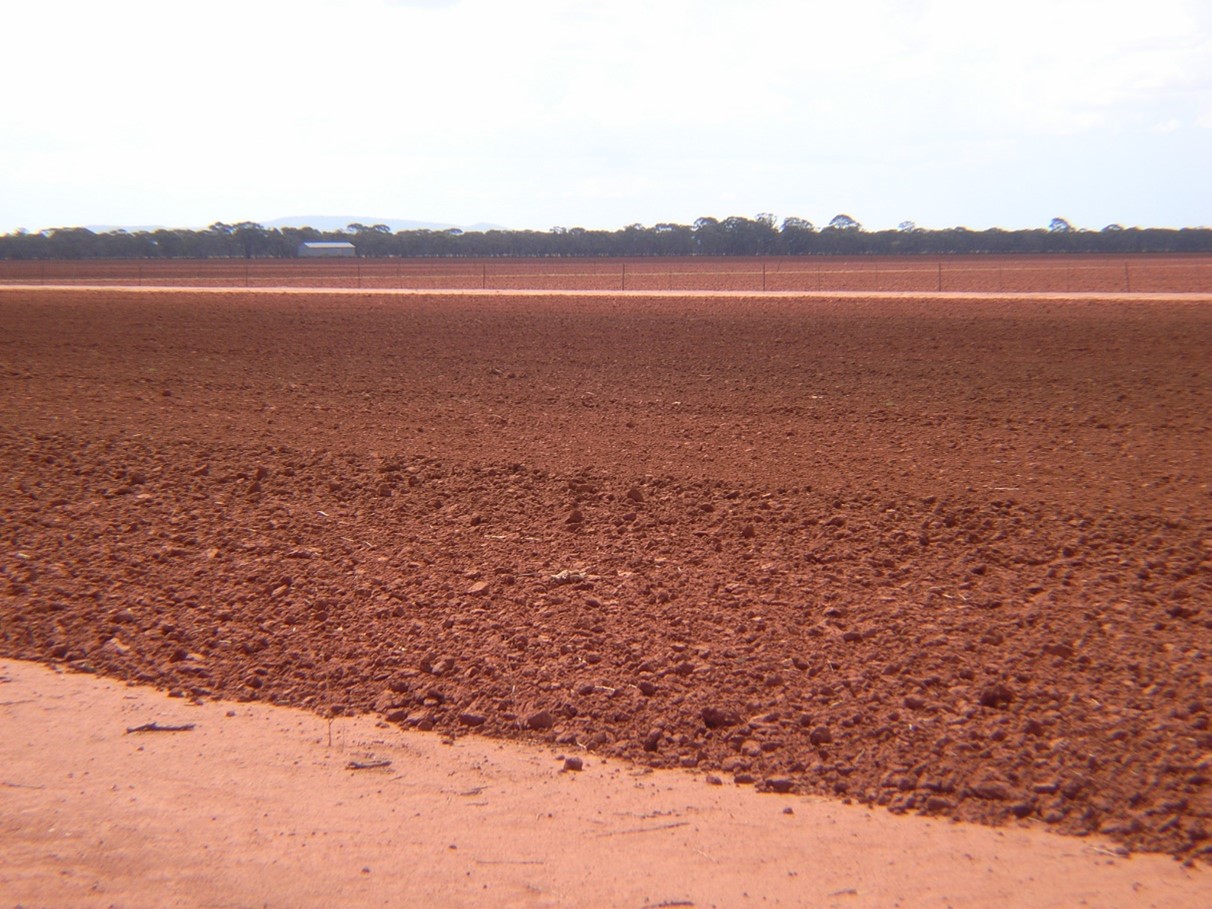
Loam and clay soils produce better clod and roughness and are better suited to tillage and ripping than sands.
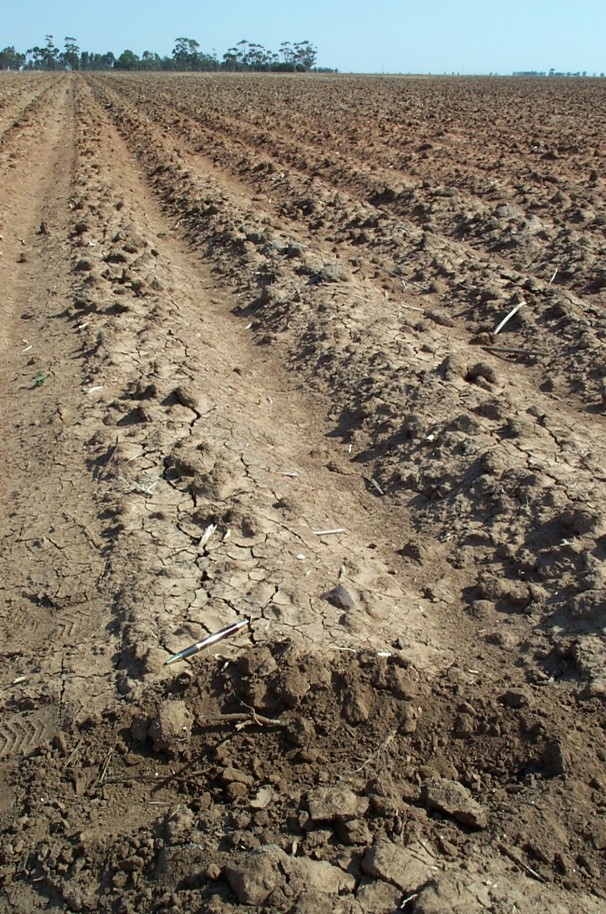
With a full cultivation of dry soil, normally the first pass will create good clods. Depending on how strong the clod is, additional dry cultivation may be ineffective. This is because it can further break down the aggregation and clod to sand-sized particles.
Which soils are not suitable for full tillage?
- Sandy soils with less than 10% clay, as they typically produce few or no clods.
- Soils that are sodic and saline at the surface, when dry cultivated, tend to form sand-sized aggregates that erode easily, and require ridging.
- Depending on the depth to sub-soil sodicity clay horizons, it may not be wise to bring the sodic clay to the surface.
- Soils with higher clay content that have been dry cultivated multiple times, pulverised with livestock or burnt can develop surfaces where the aggregation breaks down to the size of sand.
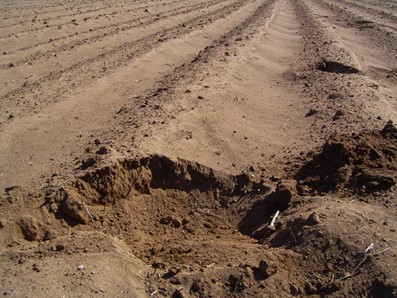
Implements for full tillage for erosion control
- Narrow points are best for clod creation.
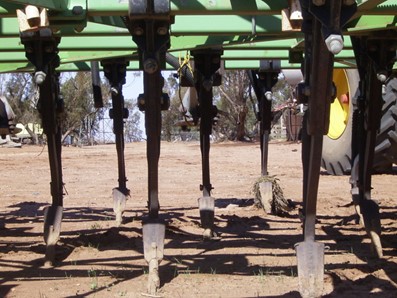
- Implements may be modified so that every second or third tyne is removed to reduce draft requirements.
- Good clods and ridges can be produced using narrow points (50 mm) at 900 mm spacing on the first row and 150 mm points at 450 mm spacing on the last 2 rows.
Ridging: when to consider for erosion control
Ridging is the best option for sandy soils or those soils where tillage does not create enough clod. Enough clod means more than 50% of the soil surface is covered in clods.
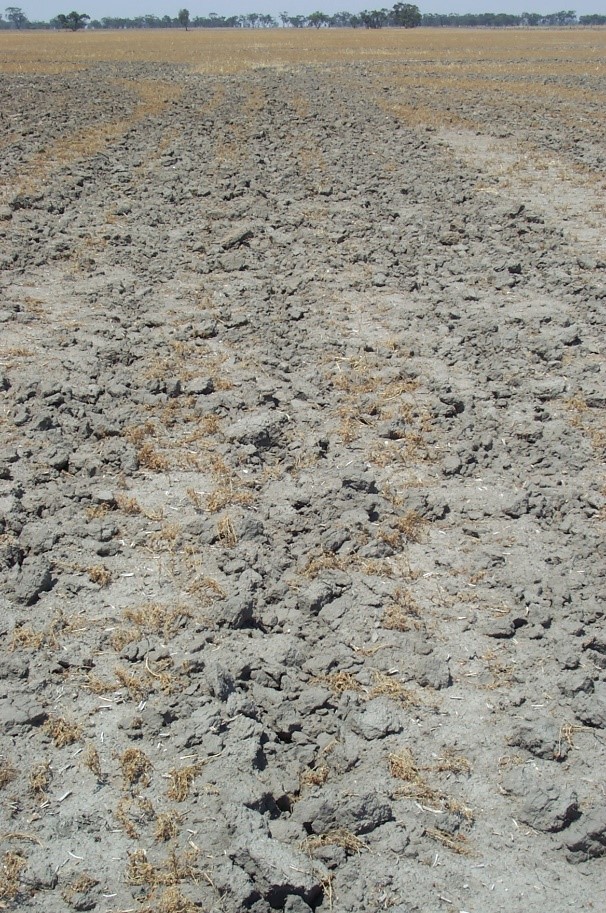
The aim is to create ridges about 50 - 100 cm apart and 20 - 30 cm high with more than 50% clods (see full cultivation of a paddock which has created adequate clod, crusting and ridging). Clod cover improves the effectiveness of ridging.
- Creating ridges without clods will not achieve long-term erosion control (see a fully cultivated soil lacking adequate clods to stop erosion). It will, however, slow the erosion but will eventually need to be re-ridged.
- In high-value areas with ridges without clods, dust-suppressing chemicals that bind to the surface can be sprayed. This extends the life of the ridges and controls erosion.
Implements for ridging for erosion control
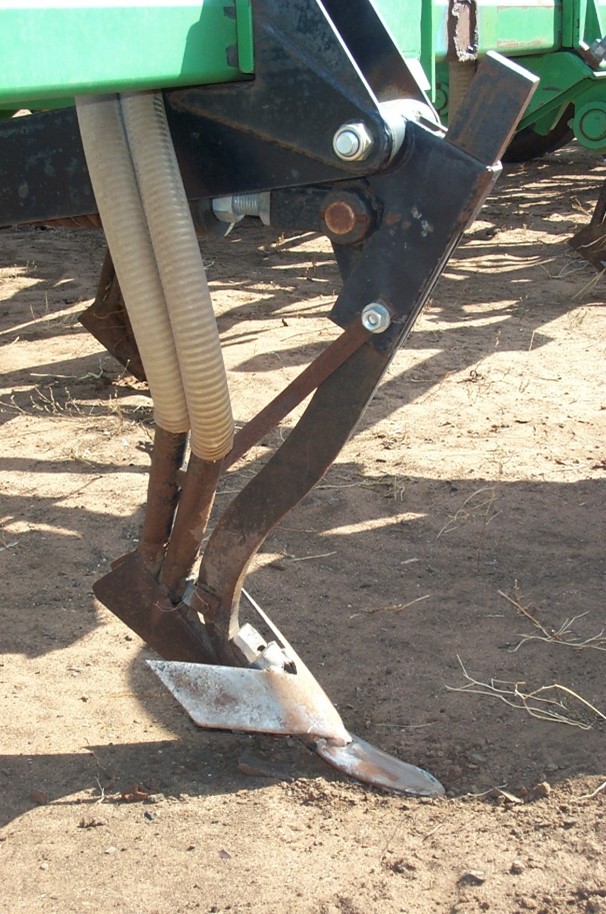
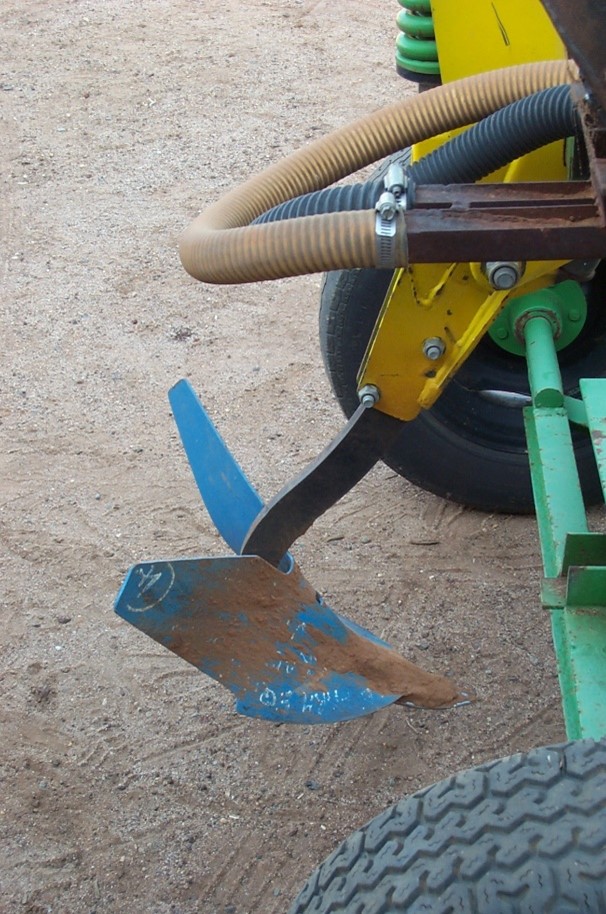
Implements with modified points are required to create ridges.
Chisel points with sweeps
Modified chisel point with sweep to create clod and ridge.
Delver or furrowing points
Delver point for creating ridges.
Strip ripping: When to consider for erosion control
Strip ripping is the most common method but it fails most of the time if the rip lines are generally too far apart unless there is clod or vegetation in-between.
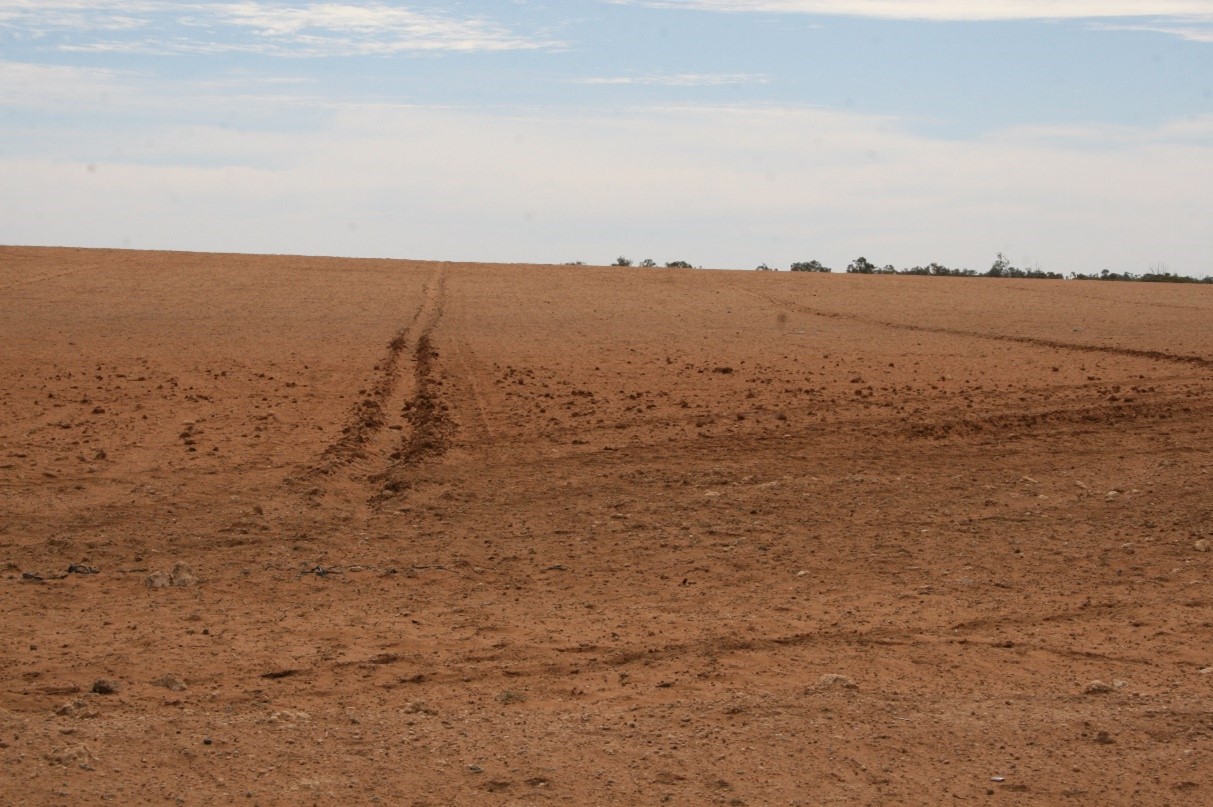
If a ‘blowout’ begins to form, it is necessary to rip the blowout to roughen it and slow erosion. A blowout is an erosion hollow more than 10 cm deep.
Tips to help make strip ripping successful
- Rip lines should be perpendicular to (90 degrees) the erosive winds. Otherwise, the soil will blow down between rip lines.
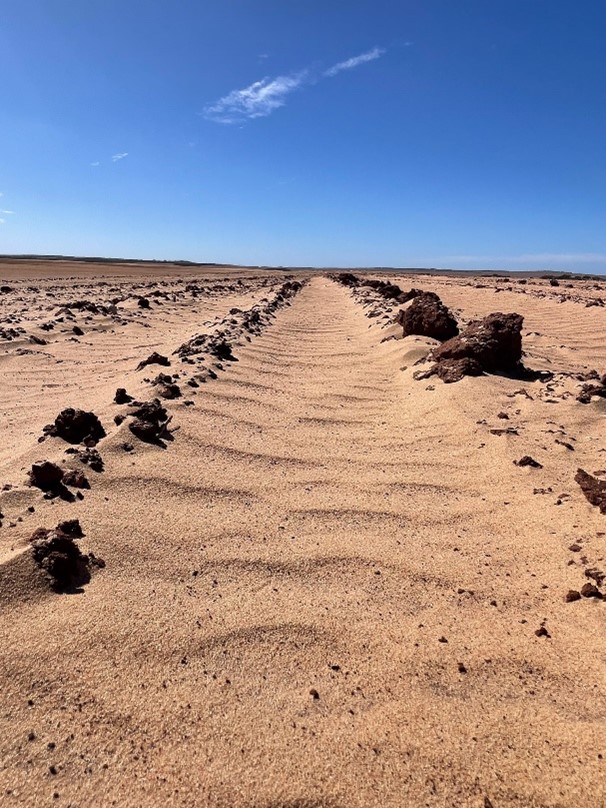
- The roughness created by the rip line must protect the area between rip lines.
- The roughness must also have the capacity to collect and store any material that blows into it e.g. the furrows catch the sand between ridges.
- Roughness slows down the wind. The deposited sand is caught amongst the clods or in the furrows between ridges (see a fully cultivated soil lacking adequate clods to stop erosion). If sand keeps blowing in, it covers the roughness or fills the furrows, flattening the surface and eroding it again.
- As a ‘rule of thumb’, roughness elements will protect soil downwind by 3 times their height. For example, roughness elements that are 20 cm high will protect about 60 cm downwind. Here, the ‘roughness elements’ are the clods and ridge, that the rip line creates.
- The advantage of ripping is that it can be repeated between the rip lines if they fill up with sand. It is best, however, if they do not fill up in the first place.
Further reading
Leys, JF, McDonald, SE, Murphy, SR, Turnbull, GL, and Harden, S (2026) Land degradation decision trigger points to minimise soil erosion in rangelands. The Rangeland Journal. (Submitted).
McDonough C and Leys J (2022) Practical tactics to improve ground cover and ensure soil preservation following successive low rainfall seasons, Ground Cover, December 2022.
McIntosh G, Leys J and Biesaga K (2006) ‘Estimating ground cover and soil aggregation for wind erosion control on cropping land’, Mallee Sustainable Farmers Inc.
Acknowledgement
Author: Dr John Leys, DustWatch Australia Pty Ltd
Editors: Melissa Cann, Jo Cameron, Felicity Pritchard and Adam Buzza
The FBR Program is jointly funded through the Australian Government’s Future Drought Fund and the Victorian Government’s Sustainability Fund.