Wind erosion control: When ground cover is low
Key points
- Ground cover is the primary way to control wind erosion of soil.
- Acting early with the aim of maintaining ground cover is the best option.
- Land managers can monitor ground cover directly in the paddock or with satellite data.
- If ground cover falls below 60%, it is best to de-stock the paddock and avoid cultivation.
- At least 50% of soil ground cover is required to control wind erosion.
Four decision trigger points to manage and control erosion
This series of decision trigger points can help land managers prepare for and mitigate wind erosion. This page discusses the second of 4 decision trigger points:
- Trigger 1: During growing season, June to September
- Trigger 2: Any time cover is less than 60%
- Trigger 3: Any time there are signs of erosion:
- Trigger 4: At sowing, to avoid sandblasting
Trigger 2: Any time ground cover is less than 60%
Ground cover of at least 50% is required to control wind erosion. Regularly monitor and review ground cover in areas of the property at highest risk of erosion to help inform decisions before erosion begins.
If ground cover falls below 60%, consider:
- destocking the paddock
- avoiding cultivation.
These actions will help maintain ground cover and prevent erosion.
Soil aggregates larger than 1 mm can help to reduce erosion. Soil aggregation occurs when fine soil particles form larger, more stable units (aggregates). Sandy soils generally have low aggregation potential as they contain less clay and organic matter, making them more vulnerable to erosion.
The risk of wind erosion is closely related to ground cover and aggregation percentages. As soil aggregation levels fall, higher levels of ground cover are needed to control erosion. Researchers have developed a wind erosion matrix of ground cover and aggregation that land managers can use to help estimate the erosion risk of a soil.
Emergency tillage may be warranted if ground cover falls below 50% (such as after a fire or during a drought).
Monitoring erosion risk on your farm
The most erodible areas of the farm are:
- the areas of sandy soils
- the elevated areas e.g. dunes, sandy rises of the paddock
- stock camps and areas close to gates.
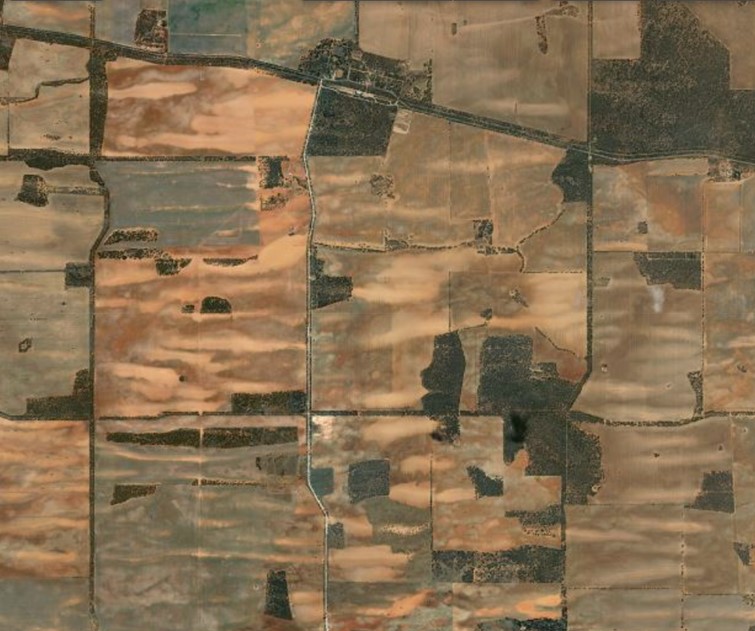
The aerial photo in northwest Mallee shows an example of erosion-prone sandhills. In this example:
- eroding areas are lighter colour
- timbered areas are dark green
- stubble pasture areas are grey
- bare soils are red.
Land managers can monitor ground cover across an area through in-paddock monitoring or satellite data.
In-paddock monitoring of ground cover
Visit Monitoring ground cover and soil degradation for a description of how to measure cover and use of photo standards.
Monitoring vegetation cover with satellite data
The free CSIRO GEOGLAMM RAPP tool provides regional vegetation cover maps. It can indicate changes between years and show trends. To use the tool, open the webpage and click ‘Continue’. The application will open, showing the latest cover data.
- For help on how to use the RAPP tool, view this RAPP User Guide video.
- General help on how to use the map viewer tools can be found in this Map Viewer Display Options video.
- How to use the workbench to turn off and on maps, change the month of the map and find locations is in this video on the Workbench on RAPP map.
Note: standard cover data in RAPP is displayed at a 500 m by 500 m resolution. It is possible to display the 30 m by 30 m data, but it can take longer to load. The main advantage of high-resolution data is that it shows changes in cover across the paddock. How to load the 30 m data is covered in the RAPP User Guide video.
Further reading
Leys, JF, McDonald, SE, Murphy, SR, Turnbull, GL, and Harden, S (2026) Land degradation decision trigger points to minimise soil erosion in rangelands. The Rangeland Journal. (Submitted).
Leys, JF, McDonald, SE, and Turnbull, GL (2025) Predicting drought using remotely sensed vegetation cover. In 'XII International Rangeland Congress.' (Eds. SE McDonald, R Hacker, T Pressland, J Silcock, J Reseigh and T Beutel) pp. 428-432. (XII International Rangeland Congress: Adelaide).
McDonough C and Leys J (2022) Practical tactics to improve ground cover and ensure soil preservation following successive low rainfall seasons, Ground Cover, December 2022.
McIntosh G, Leys J and Biesaga K (2006) ‘Estimating ground cover and soil aggregation for wind erosion control on cropping land’, Mallee Sustainable Farmers Inc.
Acknowledgements
Author: Dr John Leys, DustWatch Australia Pty Ltd
Editors: Melissa Cann, Jo Cameron, Felicity Pritchard and Adam Buzza
Proofing: Casey Tomkins
The FBR Program is jointly funded through the Australian Government’s Future Drought Fund and the Victorian Government’s Sustainability Fund.