Campylobacteriosis – how can it affect my farm at lambing?
Background
Campylobacter is an infectious bacterial agent that can lead to reproductive wastage through events such as foetal reabsorption or abortions. It has been ranked as Australia’s most common disease that causes abortions in sheep. When first introduced, it can lead to losses of up to 40% of lambs.
Symptoms can be silent, with carrier ewes (ewes that have been infected in the past) intermittently shedding the bacteria in their faeces without showing any signs of illness. Naïve ewes (ones that haven’t been exposed before, such as maiden ewes or lambs) then ingest the bacteria when eating from the ground and become infected. Infected ewes that are pregnant may abort and shed the bacteria in large amounts in their aborted material, which is a high risk for pasture contamination.
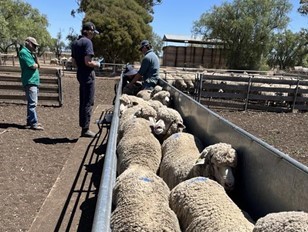 With little to no research done into the incidence of Campylobacter abortion in the Campaspe region and low vaccination uptake of ewe lambs/maiden ewes, a 3-year Enhanced Producer Demonstration site (EPDS) was started by Rochester vet Dr Frankie Collett with Agriculture Victoria, co-funded by MLA.
This demonstration aims to increase awareness of Campylobacter by collecting data on the incidence of Campylobacter infection in pregnant maiden ewes and assessing the benefits of vaccinating against Campylobacter. The results will help determine if reproductive outcomes in ewe lambs/maiden ewes in the Campaspe region can be improved.
Method
The demonstration started in late 2024 and runs for 3 lambing seasons until 2027, on 3 to 4 different farms each year.
Between 100 to 200 randomly selected ewe lambs (8 to 12 months old) and/or maiden ewes (12 to 18 months) are vaccinated prior to joining and compared to a similar number of ewes in the control/unvaccinated mob.
Ewe numbers, reproduction data, ewe condition score and paddock feed on offer during lambing will be monitored.
Lamb survival for vaccinated ewes versus unvaccinated ewes will be compared, including lambing/marking/weaning rates. Lamb postmortem assessments and paired blood samples from unvaccinated ewes will be collected to assess the presence of Campylobacter.
Year 1 update
Interest in the demonstration has been strong, with more than 16 local farmers participating in the inaugural meeting to discuss the trial outline and intended outcomes. Three farmers volunteered to participate in the first year of the demonstration. Two farms joined maiden ewes in November 2024, while the third farm joined ewe lambs in early 2025. Between 100 and 200 ewes were in each of the vaccinated and unvaccinated mobs. Merinos and first cross ewes were used in the trials.
All 3 farms undertook pregnancy scanning to identify single and twin-bearing ewes. This is not regular practice for some of these farms but is useful to inform management.
At the time of scanning, blood samples were collected from the unvaccinated mobs, with results showing no significant exposure to Campylobacter fetus subspecies fetus at that point in time on all farms. The serology samples were also tested for Campylobacter jejuni, which is less commonly a cause of abortion in ewes. The results showed that there was some background exposure, which is expected as it is a common gut commensal. However, levels were not high enough to be significant.
These findings are important because it is likely the ewes have not been exposed to Campylobacter fetus subsp. fetus, being younger ewes. The vaccinated ewes will therefore be protected from campylobacteriosis during lambing if exposed.
Two workshops discussing vaccination best practice and animal health were delivered in the first year of the demonstration and were well attended. More workshops are planned so that participants and local farmers can gain in-depth knowledge of best practice management of ewes through pregnancy and early lactation.
Outcomes
The results collected to date show that there is good opportunity to improve knowledge of campylobacteriosis, its impact and the role of Campyvax so farmers can make an informed decision about the value of Campylobacter vaccination in the Campaspe region. There is also scope to improve record-keeping and adoption of practices such as scanning, separate management of twins and singles, and performing lamb autopsies in conjunction with a local veterinarian to further investigate reasons for lamb losses.
 Partners
This demonstration is conducted with Rochester Vet Sheep producer group, Rochester Vet and co-funded by Agriculture Victoria and Meat & Livestock Australia (MLA).