Urea – an option to grow more winter feed
A case study from the Weed Managers Producer Demonstration Site (PDS) – Upper Murray
After a poor spring/summer and a late autumn break, the need to grow more feed has never been greater. Urea is a proven option for increasing pasture growth rates through winter once enough leaf area has been reached to allow the pasture to respond. For those who haven’t used urea before, this might be the year to try some at home.
We trialled urea test strips in the Upper Murray in 2024, in similar conditions to this year. There were 2 application times early (8 July) and late (19 August), 6 weeks later and 2 different application rates (75 kg urea/ha and 100 kg urea/ha). Costs and benefits were assessed for each scenario.
The urea was applied to a fertile annual ryegrass paddock, with the initial application 5 weeks after the autumn break, when soil moisture was no longer limiting pasture growth. Pasture growth and accumulation were measured for 6 weeks after each application.
Where there was no urea applied, pasture growth rates through to July and into August averaged 5 kg DM/ha, which is typical for mid-winter pasture growth (Table 1).
Early application (July)
Table 1. Pasture dry matter (DM) accumulation (kg DM/ha) and growth rates (GR) (kg DM/ha/day) in the 6 weeks (8 July – 19 August) after the early urea application
Opening DM/ha | Closing DM/ha | DM accumulation | Pasture GR | |
|---|---|---|---|---|
0 kg urea (control) | 969 | 1182 | 213 | 5 |
75 kg urea/ha | 1030 | 1723 | 693 | 17 |
100 kg urea/ha | 1027 | 2010 | 984 | 23 |
Pasture growth rates increased with increasing urea applications and were greatest at the higher urea rate (100 kg/ha). However, the higher rate did not give the best benefit:cost ratio, as discussed later.
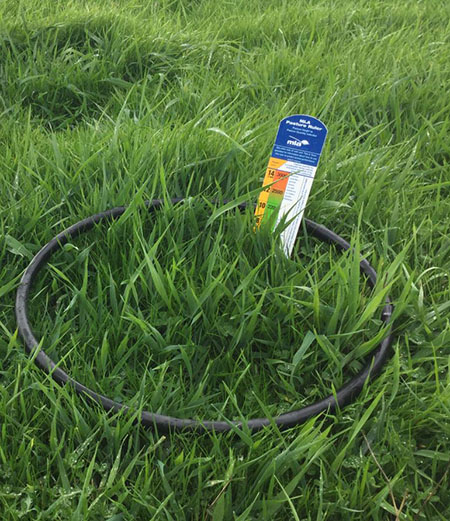 A 75kg/ha urea application lifted growth rates to 17 kg DM/ha/day and the 100 kg application lifted growth rates to 23 kg DM/ha/day (compared to 5kg DM/ha/day without urea). This showed a three- and fourfold increase in pasture growth rates, respectively.
The increase in pasture accumulation due to a single urea application made a huge difference to available feed. For context, 6 weeks after the initial observation, pasture that received no urea measured around 3 cm in height, while areas treated with 100 kg of urea/ha were approximately 10 cm.
This increase in pasture availability marked the difference between a pasture that would not maintain weaners or lactating stock and a pasture that would fully feed either stock class.
Late application (August)
Following the second urea application, pasture growth accelerated with increasing day length and temperatures (soil and ambient). Pasture that did not receive urea had a growth rate of 42 kg DM/ha.
The ‘late’ urea applications of 75 and 100 kg urea/ha doubled the existing growth rates to average 81 kg DM/ha/day and 85 kg DM/ha/day, respectively, over the 6 weeks. Interestingly there was little benefit from the higher rate of urea at this later application date.
Table 2. Pasture accumulation (kg DM/ha) and growth rates (kg DM/ha/day) in the second 6 weeks (19 August – 30 September) after the late urea application
Opening DM | Closing DM | DM accumulation | Pasture GR | |
|---|---|---|---|---|
0 kg urea (control) | 1018 | 2740 | 1722 | 42 |
75 kg urea early + 0 kg late | 1187 | 4238 | 3051 | 74 |
100 kg urea early + nil late | 1251 | 4756 | 3505 | 85 |
0 kg early + 75 kg urea late | 1025 | 4350 | 3325 | 81 |
0 kg early + 100 kg urea late | 1047 | 4546 | 3499 | 85 |
Pastures that had received the early application of urea (6 weeks prior) maintained higher growth rates, almost double those of the control during the second assessment period.
In the second 6-week phase, pastures that received an early urea application had comparable growth rates to pastures that received the late urea application. This indicates that there had been a residual benefit from the early urea applications for up to 12 weeks. Early applications had the additional benefit of lifting pasture growth rates earlier in the season, when pasture supply was most limited.
At the late (August) urea application, pastures that had received an early urea application were notably larger and more vigorous, which resulted in higher opening pasture mass. We expect that these plants had greater root mass (to match the higher DM production), which had contributed to the increase in subsequent pasture growth rates.
The heavier urea rate gave the highest pasture growth rates at the early urea application, but there was less difference between the 2 application rates for the later urea application. In this case, there was little benefit from applying a heavier rate of urea at the later application.
Benefit:cost
Urea was costed at $750/tonne spread. The cost of grown feed was calculated on an energy basis, with every kg of grown feed conservatively assumed to be 11.5 megajoules (MJ) of metabolisable energy (ME) per kg DM (Table 3).
Pastures that received the early urea applications had the greatest pasture accumulation and growth rates over the total assessment period. As a result, the earlier urea applications produced the lowest cost per megajoule of grown feed.
Table 3. Total urea application (kg/ha) and pasture accumulation (kg DM/ha) over 12 weeks (8 July – 30 Sept) with cost (cents/MJ)
kg urea applied | Total DM accumulation (kg) | Pasture GR | Cents/MJ | |
|---|---|---|---|---|
0 kg urea (control) | 0 | 1885 | 22 | |
75 kg urea early + 0 kg late | 75 | 3865 | 46 | 0.24 |
100 kg urea early + 0 late | 100 | 4415 | 53 | 0.27 |
0 kg early + 75 kg urea late | 75 | 3562 | 42 | 0.29 |
0 kg early + 100 kg urea late | 100 | 3737 | 44 | 0.37 |
The higher urea rates (for both early and late applications) produced more pasture and higher growth rates. However, it was the lower application rates that resulted in the cheapest feed by cost per unit of grown energy. In this case, higher pasture production from the higher urea rates has not offset the costs associated with higher application rates.
It is worth noting that even the highest cost of energy from feed grown using urea (0.37 cents/MJ) was considerably lower than that of bought-in alternatives – grain 3.56 cents/MJ (if $400/tonne, 12.5MJ/kg DM, 90% DM) or hay 6.23 cents/MJ (if $450/tonne, 8.5 MJ/kg DM, 85% DM) as a form of bought-in energy.
Key points:
- To maximise the likelihood of success, select a pasture/paddock that has the greatest potential for good pasture growth. Sufficient leaf area, good fertility with desirable species are all important.
- Apply urea when the pasture is growing. Soil moisture should not be limiting production. Pastures need to have some leaf area. If applying urea has the potential to double winter pasture growth, double nothing is still nothing.
- Applying urea early gave a dual benefit of increased early growth and higher residual growth rates in late winter/early spring. Early applications outperformed later applications at the same rate.
- At the early application date in midwinter, an application of 75 kg/ha delivered the cheapest feed, despite 100 kg/ha of urea having the greatest pasture growth response.
- At the later application date, when growth rates had increased due to increasing temperatures and day length, there was little benefit from 100 kg urea/ha compared to 75 kg urea/ha.
 In all cases, the energy cost from additional feed grown using urea was considerably cheaper than the cost of energy if sourcing grain or hay.
This trial is part of the Weed Managers Producer Demonstration Site funded by Meat & Livestock Australia.