African citrus psyllid
An exotic pest – not wanted in Australia
African citrus psyllid (Trioza erytreae) poses a serious threat to backyard citrus and the citrus industry.
Keeping African citrus psyllid out of the country is a national priority.
Have you seen this pest?
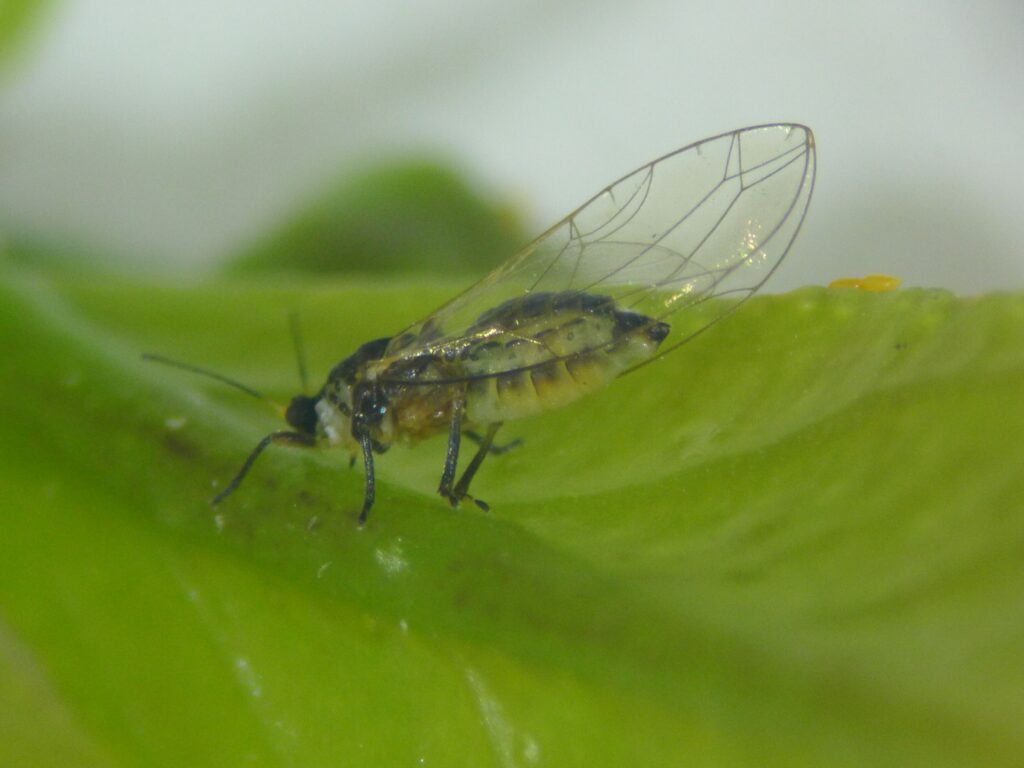
- Adults are 2 to 4 mm long with elongate clear forewings pointed at the apex (Figure 1).
- Adults and nymphs feed on young leaves and shoots.
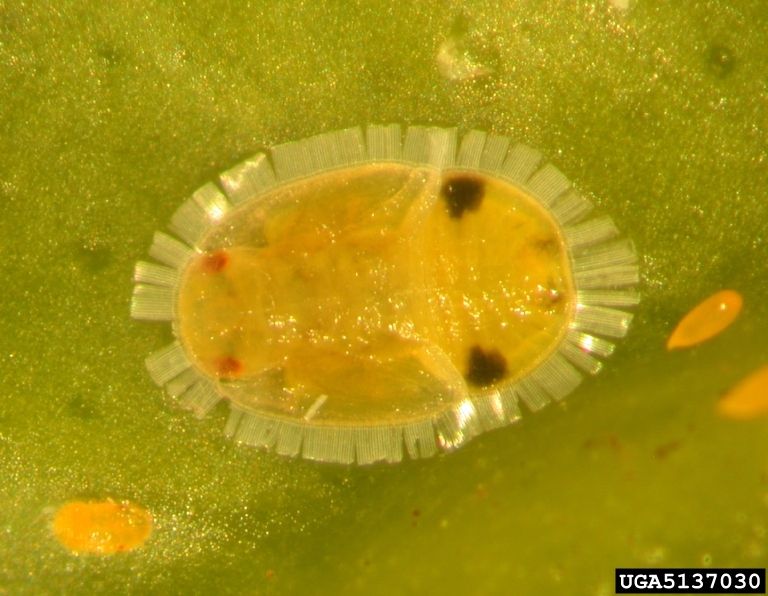
- Flat oval shaped yellow nymphs (juveniles), with a fringe of white waxy filaments, can be seen on the underside of leaves.
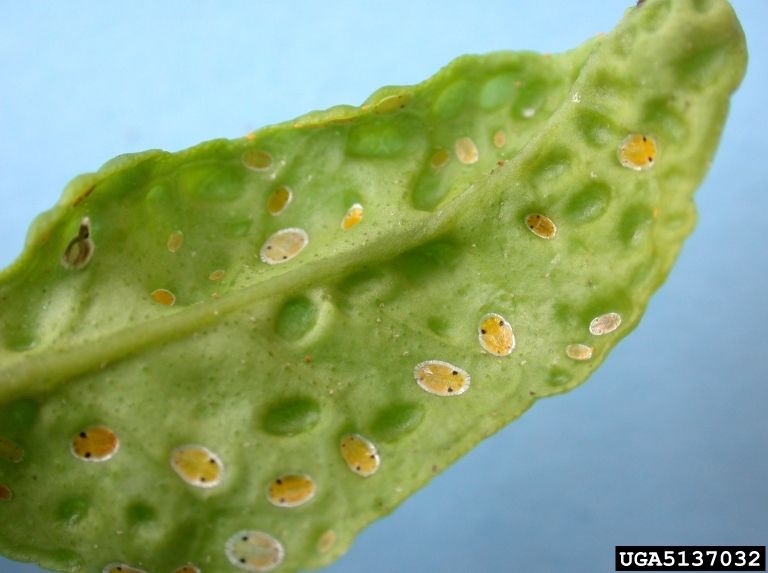
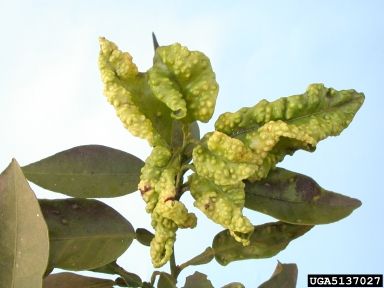
- Leaf distortion and cup-shaped galls can be seen on the leaves.
What should I do?
- Report immediately.
- Share your photos with us using the online public reporting form
- Call the Exotic Plant Pest Hotline 1800 084 881
- Please take good quality photos of the pest and/or damage to include in your report. For tips see the How to take good quality photos for a report guide.
Why is it a pest of concern?
African citrus psyllid is an exotic sap-sucking pest of wild and cultivated plants in the citrus family. Feeding by the psyllid results in discoloured, distorted leaves which become stunted and galled. Newly developed flush shoots can be killed. Heavy oviposition or nymphal activity can sometimes cause leaf drop.
African citrus psyllid can transmit both the African (Candidatus Liberibacter africanus) and Asian strains (Ca. L. asiaticus) of the bacterium that causes huanglongbing, a highly destructive citrus disease that disrupts fruit production and causes tree death.
Where to look
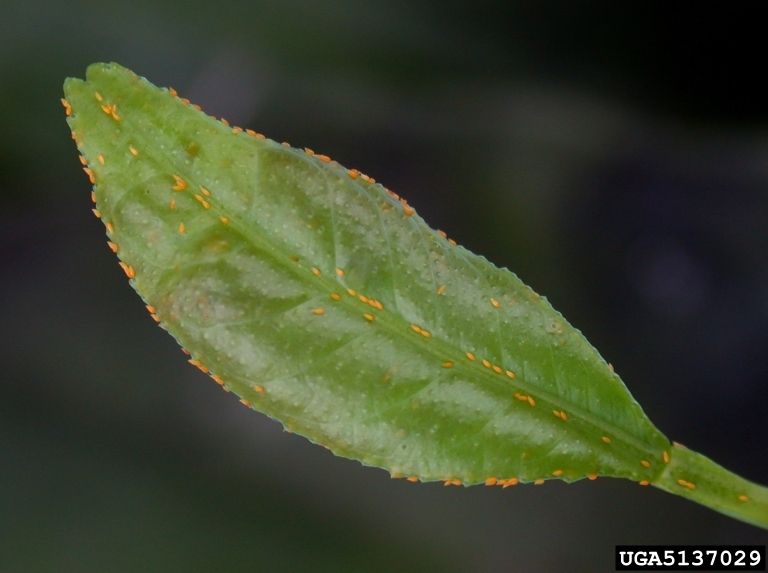
- Small orange cylindrical eggs are laid on leaf margins and midribs of young actively growing foliage (Figure 2)
- Flattened oval-shaped yellow nymphs, with a fringe of white waxy filaments, are found on the underside of young leaves (Figure 3).
- Feeding by the nymphs produces open cup-shaped galls, which on the upper side of the leaf resemble oval bulges (Figure 4).
- Feeding causes stunted, distorted and galled young leaves (Figure 5).
- Adults feed with their heads almost touching the plant surface and their bodies in the air at about a 35° angle (Figure 1).
- Feeding causes large amounts of honeydew to be excreted, which facilitates the growth of sooty mould.
Pest profile
Appearance
- Eggs: Newly laid eggs are yellow-orange, spherical and about 0.3 mm in length. Each egg is pointed at one end, which is driven through the leaf surface when laid (Figure 2).
- Nymphs (juveniles): Flat and oval-shaped, typically yellow but sometimes green or grey, with a distinct fringe of white waxy filaments. Nymphs range in size from 0.3 mm to 1.6 mm. Mature nymphs have 2 pale spots on the rear of the abdomen (Figure 3).
- Adults: Measure between 3 mm and 4 mm long, with females slightly large than males. Adults have a light brown-grey body, a black head with black antennae and clear wings that are pointed at the apex (Figure 1).
Host plants in Australia
African citrus psyllid primarily feeds and develops on plants in the family Ruteaceae, particularly Citrus species and with a significant preference for lemon and lime hosts.
Other highly attractive reproductive hosts include ornamentals such mock orange (Murraya koenigii), horsewood (Clausena anisata) and white ironwood (Vepris lanceolata).
Outside the Ruteaceae family, Ficus species (fig trees) have been reported as a possible host species but there is no evidence to suggest that nymphs develop or reproduction occurs on these species.
Life cycle
- Eggs are exclusively laid on young flush and nymphs primarily develop on tender shoots. The eggs take between 5 and 17 days to develop, with an optimal duration of 5 days at 24 ºC.
- Adults emerge from the galls and actively seek new flush shoots for feeding and laying eggs. Throughout their life females can lay up to 2,000 eggs. Females become fertile 11 to 16 days after emerging from the leaf galls.
- There are 5 nymphal stages of development. Newly laid nymphs are immobile, while mature nymphs can move freely. Nymphal development takes between 17 and 43 days, depending on temperature and host plant.
- Under optimal conditions and in the presence of flush growth, 6 to 8 generations per year can occur.
- African citrus psyllid is less heat tolerant than Asian citrus psyllid, preferring a cool and moist climate with the optimal temperature for population growth at 20 °C to 25 °C.
Distribution
- African citrus psyllid was first documented in Eritrea in 1918 and has since been confirmed in at least 19 African countries and offshore in Comoros, Saint Helena, São Tomé and Príncipe, Mauritius, Réunion and Madagascar.
- Elsewhere it has been found in the Middle East and Europe (Portugal and Spain)
Dispersal
- Weak flyers but have been known to travel up to 1.5 km a week between hosts with the assistance of prevailing winds.
- Long-range dispersal by wind has not been reported, but has been known for the Asian citrus psyllid.
- Adults, nymphs and eggs can travel long distances via movement of host budwood, grafted trees and rootstock seedlings from infected areas.
Detection and prevention measures
Agriculture Victoria does active surveillance for huanglongbing and its vectors under the National Plant Health Surveillance Program (NPHSP) and regularly responds to reports of suspect plant pests and diseases, including exclusion diagnostics on plants with symptoms.
Be vigilant when transporting plants to prevent the introduction of psyllids. Monitor imported host plants and plant material carefully to prevent the spread of the pest.
Image credits
- Figure 1: United States Department of Agriculture.
- Figures 2–5: Peter Stephen, Citrus Research International, bugwood.org
Reporting an unusual plant insect pest or disease
Report any unusual plant pest or disease immediately using our online reporting form or by calling the Exotic Plant Pest Hotline on 1800 084 881. Early reporting increases the chance of effective control and eradication.
Please take multiple good quality photos of the pests or damage to include in your report where possible, as this is essential for rapid pest and disease diagnosis and response.
Your report will be responded to by an experienced staff member, who may seek more information about the detection and explain next steps.
Report online