Sawyer beetles
An exotic pest – not wanted in Australia
Sawyer beetles, sometimes called pine sawyer beetles (Monochamus spp.), are a group of exotic longhorn beetles, and pests of conifers, that threaten forestry and amenity trees. Some species can carry and spread Bursaphelenchus nematodes, the causal agents of pine wilt disease, which can lead to rapid tree death.
Keeping sawyer beetles out of the country is a national priority.
Have you seen this pest?
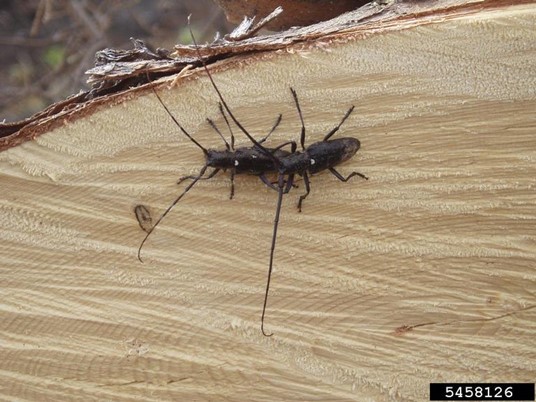
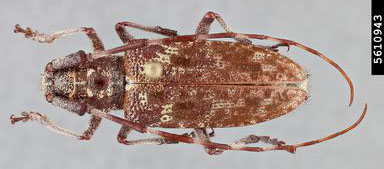
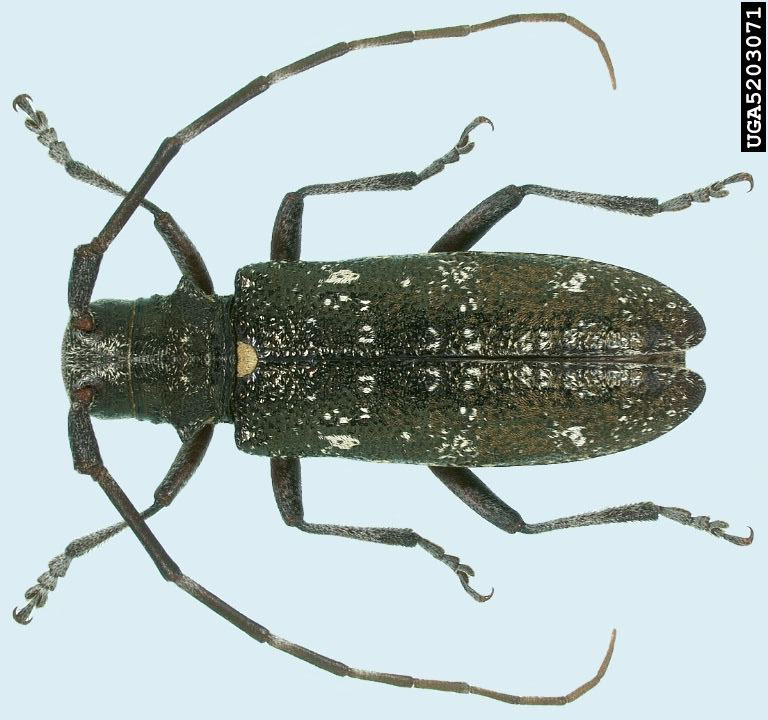
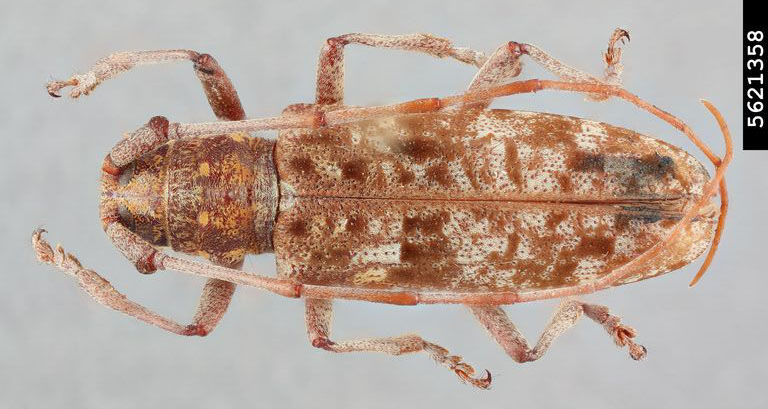
- Adults are large, up to 32 mm long, with antennae much longer than the head (Figures 1, 7–11).
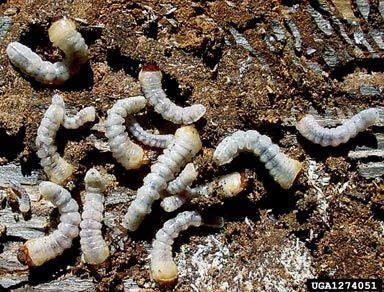
- Larvae are creamy white grubs with dark heads and strong mandibles for chewing wood, and can grow up to 50 mm long (Figure 13).
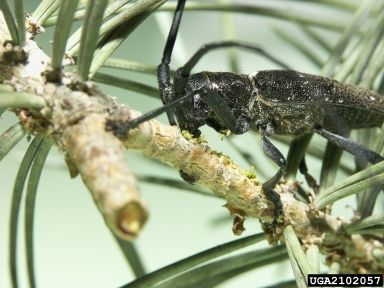
- Adults can be found chewing on twigs and needles of healthy trees in spring and early summer (Figure 5).
What should I do?
- Report it immediately.
- Share your photos with us using the online public reporting form.
- Call the Exotic Plant Pest Hotline 1800 084 881.
- Please take good-quality photos of the pest and/or damage to include in your report. For tips, see the How to take good photos for a report guide.
Why are they pests of concern?
These beetles feed on conifers (pine, spruce and fir), threatening the forestry industry and amenity trees.
Larvae can cause extensive damage to fire-affected, weakened, stressed, dying or recently felled conifers. Timber is downgraded in quality and value. Badly infested felled trees are not suitable for construction work and can only be sold as firewood.
Timber can also be attacked in warehouses, where chemical control may be necessary to protect the product.
On their own, sawyer beetles have a limited impact, as they attack already stressed or recently killed trees. However, some species carry and spread the exotic pine wood nematodes, Bursaphelenchus, which disrupt water uptake in the tree, leading to tree death within a few months.
What to look for
The following signs and symptoms may be seen in wood infested with sawyer beetles:
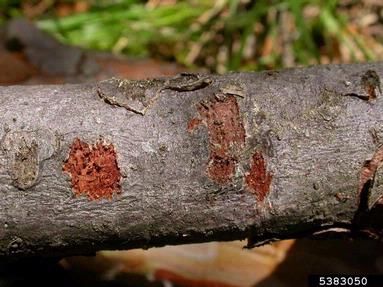
- Slits chewed by adult female for egg laying in the bark (Figure 2)
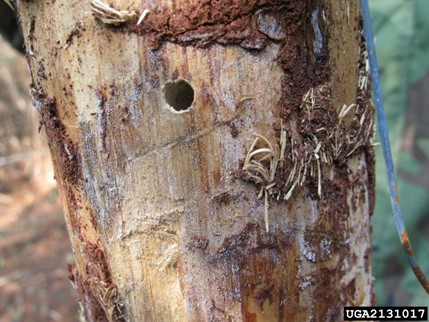
- Circular exit holes created by adults emerging (Figure 3)
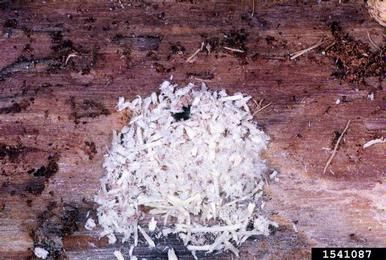
- Strawlike frass (waste expelled by feeding larvae) around an entry hole (Figure 4)
- Loud noises made as they tunnel through wood, which is how they get their common name ‘sawyers’
- Damage to shoots and twigs of living trees from adult feeding (Figure 5)
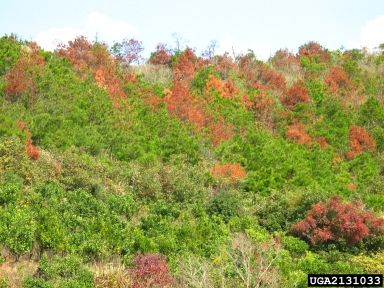
- Sudden and rapid tree death (Figure 6)
Pest profile
There are over 100 species of Monochamus species worldwide. Sawyer beetles of particular concern to Australia are:
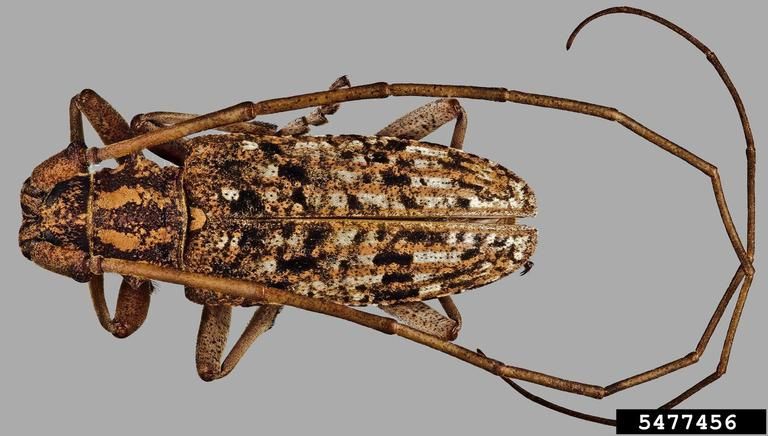
- Japanese sawyer beetle (M. alternus) – Figure 7
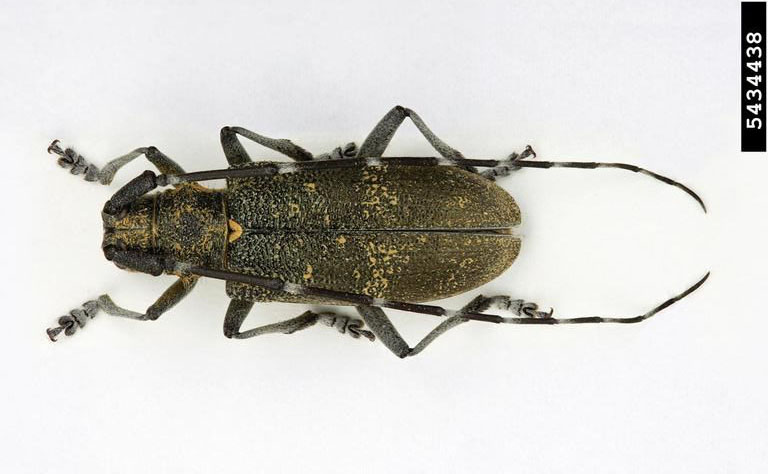
- black pine sawyer (M. galloprovincialis) – Figure 8
- obtuse sawyer (M. obtusus) – Figure 9
- white-spotted sawyer (M. scutellatus) – Figure 10
- southern pine sawyer (M. titillator) – Figure 11
Appearance
- Adults: Sawyer beetles range in size from 12 mm to 32 mm. Females are larger than the males. Colours and patterns vary between species. Like other longhorn beetles, they have antennae longer that their bodies with the antennae of males twice the length of their body and females around 1.3 times (Figures 1, 7–11).
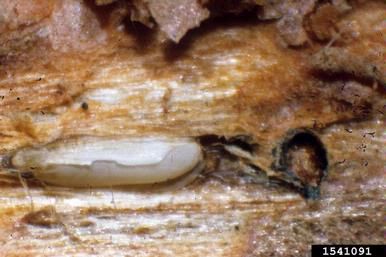
- Eggs: White, elongate, cylindrical and 3–4 mm long (Figure 12).
- Larvae: Large, soft-bodied, legless creamy white grubs with dark heads. The length of a mature larvae is between 25 mm and 50 mm, depending on the species (Figure 13).
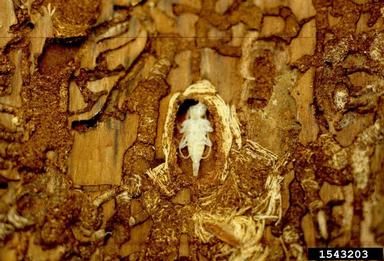
- Pupae: Pupae are white and 14–30 mm long, depending on the species. Pupae resemble a compacted adult with wings, legs, antennae and mouthparts clearly visible but held close to the body (Figure 14).
Host plants in Australia
Pine sawyer beetles feed and reproduce on coniferous forestry trees. Pine trees (Pinus species) are the primary host but other species such as fir, spruce, larch, cedar and birch are also affected.
Life cycle
- The lifecycle of sawyer beetles is relatively slow, taking 1–2 years in total.
- Eggs are laid singly, or in little groups, in a slit or pit made by the female chewing into the bark of weakened or recently dead trees.
- Upon hatching, the larvae tunnel and feed through the inner bark. They undergo 3 to 8 developmental stages (depending on the species and situation) before pupation.
- Young larvae feed under the bark and older larvae burrow deeper into the sap wood.
- Pupation takes place at the end of a larval gallery in a chamber plugged with wood shavings.
- In spring and summer the adult emerges from the tree by chewing an exit hole about 10 mm in diameter in the bark of the tree.
- After emergence, adults need to feed on the living bark of young twigs for 2 weeks in order to achieve sexual maturity.
- Once mated, the females lay eggs in stressed or felled trees to complete the cycle.
- Adults live for about 7 weeks on average.
Damage
After emergence, adult beetles feed on the needles and tender bark of conifer twigs for several weeks, which can result in twig death (Figure 5). This phase is required for the beetles to become sexually mature.
Sawyer beetles are considered secondary forestry pests, as they mostly target dead and dying trees. However, if the beetles carry pine wilt nematodes, they can transfer pine wilt disease to living hosts during the after-emergence feeding period. Pine wilt nematodes reproduce rapidly and prevent water movement within the tree, which reduces resin production. Sometimes a single branch is affected (known as flagging) and the limb becomes brown. When the infestation is large, this can lead to the death of the whole tree within a short time.
Distribution
- Japanese sawyer is native to Japan but is also found in China, Taiwan, Korea, Laos and Vietnam.
- Black pine sawyer is native to Europe, North Africa and North Asia.
- Obtuse sawyer, white-spotted sawyer and southern pine sawyer are found in North America.
Dispersal
Pine sawyer beetles can be transported as eggs, larvae or adults in raw timber materials, including packaging material, dunnage, particle wood, waste timber and even in finished wood products.
The beetles generally remain within less than 1 km of their home base, though they are capable of unassisted flight for several kilometres. Beetles caught in wind currents are capable of surviving and travelling several hundred kilometres.
Image credits
- Figure 1: Rob Routledge (Sault College, Ontario, Canada, bugwood.org).
- Figure 2: Fabio Sterguic (Università di Udine, bugwood.org).
- Figures 3 & 6: Jijing Song & Juan Shi (Beijing Forestry University, bugwood.org).
- Figures 4 & 12: Lacy L Hyche (Auburn University, bugwood.org).
- Figure 5: Joseph Berger (bugwood.org).
- Figure 7: Steven Valley (Oregon Department of Agriculture bugwood.org).
- Figure 8: Lars Sandved Dalen (Norwegian Institute of Bioeconomy Research, bugwood.org).
- Figures 9 & 11: Sarah Smith (CerambycID, USDA APHID PPQ, bugwood.org).
- Figure 10: Natasha Wright (Braman Termite & Pest Elimination, bugwood.org).
- Figure 13: Herbert A ‘Joe’ Pase III (Texas A&M Forest Service, bugwood.org).
- Figure 14: Jim Baker (North Carolina State University, bugwood.org).
Reporting an unusual plant insect pest or disease
Report any unusual plant pest or disease immediately using our online reporting form or by calling the Exotic Plant Pest Hotline on 1800 084 881. Early reporting increases the chance of effective control and eradication.
Please take multiple good quality photos of the pests or damage to include in your report where possible, as this is essential for rapid pest and disease diagnosis and response.
Your report will be responded to by an experienced staff member, who may seek more information about the detection and explain next steps.
Report online