Burnt pine longhorn beetle
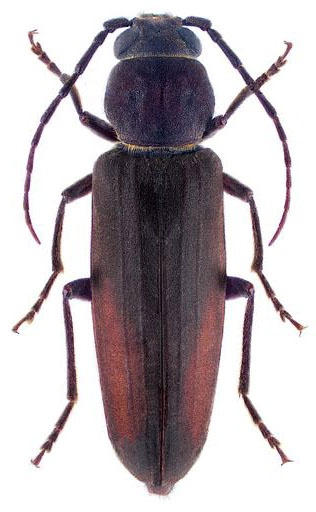
Burnt pine longhorn beetle, Arhopalus ferus, is a pest of pine trees and a threat to Australia’s pine plantation and timber production (Figure 1).
Burnt pine longhorn beetle is not found in Australia but has been intercepted at the Australian border in consignments from New Zealand.
Description
Eggs
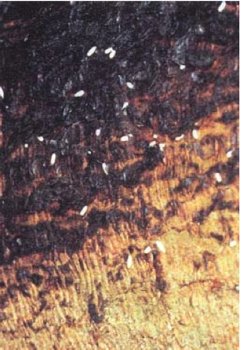
The eggs of BPL are milky-white, elongated and up to 1.8 mm long (Figure 2).
Larvae (juveniles)
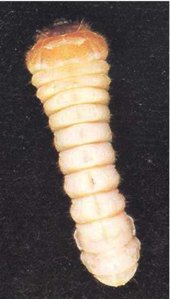
Larvae are creamy-white and cylindrical but slightly flattened grubs with a dark head and small black projections at the end of the abdomen (Figure 3).
Pupae
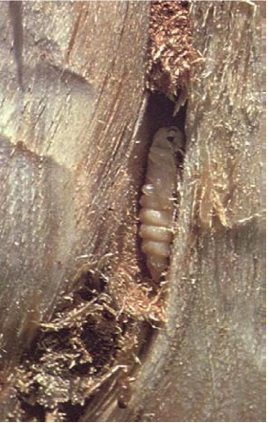
The pupa is creamy-white in colour and looks like an adult with legs, head and antennae compressed together (Figure 4).
Adults
Adults range in size from 8 mm to 30 mm long, with females larger than males (Figure 1). Females are reddish-brown to black, while males are generally lighter in colour. Female antennae are only half to three-quarters of their body length; male antennae are longer.
Feeding damage
Burnt pine longhorn beetles infest logs, stumps and dead or dying pine trees, but prefer fire-damaged trees. Following a fire or clear-felling the population can increase rapidly, due to the abundance of egg-laying sites. Heavy infestations can cause considerable damage. Extensive larval tunnelling results in weakening of the wood and wind breakage. The beetles can introduce a fungus that can stain the sap wood. Log salvation following a fire may be limited to a 6-week window before irrevocable damage results in loss of economic value.
Females are highly attracted to volatiles emitted from freshly sawn logs and fire-damaged pines. Beetles will shelter in timber mills and at ports where cut timber is stored, causing a biosecurity issue around exporting timber that must be free of live insects.
Hosts
Pine (Pinus) and spruce (Picea) species with a preference for dead, dying or damaged trees, particularly by fire.
In New Zealand, it has been found on Douglas fir (Pseudotsuga menziesii) and larch (Larix decidua). In Europe, it is commonly seen on Norway spruce (Picea abies).
Life cycle
Adults appear from spring to autumn and are seen flying at dawn and dusk and mate immediately. Females disperse immediately in search of egg-laying sites. During daylight hours they seek shelter beneath bark, fallen branches and other debris.
Eggs are laid in the bark cracks of fire-scorched or damaged timber, usually in batches of 5 to 50. A female may lay up to 1,000 eggs in her lifetime, which is a matter of only several weeks.
Larvae hatch in 10 days and bore into the outer layer of wood. In heavy infestations the larvae will move into the bark or sapwood. Larval tunnels are oval in cross-section and up to 12 mm wide. Fully grown larvae cut oval exit holes, around 6.3 mm, through the bark outer surface. The exit holes are plugged with wood shavings just before larvae retreat into the wood to pupate (Figure 4). Adults emerge around 50 days after this process.
In the northern hemisphere 3 to 4 years are needed to complete a life cycle but in New Zealand the cycle lasts between one and 2 years.
Distribution
Burnt pine longhorn beetle is native to Europe, northern Asia (not Japan) and North Africa. It was thought to have been accidentally introduced into New Zealand in the 1950s, although not detected until 1963. It does not occur in Australia.
Spread
Female beetles will fly 3 km or more in search of a suitable tree for egg laying. During the summer flight season, adults may congregate around timber mills, seeking shelter among stored wood. This behaviour increases the risk of inadvertent transport to Australia via shipments of timber products.
Photo credits
- Figure 1: U R Schmidt CC-By-SA 4.0 Wikipedia Commons.
- Figures 2–4: Farm Forestry New Zealand.
Reporting an unusual plant insect pest or disease
Report any unusual plant pest or disease immediately using our online reporting form or by calling the Exotic Plant Pest Hotline on 1800 084 881. Early reporting increases the chance of effective control and eradication.
Please take multiple good quality photos of the pests or damage to include in your report where possible, as this is essential for rapid pest and disease diagnosis and response.
Your report will be responded to by an experienced staff member, who may seek more information about the detection and explain next steps.
Report online