Melon fly
Exotic pest – not wanted in Australia
Melon fly (Zeugodacus cucurbitae) poses a serious pest of vegetable crops particularly cucurbits such as melon, pumpkin, squash, zucchini and cucumber.
Keeping Melon fly out of the country is a national priority.
Have you seen this pest?
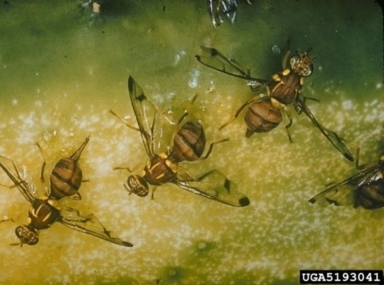
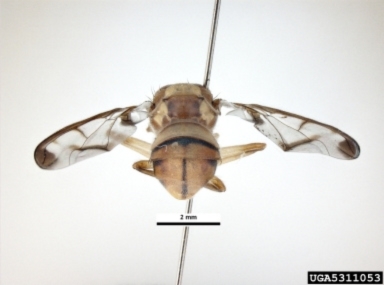
- Adults are 6-8 mm long with a distinctive wing pattern and T-shaped marking on the abdomen (Figures 1&2).
- Females lay eggs under the skin of fruit and vegetables of host plants.
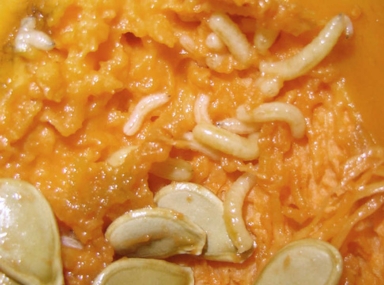
- Creamy white larvae (maggots), up to 11 mm long, feed inside fruits and vegetables of host plants (Figure 3).
What should I do?
- Report immediately.
- Share your photos with us using the online public reporting form or
- Call the Exotic Plant Pest Hotline 1800 084 881
- Please take good quality photos of the pest and/or damage to include in your report. For tips see the How to take good quality photos for a report guide.
Why is it a pest of concern?
- Melon fly, along with Oriental fruit fly and Mediterranean fruit fly are included in the list of major exotic fruit fly pests of national priority.
- Melon fly is a serious pest of cucurbit crops (e.g., pumpkin, zucchini, watermelon and cucumber) attacking flowers as well as fruit.
- When adult females puncture the fruit to lay eggs, they cause a sting mark causing bacteria to be introduced. The fruit starts to rot and may show skin discolouration or watery patches around the sting marks. Larval feeding on the fruit pulp leads to fruit rot.
- If introduced, Melon fly could potentially spread across much of Australia’s horticultural regions.
Where to look
- The most likely risk for introduction is through the importation of fruit containing larvae through cargo, airline passengers or mail.
- Eggs and larvae are found within fruit and pupae in the soil under fruit.
- Unlike most fruit flies, including the local Queensland fruit fly, Melon fruit fly can also infest immature, green and hard fruit.
Pest profile
Appearance
- Adults: Measure between 6–8 mm long with distinctive smoky-brown markings at the tips of the wings (Figures 1&2).
- Pupae: Barrel-shaped, dull red or brownish yellow, 5-6 mm long
- Larvae: Maggot shaped, elongated with one end narrowed and slightly curved. Range in size from 7-11 mm in length and about 1-2 mm wide (Figure 3).
- Eggs: White, elliptical and 2 mm long. Flat on the underside and curved on the top.
Host plants in Australia
- Melon fly has been recorded on 44 host species from 12 plant families.
- It is mainly a pest of cucurbits such as melon, pumpkin, squash, zucchini, and cucumber.
- In south-east Asia, other host species include beans, tomato, papaw, and guava.
Life cycle
- The life cycle from egg to adult ranges from 3-5 weeks depending on the temperature (faster in warmer weather).
- Adult females ‘sting’ host fruit, flowers or succulent stems to lay eggs just below the surface of the skin. These hatch within 1-2 days.
- Larvae feed for another 4-35 days after which they drop to the soil to pupate.
- Pupation occurs in the soil under the host plant for 7-13 days but could end up taking several weeks in cold weather.
- Adults emerge from the soil and can live between 5-15 months.
- A female can lay as many as 1000 eggs in their lifetime.
- There is 8-10 generations a year.
Distribution
- Native to the Indian subcontinent it is widely distributed over Asia from the Middle East to China. Melon fly occurs in more than 20 countries in Africa and is also present in Papua New Guinea, Christmas Island and many islands in the Pacific.
Dispersal
- Adults are strong flyers with recorded rates of 20-30 kms.
- The main method of dispersal is the larvae or eggs being carried in fruit, sent through the mail or via trade across borders.
- Monitor imported host plants, fruits and vegetables carefully to prevent the spread of the pest.
Prevention
- Monitor imported host plants, fruits and vegetables carefully to prevent the spread of the pest.
Image credits
- Figure 1. Alchetron.com, The Free Social Encyclopedia.
- Figure 2. Pest and Disease Image Library, Bugwood.org.
- Figure 3. Plantwise Knowledge Bank.
Reporting an unusual plant insect pest or disease
Report any unusual plant pest or disease immediately using our online reporting form or by calling the Exotic Plant Pest Hotline on 1800 084 881. Early reporting increases the chance of effective control and eradication.
Please take multiple good quality photos of the pests or damage to include in your report where possible, as this is essential for rapid pest and disease diagnosis and response.
Your report will be responded to by an experienced staff member, who may seek more information about the detection and explain next steps.
Report onlinePage last updated: 22 Jul 2026