Red imported fire ant (RIFA)
For more information relating to this invasive species, see Victoria’s invasive ant surveillance program.
Pest alert
The red imported fire ant (RIFA; Solenopsis invicta) is a very successful invader that is among the 100 worst invasive species in the world. This is because of its negative impacts on the environment, human health and the economy. RIFA is also globally the fifth most costly invasive species.
RIFA is not known to be present in Victoria and is a declared exotic pest under the Plant Biosecurity Act 2010. If it is discovered, an eradication program will immediately be put in place.
Victoria is currently contributing to the national eradication program being conducted in Queensland, where fire ants are widespread in the greater Brisbane area.
Additionally, a comprehensive set of regulations is in place to control the movement of high-risk materials from infested and movement-control areas in Queensland and NSW, including:
- soil
- hay
- manure
- turf
- nursery plants
- potting mixtures
- mulches
- used packaging that has contained any RIFA host material
- agricultural equipment.
About RIFA
Native to South America, RIFA has become globally widespread in the last century as a result of the increasing trade and travel between countries. Since it was found in Queensland in 2001, this species has been under eradication through the National Fire Ant Eradication Program. This is funded via cost-sharing arrangements involving all jurisdictions and the Commonwealth.
RIFA has also invaded part of Northern NSW and has been detected further south in 2 other areas (Murwillumbah and Wardell), which are now under restricted movement controls. Given that ant invasions are associated with trade and travel, the importation of some commodities from controlled RIFA-infested areas in Queensland and NSW could pose a high biosecurity risk for Victoria.
Agriculture Victoria only allows the importation of RIFA host material originating from quarantine or control zones in Queensland and NSW if businesses comply with the current legislation. This legislation allows trade to continue while reducing the risk of RIFA incursions into Victoria.
RIFA biology
RIFA, like other ants, is a social insect that lives in colonies. These can occur in one of 2 structural forms – either established by one newly mated queen (monogyne colony) or by multiple queens (polygyne colony).
Queens live between 2 and 6 years and stay within the nest, where their sole role is to lay eggs (more than 1,400 eggs per day). Colonies generally grow to around 80,000 workers, but can have up to 400,000.
A key feature of RIFA workers is that they are polymorphic, meaning that they can have different forms and sizes (Figure 1). Workers have multiple roles within the colony. They:
- care and tend to the queen and brood
- forage for food
- defend the colony
- build and maintain the nest.
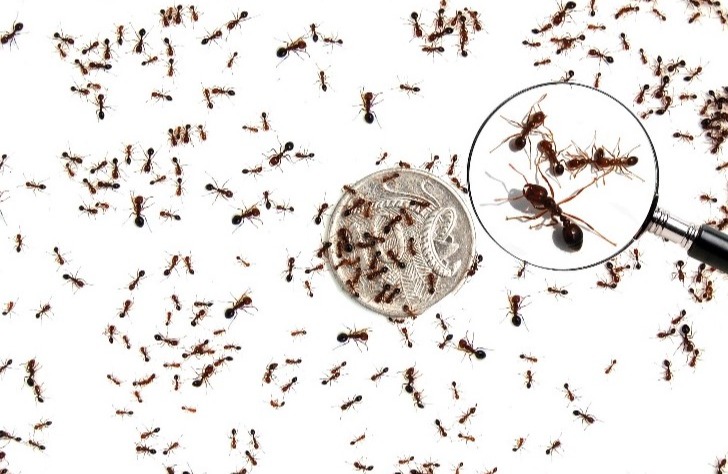
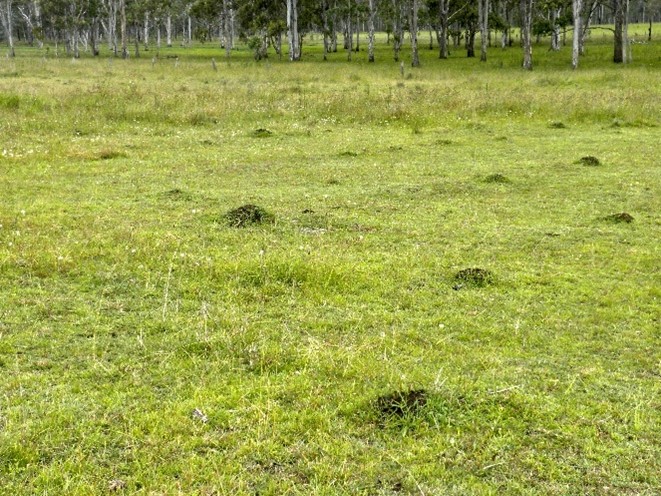
Nests are often visually barely noticeable for the first 6 months after becoming established. After this period, depending on soil and weather conditions, mounds can be easily identified in the field (Figure 2).
Once the colony has between 22,500 and 32,500 workers, the queen may produce up to 4,500 reproductive individuals each year. When they become adults, reproductives will mate and the females will disperse to start new colonies.
Monogyne and polygyne queens have distinct reproductive strategies. Monogyne queens undertake ‘nuptial flights’, where mating occurs. Afterwards, queens will usually travel long distances (up to 5 km) to start a new colony.
Rather than nuptial flights, polygyne queens usually mate in the nest and disperse very short distances from their original nest. They generally take workers with them in a strategy known as ‘budding’.
The longer dispersal distances of monogyne queens make them a greater biosecurity concern. Queensland currently has monogyne and polygyne populations, with the former being predominant.
Like many ant species, RIFA will eat a wide variety of animal and plant material. This trait is responsible for much of the species’ negative impacts on the environment and primary industries.
Why should we protect Victoria from RIFA?
RIFA is an invasive species that is exotic (not native) to Australia. When RIFA establish outside of their native range, they spread quickly and can be a serious threat to urban and natural environments, causing significant negative ecological, economic, health and social impacts.
Ecological impacts
RIFA colonies can invade and disrupt natural habitats. This reduces biodiversity in areas where they become established by displacing or predating on native ant species and other invertebrates. This can indirectly impact ecosystem processes.
Economic impacts
In urban areas, RIFA can be a structural pest. It can cause electrical failure and damage by short-circuiting or occupying connection boxes or electromechanical devices.
Fire ants also cause significant economic losses in agriculture by invading and damaging a wide variety of crops and swarming and stinging livestock. This can lead to reduced production, weight loss and death of farm animals in extreme cases.
Health impacts
RIFA can inflict multiple painful stings. These have a burning sensation and can cause severe allergic reactions in some people.
Social impacts
This species can change the way we go about our day-to-day life. It can limit our capacity to play sports outside, spend time with family and friends at parks and beaches, do gardening and walk our pets safely.
Identifying, collecting and photographing RIFA
Reporting an unusual plant insect pest or disease
Report any unusual plant pest or disease immediately using our online reporting form or by calling the Exotic Plant Pest Hotline on 1800 084 881. Early reporting increases the chance of effective control and eradication.
Please take multiple good quality photos of the pests or damage to include in your report where possible, as this is essential for rapid pest and disease diagnosis and response.
Your report will be responded to by an experienced staff member, who may seek more information about the detection and explain next steps.
Report online