Varroa mite – resources
Varroa treatment planning template
A Varroa treatment plan is a valuable resource that can help beekeepers:
- keep track of specific details unique to their apiaries
- streamline operations
- chart a forward program of mite management
- remove confusion
- potentially save time and money.
The Varroa treatment planning template teaches beekeepers how to build their own customised Varroa treatment plan using information specific to their apiary. This includes hive locations, weather, colony cycles, labour scheduling, income-producing activities, existing treatment practices, costings and more. It’s best to include as much data as you have available.
Beekeepers may choose to use the below PDFs or Excel spreadsheet to create their own customised plan.
- National Varroa IPM treatment plan template
 [PDF File - 216.3 KB]
 - National Varroa IPM treatment plan template – editable
 [MS Excel Document - 45.1 KB]
Varroa treatment planning template instructions
This treatment planning template has been developed by the National Varroa Mite Management Program as a guide only; with limited spread of Varroa across Australia and little peer-reviewed science on managing Varroa in all Australian conditions, beekeepers should enter data and select control mechanisms based on their own knowledge, conditions and chemical usage requirements.
Step 1: Environmental factors
A: List range of daily high temperatures for the location of your bees (note the ‘Temps min’ is not the overnight low but just the lower range of possible daily highs)
B: Mark out where the following listed conditions exist either by ‘X’ing the boxes or drawing a line across the whole period.

Step 2: Beekeeper inputs
Mark where the listed activities would be occurring in the year:

Step 3: Income-producing activities
Mark where the following activities occur in the year:

Step 4: Mechanical controls
Now based on what’s filled in in the above rows, indicate here where it might be practical to implement these mechanical control methods:

Step 5: Chemical controls
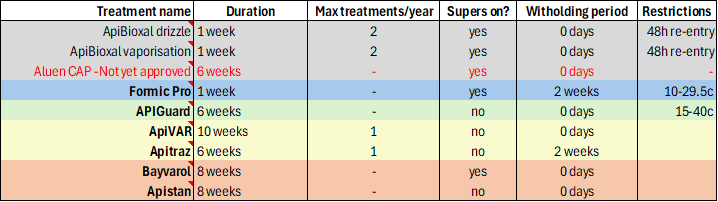
With the above information, and possibly the AHBIC Table as a reference, now indicate where you can fit in chemical miticides:

This table can also help:
All mite control programs promoted by Agriculture Victoria and the National Varroa Mite Management Program are underpinned by best-practice beekeeping and the principles of integrated pest management.
Beekeeper treatment record keeping
You can keep your records in any format that suits you. Records of use can be:
- handwritten
- computer-generated
- kept in record books
- recorded as part of a quality assurance program.
The only requirement is that the records:
- contain all the required information
- are clear and accurate
- are readily available to an authorised officer on request.
Records may be made by a third party (such as a supervisor or assistant) or through automated data logging, but the chemical user must make sure records are accurate and are kept for the required period.
A good sign that your record-keeping system is suitable is if another person can pick up your documentation and get a clear picture of exactly what you did, on any given day, without any assistance.
You can use the following template to keep records of your chemical use or supply:
Record keeping template – Treatment of bees or beekeeping equipment  [MS Word Document - 105.2 KB]